First-time peg-bag maker
If this is your first sewing project, manageable straight stitching matters more than a long stitch list. John Lewis & Partners recommends starting with a simple entry-level mechanical machine.


For one or a few peg bags made from light- to medium-weight fabric, start by considering a straightforward mechanical machine with a foot pedal and basic stitches. A sturdier machine is more relevant if it will be shared or used repeatedly. Before choosing a compact mini machine, check its guidance for your fabric, its UK electrical suitability and any school requirements.
If this is your first sewing project, manageable straight stitching matters more than a long stitch list. John Lewis & Partners recommends starting with a simple entry-level mechanical machine.
If several learners will use the machine, consider how its controls and construction suit repeated use. Janome describes its 423S as a metal-bodied machine used in schools; that description applies to this model, not every Janome machine.
If the peg bag is the start of further projects, setup features may matter beyond the first set of seams. Janome lists a needle threader, top-loading bobbin and LED light for its Sewist 725S.
Decide whether learning the first seams, accommodating repeated use or finding a machine you can store easily is your main priority. A mini machine needs an additional check of the exact model and its electrical arrangement.
| Concern | What to check | Who this matters to |
|---|---|---|
| Simple setup and speed control | Check for a straight stitch, a foot pedal and guidance for the intended fabric. | If I am learning to make a peg bag, I want to control my first straight seams without navigating extra settings. For around 50% of consumers, simple setup and speed control would come first. |
| Repeated or shared use | Compare the exact model’s construction, controls and arrangements for servicing and replacement needles. | When several learners will use one machine, I want controls they can understand and construction suited to repeated projects. Around 30% of consumers would make shared-use practicality their primary concern. |
| Storage and a proportionate choice | Check weight and storage space; for a mains-powered mini model, confirm its exact identity and UK plug suitability. | If I must pack the machine away after the project, I want a manageable size without overlooking the electrical details of a compact option. For roughly 20% of consumers, storage and a proportionate choice would take priority. |
Straight seams on ordinary light- to medium-weight fabric do not, by themselves, call for computerised controls or an extensive stitch range.
Start with the project fabric and the learner’s confidence. Consider additional functions when you have a specific use for them in later projects.
Janome specifies its 423S at 7.4 kg and its Sewist 725S at 6.7 kg. Those weights matter if the machine will be moved or packed away regularly.
Check the exact model’s listed weight, carrying arrangement and available storage space before choosing it for use in more than one place.
In a February 2026 product-safety report, the UK Office for Product Safety and Standards identified a serious fire risk from non-compliant plug pins on the specific SM-505A, Item STL0044. The report does not establish that every mini machine has the same fault.
Avoid that identified product. For another mains-powered model, check its exact identity, UK plug arrangement, instructions and seller details rather than relying on its size or intended craft use.
The Sewist 725S and 423S offer two different mechanical-machine starting points for this decision.
Brother has several domestic sewing-machine models listed by UK retailer John Lewis & Partners, including the LK14S and HF37.
John Lewis & Partners lists Singer domestic models including the M2405, M2605 and Heavy Duty-labelled machines.
The compact electric option below is relevant if storage is a priority. Check its fabric guidance and electrical arrangement before deciding whether it suits the school peg-bag project.
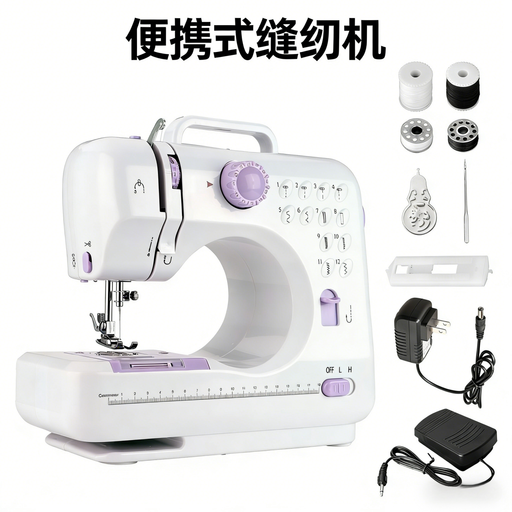 No image available
Consider this compact machine for practising basic seams, provided its guidance covers your chosen peg-bag fabric.
The product name lists 12 stitches, dual power and an LED light.
Before mains use, confirm the exact model’s UK plug suitability and instructions. Check the school’s supervision and permitted-machine requirements before classroom use.
Usually, yes, if you are making straightforward seams in ordinary light- to medium-weight fabric. John Lewis & Partners recommends simple mechanical machines for newcomers; check that the exact model can handle your fabric and that you have the appropriate needle, bobbin and presser foot.
Not for a basic peg bag with straightforward seams. Consider computerised controls if you have a specific need for additional stitches or functions in later sewing projects.
Give more attention to understandable controls, construction suited to repeated use and access to compatible needles and bobbins. Janome describes its 423S as a robust metal-bodied model used in schools, but that model-specific statement does not settle whether it meets your school’s requirements.
Check the exact model’s fabric guidance, instructions, seller details and UK electrical arrangement. The UK Office for Product Safety and Standards identified a serious fire risk involving the specific SM-505A, Item STL0044, in February 2026; that finding does not apply automatically to other compact machines.
Check which needles, bobbins, thread and presser feet your intended project requires, and which are compatible with the exact machine. Confirm what comes with the model rather than assuming accessories are interchangeable.