Who is the machine for?

Volunteer beginners sewing cotton peg bags

A straightforward stitch selector and threading process matter when several people are learning on the same machine. The Sewing Directory’s peg-bag instructions use straight stitch and zigzag, making those the stitches to confirm on the model you choose.

Organisers moving between venues

If volunteers carry and set up the machine for each session, check its stated weight, dimensions and carrying arrangement. Simple bobbin and stitch controls can also make a short session easier to start.

Groups making lined bags regularly

Repeated sewing and thicker assemblies put more emphasis on presser-foot clearance, adjustable settings and access to service. Janome describes its HD2200 as intended for schools and heavy users, though its stated 8.0 kg weight also matters if the machine must travel.

What matters when choosing?

Start with the stitches required by the peg-bag pattern, then decide whether easy transport or regular work with layered fabric is the more important condition for your group.

Concern What to check Who this matters to
Stitches and simple operation Confirm straight stitch, zigzag, reverse stitching and a threading process volunteers can follow. If I am learning to sew peg bags, I want to make the seams and finish raw edges without struggling to set up the machine. Around 45% of consumers put straightforward operation first.
Portability and setup Check weight, dimensions, carrying arrangement and the plug supplied with the exact model. When I take equipment to different venues, I need to carry it safely and get a session started promptly. Portability is the primary concern for roughly 28% of consumers.
Layers and frequent use Check presser-foot clearance and relevant adjustments; test the planned fabric stack on scraps. If our group regularly sews lined or reinforced bags, I need the intended layers to pass through the machine reliably. Around 27% of consumers prioritise layered work or repeated shared use.

Buying pitfalls

  • Choosing by stitch count alone

    More decorative stitches do not replace the straight stitch and zigzag used in The Sewing Directory’s peg-bag instructions, or make a machine easier for new volunteers to thread.

    Confirm those stitches, reverse stitching and clear operating instructions first. Consider additional stitches if the group has other projects planned.

  • Assuming every beginner machine handles the same fabric layers

    Binding, interfacing or a coated lining can change the thickness of a peg-bag assembly. Presser-foot lift and pressure adjustments differ between models, and neither feature alone establishes suitability for every material.

    Test scraps arranged in the intended layers and check clearance under the foot before buying machines for that version of the bag.

  • Forgetting who will carry and store the machine

    A machine kept at one venue presents a different practical choice from one carried to every session. Singer states a 4.4 kg weight for the M1605, while Janome states 8.0 kg for the HD2200.

    Check dimensions, carrying arrangements and storage as well as weight, and make sure volunteers can move the chosen machine safely.

  • Treating a warranty as a compliance marking

    Electrical-product markings and a manufacturer’s warranty address different questions. Warranty terms can also depend on how a community group uses the machine.

    Check the exact model’s documentation and warranty conditions with the retailer before purchase. Brother states a three-year warranty for the LX25 but specifies one year for commercial use, so organisers should clarify how their planned use is treated.

Sewing-machine brands to consider

Brother

Brother’s LX25 is a beginner-oriented mechanical model with 25 stitches, a front stitch-selection dial and a top-load drop-in bobbin.

  • Its controls and bobbin arrangement are worth trying with volunteers who will share the machine.
  • Brother specifies a shorter warranty for commercial use of the LX25; confirm how the group’s intended use is covered rather than assuming the standard term applies.

Singer

Singer offers different mechanical options: the M1605 has preset stitch controls and a stated 4.4 kg weight, while the 3223 offers adjustable stitch dimensions and an extra-high presser-foot lift.

  • The M1605’s UK plug and lower stated weight are relevant to mobile sessions; the 3223’s adjustments are relevant when the project calls for more control.
  • Preset controls allow less adjustment, and presser-foot clearance does not guarantee that every thick or coated fabric will sew well.

Janome

Janome’s mechanical range includes the two-dial 2200XT and the HD2200, which Janome positions for schools and heavy users.

  • The HD2200 has adjustable foot pressure, an automatic needle threader and a drop-in bobbin that may be useful in a regularly shared workspace.
  • At a stated 8.0 kg, the HD2200 needs more consideration for transport. Janome advises purchasing through an official UK retailer for aftersales care and warranty.

Joybuy product choices

This portable sewing machine is a candidate for community craft sessions if its exact stitch options and supplied power connection suit your peg-bag project.
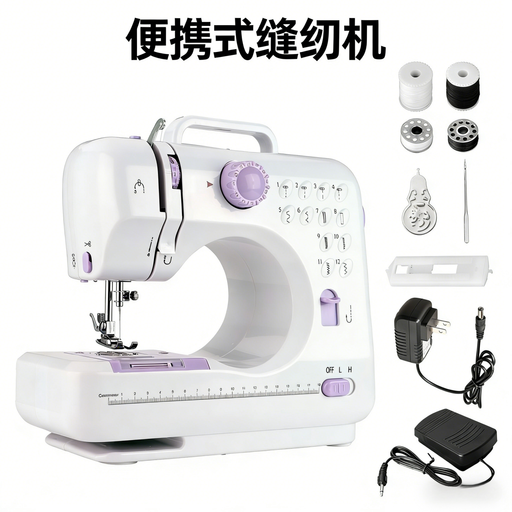
Purple IAGREEA mini portable electric sewing machine

IAGREEA Mini Portable Electric Sewing Machine, 12 Stitches, Dual Power, Purple

For sessions where a portable craft machine is useful, consider this model only after confirming it has the stitches your peg-bag pattern requires.

Its listed features include 12 stitches, dual power and an LED light. Check for straight stitch and zigzag, confirm that the supplied power connection suits your venue, and test the intended layers if making lined bags.

Joybuy

Common questions

Which stitches do we need for a basic peg bag?

Prioritise straight stitch and zigzag, and check that the machine can backstitch at seam ends. The Sewing Directory’s peg-bag project specifies straight and zigzag settings, while Creative Rehab’s tutorial uses straight stitching with backstitching.

Do cotton peg bags require a heavy-duty machine?

A basic cotton peg bag does not, by itself, call for a heavy-use model. If the group will sew frequently or add binding, interfacing or coated lining, test the planned layers on scraps and check the exact machine’s presser-foot clearance.

What should a community group ask about warranty and support?

Ask whether the exact warranty covers the group’s intended use and where the machine can be serviced. Brother lists a three-year warranty for the LX25 but specifies one year for commercial use; Janome says buying from an official UK retailer matters for its aftersales care and warranty.

What does an electrical-product marking tell us?

For products placed on the market in Great Britain, GOV.UK explains that UKCA and CE markings indicate the manufacturer believes the product meets relevant requirements; a marking is not a substitute for checking the machine’s instructions and seller details. That Great Britain guidance covers England, Scotland and Wales, so buyers in Northern Ireland should check the rules applicable there separately.