What matters when choosing
Choose a machine route around the fabric and seams you expect to sew most often, then check whether its setup works on your table.
Compact computerised machine
Consider it when: You want speed control for short pouch seams and a machine you can put away between sessions.
Trade-off: Compact size and electronic controls do not establish whether it can handle your thickest seam intersection.
Mechanical machine
Consider it when: You mainly use light-to-medium fabrics and prefer straightforward controls.
Trade-off: Speed management and repeated tasks rely more on your control than on automated settings.
Heavy-duty domestic machine
Consider it when: Dense fabrics and bulky pouch seams are a regular part of your projects.
Trade-off: Material-handling claims are model-specific and do not guarantee that every combination of fabric, foam, binding and webbing will sew successfully.
| Concern |
What to check |
Who this matters to |
| Setup and storage |
Measure the machine and foot-controller space against your table. Check whether an extension table can be removed and whether a case is included. |
If I have to clear the table after sewing, I need a machine I can set up and put away without taking over the room. Around 42% of consumers would put compact setup and storage first. |
| Layered seams |
Identify your thickest seam intersection and check the exact model’s material guidance, presser-foot clearance and compatible feet. |
When my pouch pattern brings dense fabric, lining and binding together, I need to know whether the machine suits that seam. Around 33% of consumers would make layered-material handling their primary concern. |
| Zips and control |
Confirm zip-foot compatibility and what comes in the box. Check speed and needle-position controls if you want them for close work. |
If I am sewing beside zip teeth and turning short corners, I want controls I can manage without rushing. Around 25% of consumers would put zip work and ease of control first. |
Joybuy product choices
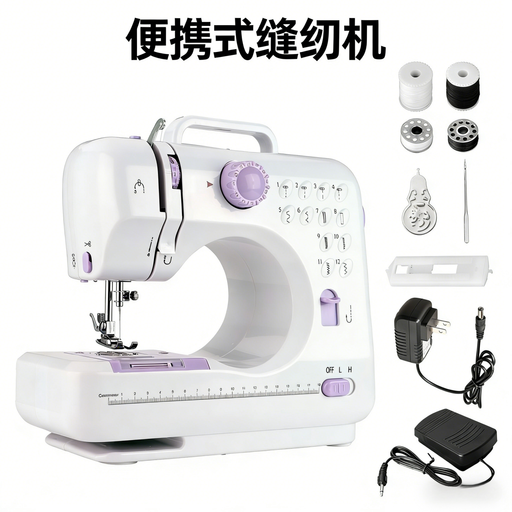
This mini sewing machine is a small-space option to consider for basic pouch stitching; check its accessories, power supply and suitability for your planned seams before choosing it for zippered or heavily layered pouches.
 No image available
IAGREEA Mini Portable Electric Sewing Machine, 12 Stitches, Purple
Consider this mini machine if you need a sewing setup you can put away after working at a small table. Its name lists 12 stitches and an LED light. Before choosing it for travel pouches, confirm the included zip foot or a compatible alternative, the supplied power adapter and the machine’s guidance for your thickest seams.
View on Joybuy
Common questions
What should I look for when sewing pouches on a small table?
Look for a machine that fits your working and storage space, then check zip-foot compatibility and the controls you need for short seams. A free arm can help with narrow sections, while an extension table takes up more surface area when fitted.
Do I need a heavy-duty machine for travel pouches?
Not for every pouch: a domestic machine may suit light-to-medium fabric projects. If you regularly use dense canvas, vinyl or bulky seam intersections, check a heavy-duty model’s guidance against your exact materials and construction rather than relying on its label.
Does a pouch-sewing machine need a zip foot?
A zip foot is useful for stitching close to the teeth on a zippered pouch. Check whether one is included with the exact package or whether a compatible foot is available for that model.
Is a free arm necessary for making pouches?
A free arm can make narrow or awkward sections easier to reach, but it does not replace a stable flat surface for larger panels. Decide whether your pouch patterns include sections where that access would help.
What should I check before using a sewing machine in the UK?
Check that the exact machine and supplied power adapter are intended for your location, including their voltage and plug. Review the seller’s instructions and warranty information rather than assuming that a plug adapter alone settles suitability.


