First-time napkin maker
If this is your first sewing project, clear threading guidance and fewer stitch-setting decisions may matter more than a long stitch menu. Singer Sewing UK lists preset stitch length and width on the M2105.


For simple fabric napkins, start with a domestic machine that can sew a straight seam and has clear threading instructions; check how the exact model secures seam ends. Preset stitch settings reduce setup decisions for a one-off project, while adjustable stitch length is more relevant if you expect to try other fabrics or keep sewing afterwards. If a school provides the machine, instruction and supervised use need attention separately from its sewing features.
If this is your first sewing project, clear threading guidance and fewer stitch-setting decisions may matter more than a long stitch menu. Singer Sewing UK lists preset stitch length and width on the M2105.
If you expect to try other fabrics or projects, consider whether you want to adjust stitch length. Singer Sewing UK lists this control on the M2405 and M2605, with adjustable thread tension also listed for the M2605.
If you provide the machine for others to use, plan how they will be instructed, supervised and shown to make adjustments safely. For organised use, the Health and Safety Executive and the Design & Technology Association also emphasise suitable equipment and risk assessment.
Choose the controls needed for the napkin seams first, then decide whether later projects or organised school use call for anything more.
| Concern | What to check | Who this matters to |
|---|---|---|
| Simple setup and basic seams | Check for a straight stitch, clear threading instructions and a way to secure seam ends. Confirm that the required foot and bobbins suit the project. | If I am making napkins for the first time, I want to spend less time choosing settings and more time practising seams. Around 42% of consumers may put straightforward setup first. |
| Adjustment for continued use | Check whether stitch length is adjustable; consider tension control or a needle threader if you expect to use them. | When I plan to try other fabrics after the napkins, I want room to change my stitch settings. Adjustable controls may be the primary concern for around 33% of consumers. |
| Managed use at school | For school-provided equipment, check the risk assessment, machine condition, instruction arrangements and procedures for switching off before adjustments. | If I am arranging shared use, I need pupils to have appropriate instruction and supervision, not just a machine with suitable stitches. Around 25% of consumers may prioritise managing that use. |
A longer stitch list does not tell you whether setting up and sewing the napkin hems will be straightforward. Singer Sewing UK lists eight stitches on both the M2105 and M2405, but adjustable stitch length only on the M2405.
Compare threading, the basic stitch controls and the method for securing seam ends on the exact model before considering decorative stitches.
Sewing features do not replace instruction, maintenance or a risk assessment for organised use. The Health and Safety Executive advises switching off power before adjustments and needle changes.
If the school provides the machine, follow its risk assessment and arrange appropriate instruction and supervision.
Janome UK & Ireland lists variable stitch controls, an automatic needle threader and a hard cover for the J3-24. Those features have a clearer purpose if the machine will also be used after the napkins.
Decide which later projects you expect to tackle before choosing additional controls over a simpler machine.
Napkins require suitable fabric, thread and needles as well as the machine. An accessory listed for one model should not be assumed to fit another.
Check the exact box contents and compatible needles, bobbins and presser feet before starting the project.
Singer Sewing UK lists mechanical models with different levels of stitch adjustment relevant to a beginner napkin project.
Janome UK & Ireland lists the J3-24 as a mechanical option with controls and storage features to consider if sewing will continue beyond this project.
A Joybuy listing presents an IAGREEA mini portable machine as a compact option for basic craft sewing.
These compact IAGREEA machines are choices to consider for basic napkin sewing. Check seam-end finishing, supplies and the intended fabric before deciding between them.
 No image available
Consider this compact model if you want a basic craft machine for napkin seams and a listed reverse-sewing function for securing their ends.
The product listing describes 12 stitch patterns and forward and reverse sewing; the product name specifies dual power and an LED light. Check the included feet and compatible needles, and practise on an offcut of the intended fabric.
 No image available
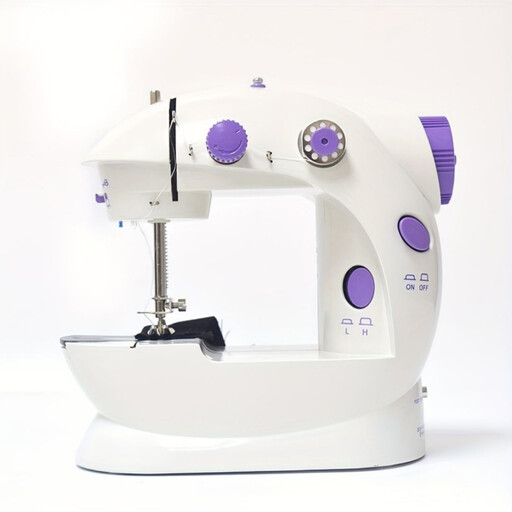
Consider this machine if you want a compact model with a pedal, but confirm how you will secure napkin seam ends before choosing it.
The product name specifies battery or plug-in power, including operation with four AA batteries, and lists thread shuttle cores, a spare needle and a threading device. Stitch length and width are fixed, and the listed limitation states that there is no backstitch function. Practise on an offcut of the intended fabric.
Start with a straight or other suitable basic stitch, clear threading instructions and a method for securing seam ends. A preset-stitch machine may cover a straightforward project; adjustable stitch length is more relevant if you intend to try different fabrics or continue sewing afterwards.
No particular machine size follows from the project alone. Compare the exact model’s seam controls, setup instructions and storage needs; a compact design does not by itself establish stitch consistency or suitability for supervised classroom use.
Do not decide supervision arrangements from a product listing. The school should use its risk assessment and appropriate instruction arrangements; Health and Safety Executive guidance also advises switching off power before adjustments or needle changes.
CE marking can still be relevant: GOV.UK guidance dated March 2025 says Great Britain indefinitely recognises certain goods meeting EU requirements, including CE marking. That does not mean a mark alone settles whether a particular machine and its documentation meet the requirements for its intended destination. Northern Ireland has different arrangements, so a school procuring equipment there should confirm the applicable requirements.