For occasional shoe bags made from ordinary woven fabric, start with a domestic machine that offers controllable straight stitching and a compatible zipper foot if your design has a zip. Bulky seam intersections or frequent sewing make presser-foot clearance and pressure adjustment more important; a professional straight-stitch machine is chiefly worth considering for sustained work, provided you do not need other stitch types.
Who needs which machine?
First-time shoe-bag makers
If you are making a few cotton, canvas or lined bags, prioritise straightforward controls and the ability to use a zipper foot if your pattern calls for one. You need not choose a professional machine for an occasional project.
Layered bag-project hobbyists
Linings, handles, webbing and thicker outer fabrics can meet at one seam. Check the exact machine’s presser-foot clearance and pressure adjustment against the layers you plan to sew.
Frequent small-batch makers
If you repeatedly sew bags with heavy layers, work area and sustained straight-stitch use may matter more to you than a wide choice of stitches. Check which stitch types your other projects still require.
What matters when choosing?
Choose around the most demanding part of your planned shoe bag: a zip, a bulky seam intersection or repeated production. A machine’s category alone does not establish that it can handle your particular fabric stack.
Domestic mechanical machine
Consider it: For occasional bags in ordinary woven fabric, particularly when you want manual controls and a compatible zipper foot.
Trade-off: Repeated bulky seam intersections may call for clearance or adjustments that the exact model cannot provide.
Heavy-duty domestic machine
Consider it: For heavyweight outer fabric, bulky seams or regular bag sewing, after checking the model’s relevant features.
Trade-off: The heavy-duty label does not establish compatibility with every combination of fabric, webbing, foam or vinyl.
Professional straight-stitch machine
Consider it: For frequent, predominantly straight-stitch work with consistently heavy layers.
Trade-off: A straight-stitch-only model such as the Janome HD9 cannot provide zigzag or decorative stitches.
| Concern |
What to check |
Who this matters to |
| Zip and construction seams |
Check for a supplied or compatible zipper foot and controllable straight stitching; consult the exact model’s zipper instructions. |
If my shoe bag has a zip, I want to stitch alongside it and keep the construction seams under control. Around 44% of consumers put zip and seam control first. |
| Bulky layered seams |
Check presser-foot clearance and pressure adjustment, then ask about your intended fabric and seam stack. |
When lining, outer fabric and handles meet, I need a machine I can use on that particular stack. For around 33% of consumers, handling layered seams is the primary concern. |
| Repeated sewing |
Check the work area, required stitch types and whether the machine suits the frequency of your projects. |
If I make bags regularly, I care about a workable setup for repeated straight seams without giving up stitches I need elsewhere. Repeat-production needs come first for around 23% of consumers. |
Buying pitfalls
-
Choosing by stitch count alone
Extra decorative stitches do not tell you whether you can position a stitch beside a zip or guide a bulky seam beneath the foot.
For your chosen pattern, check the exact model’s included or compatible feet, straight-stitch controls and presser-foot adjustments.
-
Assuming “heavy duty” covers every material
That label does not establish how a particular machine will handle your combination of outer fabric, lining, webbing and seam intersections.
Tell the seller or manufacturer what you intend to sew, including the thickest junction, and test the planned layers on scraps before cutting the bag.
-
Overlooking electrical details on an imported model
A machine intended for another market may have electrical or support arrangements that affect its suitability for use in the UK.
Before buying, confirm the stated mains input, supplied plug, seller, warranty territory and applicable product information for the exact model.
Brands to consider
Janome
Janome UK & Ireland lists domestic mechanical models as well as the professional, straight-stitch-only HD9. The Sewist 725S and HD2200 offer different starting points for shoe-bag projects.
- Janome lists an extra-high presser-foot lift and foot-pressure adjustment for the Sewist 725S.
- Do not assume an entry model has the HD9’s features; check the feet, stitches and adjustments of the exact machine.
Singer
Singer’s Heavy Duty 4432 is a model to examine if your pattern includes bulkier seams.
- Singer lists an extra-high presser-foot lift for multiple layers of bulky fabric and a zipper foot for the 4432.
- Those model-specific features do not guarantee suitability for every thickness or material combination.
Brother
Brother’s XM3700 illustrates a domestic-machine route with a zipper foot and free-arm conversion, but it is a US-market model.
- Brother USA lists a zipper foot among the XM3700’s accessories.
- For a UK purchase, check the locally offered model’s specification, electrical details and support rather than assuming they match the XM3700.
Joybuy options for simple seams
These mini machines are options to consider for straightforward shoe-bag seams. Before choosing either one for a zipped or layered design, check its zipper-foot compatibility, capacity for your intended fabric stack and UK electrical details.
 No image available
IAGREEA Mini Portable Electric Sewing Machine, Purple
Consider this model for straightforward shoe-bag seams, subject to testing your chosen fabric and layers.
The product name specifies 12 stitches, dual power and an LED light.
For a zipped bag, confirm whether a compatible zipper foot and suitable instructions are available. Check the mains input and supplied plug before purchase.
View on Joybuy
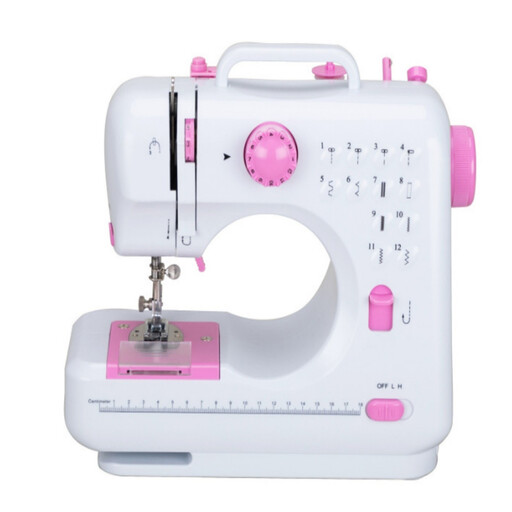 No image available
IAGREEA Mini Portable Electric Sewing Machine, Pink
Consider this model for straightforward shoe-bag seams, subject to testing your chosen fabric and layers.
The product name specifies 12 stitches, dual power and an LED light.
If your pattern includes a zip or bulky junctions, confirm the compatible foot and the machine’s suitability for your materials. Check the mains input and supplied plug before purchase.
View on Joybuy
Frequently asked questions
Do I need an industrial machine to sew shoe bags?
Usually not for occasional bags made from ordinary cotton, canvas or lined woven fabric. Match a domestic machine to your actual seam layers and closure; consider a professional straight-stitch model for frequent work with consistently heavy layers, bearing in mind that a model such as the Janome HD9 does not offer other stitch types.
What foot do I need for a zippered shoe bag?
Check that the exact machine includes a zipper foot or accepts a compatible one. Follow its manual for positioning the foot, and turn the handwheel before sewing to check that the needle clears the foot and zip.
How can I check a machine against my shoe-bag fabric?
Test the intended outer fabric, lining, zip and thickest seam junction on scraps before sewing the bag. Use the exact machine’s manual for needle, stitch and presser-foot settings, as well as its cleaning and oiling instructions.


