Beginners sewing occasional scrunchies
If storage space is tight, you need room to set up the machine, sew basic fabric tubes and put it away again. Singer describes its M1605 as lightweight and portable for smaller spaces.


For occasional scrunchies made from woven fabric, start with a machine that has a straight stitch and is practical to set up and store in your small craft room. Hobbycraft’s scrunchie instructions use a straight seam for the fabric tube and machine stitching to join the elastic; consider more stitch and speed controls if stretch fabrics or larger projects will become a regular part of your sewing.
If storage space is tight, you need room to set up the machine, sew basic fabric tubes and put it away again. Singer describes its M1605 as lightweight and portable for smaller spaces.
If you mainly want to make accessories, practise seams and do basic repairs, check the machine’s stated fabric suitability before adding features for projects you do not yet plan to sew.
If scrunchies are a starting point for working regularly with jersey or stretch knit, check the exact model’s fabric guidance and stitch options rather than choosing on size alone.
Check that a machine can make the basic scrunchie seam, then compare how it fits your worktop and storage space. Let the fabrics and projects you plan next determine whether you need more controls.
| Concern | What to check | Who this matters to |
|---|---|---|
| Storage and portability | Compare published dimensions and weight with the space where you will sew and store the machine. | I need to clear my worktable after sewing and lift the machine into storage without difficulty. Around 36% of consumers put storage and portability first. |
| Simple basic seams | Check for a straight stitch, reverse sewing and clear threading instructions on the exact model. | When I am learning to make fabric tubes and join elastic, I want controls I can understand and use repeatedly. Roughly 29% of consumers prioritise that straightforward setup. |
| Fabric flexibility | Check the model’s stated fabric suitability and relevant stitch options if you plan to use stretch fabrics. | I expect to try jersey as well as woven scraps, so the fabrics I plan to sew matter more to me than the smallest footprint. Around 21% of consumers make fabric flexibility their main concern. |
| Future projects | Compare controls and stitch functions with the garments or other projects you actually plan to make. | Scrunchies are my starting project, but I want to move on to more varied sewing. Approximately 14% of consumers put room to grow ahead of the other concerns. |
Hobbycraft’s scrunchie instructions call for a straight seam along the fabric tube and machine stitching to join the elastic. A larger stitch count does not establish that a machine is easier to thread or store.
Check the straight stitch, reverse function, threading guidance and dimensions first. Consider additional controls in light of your later projects.
A machine described for lightweight projects should not automatically be treated as suitable for thicker layers or regular stretch-fabric sewing.
Match the exact model’s fabric guidance and stitch options to the materials you intend to use.
Support arrangements matter when you need help with the machine after purchase. Janome advises buying through an official UK retailer for aftersales care and warranty.
For a Janome model, check the retailer through Janome’s official UK retailer search. For any brand, read the guarantee terms for the exact product and keep your receipt.
The model and supplied power arrangement need to match what you intend to buy and use; a product listing alone is not a substitute for checking the applicable documentation.
Confirm the exact model, plug and power information, applicable conformity marking, supplied documentation and warranty territory before ordering.
Singer’s UK range includes compact mechanical machines and models with more controls for broader sewing plans.
Janome’s UK range covers mechanical, computerised and specialist machines, allowing buyers to compare models against their planned projects.
Hobbycraft’s own-brand 12S is an entry-level option described by the retailer for lightweight projects.
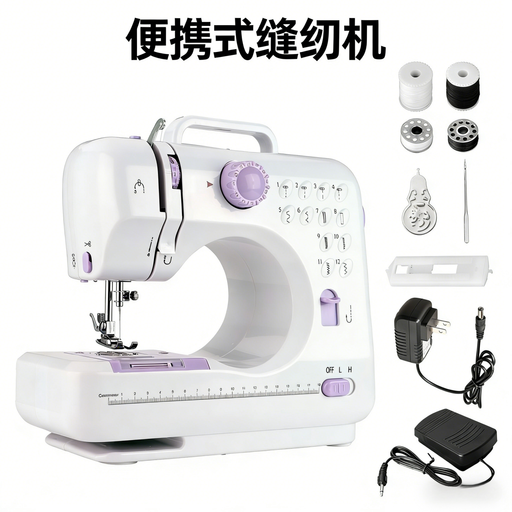
This compact machine is relevant if you are looking for a small-room setup for basic scrunchie sewing. Confirm that its stitch options include the straight seam your project requires before choosing it.
 No image available
Consider this mini machine if you need a sewing setup that can be put away after making scrunchies, provided its stitch options meet your seam requirements.
The product name specifies 12 stitches, dual power and an LED light. Check that a straight stitch is among those options, and confirm the supplied power arrangement, UK plug compatibility and applicable product documentation before ordering.
No, not for the basic woven-fabric method in Hobbycraft’s scrunchie instructions. That method uses a machine straight seam for the fabric tube and machine stitching to join the elastic; consider an overlocker separately if you want overlocked edges or plan regular knit-fabric projects.
Start by checking for a straight stitch, then look at reverse sewing, threading guidance and a light for your work area. Hobbycraft’s illustrated scrunchie method uses a straight seam, so check the exact machine’s stitch list rather than assuming that every compact model includes the same options.
It may suit scrunchies made from lightweight fabric if that use matches the model’s stated guidance. Hobbycraft describes its 12S as suitable for lightweight projects; check the manual before extending that description to thicker layers or frequent sewing.
For a machine placed on the market in England, Scotland or Wales, check its applicable conformity marking and documentation alongside the plug and power details for the product supplied. GOV.UK states that CE marking continues to be recognised alongside or instead of UKCA marking in Great Britain; Northern Ireland has separate market processes.
Turn it off and disconnect or remove its power supply first. Hobbycraft’s machine safety instructions give that precaution for threading and needle changes; follow the instructions for the exact model you use.