What matters when buying?
Start with the fabric, the thickness of its folded hem and how many napkins the group expects to make. Those answers help distinguish a general-purpose machine from one chosen for easier shared use or frequent production.
Mechanical domestic machine
Consider it when: The work is mainly routine woven-napkin hems with occasional other sewing.
Trade-off: Check whether the chosen model and operators can keep pace with the planned batches.
Electronic domestic machine
Consider it when: Volunteers with differing experience will share the machine. Brother specifies needle threading, quick-set bobbin loading and slide speed control on the Innov-is A16.
Trade-off: Brother positions the A16 for beginner and intermediate users, not as a professional production machine.
Heavy-duty domestic machine
Consider it when: Napkin making also involves thicker table textiles, multiple layers or soft-furnishing repairs.
Trade-off: A higher stated sewing speed does not remove the need to control each hem and test the fabric stack.
Professional straight-stitch machine
Consider it when: Large, frequent runs of straight stitching justify dedicated workspace.
Trade-off: Janome’s HD9 weighs 14 kg and sews straight stitches only, limiting portability and other stitch work.
| Concern | Buying checks | Who this matters to |
|---|
| Repeatable hems |
Test the intended fabric and folded hem for feeding and foot clearance; check that the available speed remains controllable. |
If I have stacks of napkins to hem, I need the fabric to feed consistently while I keep each seam accurate; around 44% of consumers put repeatable throughput first. |
| Shared setup |
Check bobbin loading, needle threading and whether the exact model has a speed control. |
When volunteers take turns, I need a setup they can learn and operate confidently; roughly 33% of consumers make shared-use simplicity their main concern. |
| Storage and versatility |
Check the machine’s weight, storage arrangement and useful straight-stitch settings before prioritising decorative stitches. |
For occasional productions, I want to put the machine away and still use it for other routine sewing; around 23% of consumers place storable, general-purpose use first. |
Joybuy products for basic hemming
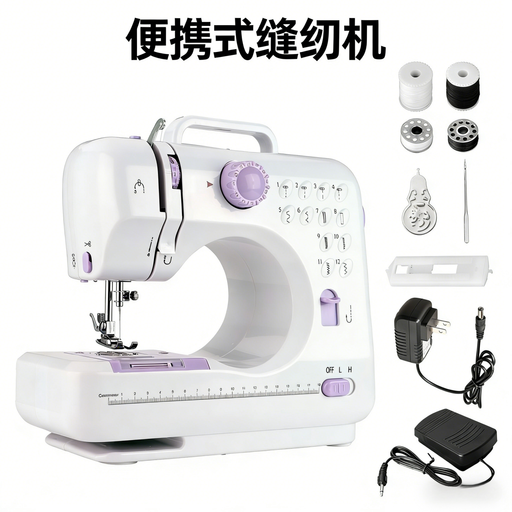
This mini sewing machine is an option to assess for occasional basic hems. Test the group’s napkin fabric and folded hems before choosing it for repeated batches.
 No image available
IAGREEA Mini Portable Electric Sewing Machine, 12 stitches, purple
Consider this machine for basic seams and hems if a sample of the group’s napkin fabric sews as needed.
The named variant has 12 stitches, dual power and an LED light. Confirm straight-stitch adjustment, handling of the intended folded hem, the UK electrical setup and warranty arrangements with the seller.
Joybuy
Common questions
Do we need an industrial machine to make theatre-group napkins?
Not necessarily: a domestic machine is a reasonable starting point for ordinary woven napkins in modest batches if it handles the planned hems. For frequent runs or thicker theatre textiles, compare heavy-duty domestic and professional straight-stitch machines against the actual workload; Janome’s HD9, for example, is straight-stitch-only.
Which features help when several volunteers share one machine?
Prioritise controls that each volunteer can set up and operate at a comfortable speed. Brother specifies one-step needle threading, quick-set bobbin loading and slide speed control on the Innov-is A16; Janome specifies a built-in needle threader and top-loading bobbin on the Sewist 725S.
What should we ask about warranty and servicing?
Ask the seller how the exact machine can be demonstrated, serviced and handled under its warranty. Janome says purchasing through an official UK retailer matters for its after-sales care and warranty arrangements.
What documentation matters if the machine will be used at work?
For new machinery placed on the Great Britain market for use at work, the Health and Safety Executive’s guidance calls for UKCA or CE marking, a declaration of conformity and English instructions. The Department for Business and Trade’s March 2026 guidance distinguishes Great Britain and Northern Ireland marking routes for electrical equipment, so confirm the applicable product category and place of use with the supplier rather than applying the GB route to Northern Ireland.
What safety instructions should volunteers follow?
Follow the manual supplied with the chosen machine, including its instructions for disconnecting power. A Brother sewing-machine manual instructs users to unplug that machine after use and before cleaning or user-servicing adjustments; check the instructions for the model your group buys.


