Small-space tool-roll makers
If the machine must be put away after each project, consider its weight, storage cover and the space needed to support fabric while you sew—not just whether the machine fits on the table.


If your tool roll includes stacked canvas, denim, binding or reinforced pockets, start with a compact full-size sewing machine rather than choosing a mini mending machine for its size alone. Check the thickest seam against the machine maker’s material and needle guidance; speed control can help with careful corners, but it does not establish that a machine can handle that seam.
If the machine must be put away after each project, consider its weight, storage cover and the space needed to support fabric while you sew—not just whether the machine fits on the table.
Reinforced pockets, binding and denim sections make the thickest seam the important test. Prioritise the machine maker’s fabric guidance, feeding and suitable needles over minimum machine size.
Repeated pocket edges and corners call for manageable starts, stops and pivots. Threading assistance, visible settings and speed control may make those tasks easier to manage.
Decide what your thickest planned seam requires before choosing how small a machine you can store. These three routes differ in the work they are intended to handle, not simply in their footprint.
Consider it when: You want controlled starts and corner pivots alongside a machine whose maker addresses layered fabrics; Brother describes these features and multiple-layer feeding for the Innov-is A16.
Bear in mind: Brother’s heavier-fabric statement is a manufacturer claim, not a tested limit for your particular seam.
Consider it when: You prefer dial controls and a machine you can store between projects; Janome lists a hard cover and a 6.0 kg weight for the J3-24.
Bear in mind: You still need a suitable place to lift and store it, and its weight says nothing about the thickness it can sew.
Consider it when: Easy storage matters most and the planned work consists of simpler, thinner-material seams.
Bear in mind: SINGER recommends a full-size machine rather than its 2.5 kg M1005 for thicker fabrics and more applications.
| Concern | What to check | Who this matters to |
|---|---|---|
| Layered seams | Compare the maker’s fabric and needle guidance with the layers at your thickest pocket, binding or webbing intersection. Check feeding and presser-foot clearance separately. | If my roll has reinforced canvas or denim intersections, I need the machine to cope with those seams, not just its flat sections. Around 40% of consumers put layered-seam capability first. |
| Table and storage space | Measure the usable table and space for fabric around the machine; compare its dimensions, weight and storage arrangement. | When I have to clear the table after sewing, lifting and storing the machine matters as much as setting it up. Storage is the primary concern for around 40% of consumers. |
| Controlled stitching | Look for speed control, needle up/down and threading aids if you need them for repeated short seams and corners. | As a newer sewer making several pockets, I want to stop at an edge and turn the fabric without rushing. Around 20% of consumers prioritise that control. |
A light machine is convenient to put away, but that does not establish its suitability for a reinforced tool roll. SINGER recommends a full-size machine over its M1005 mending machine for thicker fabrics and more applications.
Build a sample of your thickest planned seam, including any lining, pocket layers, binding and webbing, and check it against the machine maker’s guidance before deciding.
Janome identifies denim needles for canvas and other heavy, tightly woven fabrics. Needle choice alone does not establish whether a particular machine can feed or accommodate your complete stack.
Check needle compatibility for the exact model, then assess the maker’s material guidance and the thickness at seam intersections separately.
Electrical-equipment requirements and conformity guidance need to be considered for the market where the machine will be supplied; Great Britain guidance should not simply be assumed to apply unchanged in Northern Ireland.
Before paying, confirm the intended market, supplied power arrangement, instructions, warranty route and applicable conformity information with the seller.
These model examples illustrate different choices; a brand name alone does not establish that a machine will sew your thickest tool-roll seam.
Janome’s J3-24 illustrates a dial-controlled, compact full-size choice, while the 230DC adds electronic controls.
The Innov-is A16 illustrates a compact computerised route for makers who value controlled stitching.
The M1005 illustrates the very light mending-machine route rather than a default choice for a structured canvas roll.
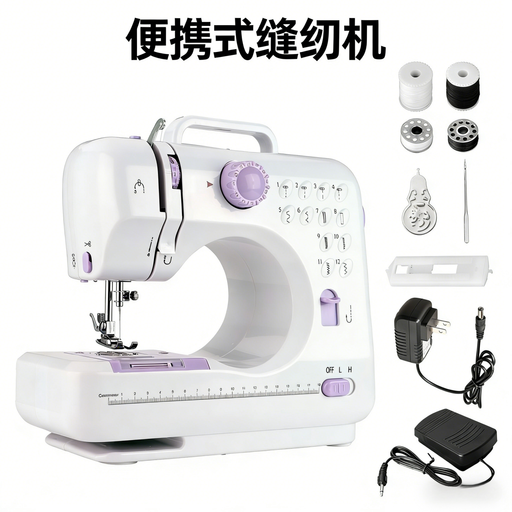
This mini portable machine is a space-conscious option to consider for simpler tool-roll seams. If your design includes thick canvas, webbing or binding intersections, check the complete material stack against the exact machine before choosing it.
 No image available
Consider this mini machine when putting it away between simpler sewing tasks is a priority; check whether it suits the thickest seams in your tool-roll plan.
The product name specifies 12 stitches, dual power and an LED light. Confirm the power arrangement and documentation appropriate to where you will use it before purchase.
Consider one only if the planned seams fall within that machine’s material guidance. SINGER recommends a full-size machine rather than its M1005 mending machine for thicker fabrics; for a canvas roll, check the thickest intersection as well as the flat fabric.
Controllable speed and needle up/down can help you stop and pivot at a pocket corner. Brother lists both on the Innov-is A16, but those controls do not establish whether its fabric guidance covers your thickest seam.
Start with the exact machine’s manual and compatible-needle guidance. Janome identifies denim needles for denim, canvas and other heavy, tightly woven fabrics; a suitable needle does not override a machine maker’s material limits.
Confirm that the machine, power arrangement and documentation are intended for the market where it will be supplied. The Office for Product Safety and Standards’ Great Britain guidance addresses the Electrical Equipment (Safety) Regulations 2016; buyers in Northern Ireland should check the applicable requirements rather than assuming Great Britain guidance applies unchanged.
Check a local-authority or retailer electrical-equipment collection route rather than putting it in ordinary household refuse. UK government guidance on waste electrical and electronic equipment describes a framework intended to encourage recovery, reuse and recycling.