Volunteer teams making repeat batches
A wardrobe or props team sharing one machine across repeated lining sessions needs controls that different volunteers can pick up without a lengthy handover.


For a theatre group sewing mainly lightweight tote-bag linings, start with a shared machine that makes straight seams and is easy for volunteers to thread and operate. If sessions regularly involve thicker seam junctions or canvas outer layers, consider a sturdier domestic model and test it on the actual fabric layers. A professional straight-stitch machine is a more specialised choice for frequent straight-seam work, provided its weight and lack of other stitch types suit the group.
A wardrobe or props team sharing one machine across repeated lining sessions needs controls that different volunteers can pick up without a lengthy handover.
If the work extends beyond lining fabric to thicker seam junctions or canvas outer layers, the group needs to assess the complete fabric stack, not just a single lining layer.
Volunteers sewing in rehearsal rooms or workshops may need a machine they can carry and store between occasional sessions.
Choose the type of machine around the work the group does most often, then check the controls and test a seam through the thickest planned junction.
Choose it when: Volunteers mainly sew ordinary lining fabric and need straightforward controls or easier transport.
Trade-off: Simple operation alone does not establish suitability for sustained work through heavier layers.
Choose it when: Regular sessions also involve thicker seam junctions or mixed fabric weights.
Trade-off: A sturdier construction may be harder to carry, and the intended fabric stack still needs testing.
Choose it when: Frequent production centres on straight seams and the machine can stay at a stable worktable.
Trade-off: The Janome HD9, for example, weighs 14 kg and cannot make zigzag stitches, according to Janome UK & Ireland.
| Concern | What to check | Who this matters to |
|---|---|---|
| Repeated batch sewing | Check the machine’s stated intended use and try repeated seams with the group’s fabric. | If we sew batches over several sessions, keeping work moving matters more than extra stitch choices. Around 33% of consumers might put batch reliability first. |
| Volunteer handovers | Have different users try threading, selecting a stitch and changing the bobbin. | When several volunteers share the machine, I need the next person to take over without a long explanation. Roughly 27% of consumers might prioritise simple shared use. |
| Mixed fabric weights | Test the thickest planned seam junction; check whether presser-foot pressure is adjustable if fabric weights vary. | If our tote construction includes canvas or bulky joins, a neat seam through lining fabric alone does not settle the choice. About 27% of consumers might put mixed-fabric handling first. |
| Carrying and storage | Check the machine’s weight and how it will be carried and stored between sessions. | When sewing moves between rooms, I need to be able to put the machine away and bring it back for the next session. Around 13% of consumers might make portability their primary concern. |
Tote-bag linings mainly call for construction seams; a long stitch list says little about how easily volunteers can thread the machine or manage the planned fabric layers.
Try threading, bobbin changes, straight stitching and a seam through the thickest planned junction before treating additional stitches as a deciding feature.
Features described for the Singer Heavy Duty 4423 and Brother ST371HD relate to specific overseas-market models; the name alone does not establish the electrical supply or accessories for a UK listing.
Check the exact model, supplied plug and voltage, included accessories and warranty arrangements for the machine being offered.
The Health and Safety Executive says electrical-appliance inspection or testing is not automatically an annual legal requirement. A test label does not replace checks suited to how and where a shared machine is used.
Check for visible damage before use and arrange competent inspection or testing at intervals appropriate to the group’s equipment and working environment.
Janome UK & Ireland specifies that the HD9 makes straight stitches only. It cannot cover a task for which the group needs zigzag stitching.
Check the group’s construction methods before choosing a straight-stitch-only machine as its sole sewing machine.
The HD9’s stated 14 kg weight also makes moving it between rehearsal rooms a practical consideration.
Janome UK & Ireland describes machines ranging from the two-dial 2200XT to the HD2200 for schools and heavy users and the straight-stitch-only HD9. Those are distinct routes for different group workloads.
Singer describes its Heavy Duty 4423 as intended for projects involving fabrics such as denim and canvas, making the exact model worth examining if tote outer layers are part of the work.
Brother’s ST371HD is a model to examine when straightforward bobbin changes and work with heavier layers are relevant.
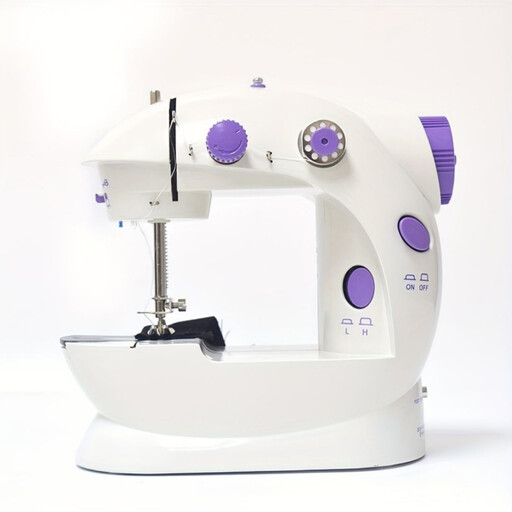
These compact IAGREEA machines are choices for straightforward lining seams where simple operation or transport matters. Test the planned fabric layers and check the power arrangements before selecting either for shared sessions.
 No image available
For volunteers seeking a compact machine for straightforward lining seams and transport between sessions.
The named variant has 12 stitch choices, dual power and an LED light.
Test seams through the group’s thickest planned junction and confirm the supplied adapter’s plug and suitability for the intended UK electrical supply.
 No image available
For occasional, simple lining seams where volunteers want a portable machine with pedal operation.
The named variant specifies 6V 1A and battery or plug-in power using 4AA batteries. It has one fixed stitch type and no backstitch function, which matters if the group’s seam construction calls for reverse stitching.
Test the intended fabric layers and confirm the supplied adapter’s plug and suitability for the intended UK electrical supply.
No: the Health and Safety Executive says the relevant electrical-safety rules do not make annual appliance testing a legal requirement. The machine must be maintained in a safe condition, with inspection or testing considered according to its use and environment.
Check the plug, lead, casing, foot controller and connectors for visible damage before use, and take damaged equipment out of service for competent assessment. The Health and Safety Executive notes that visual checks can reveal many defects, while some require testing.