Costume coordinator making batches
When several similar aprons must be ready for a production, repeatable seams and manageable sewing speed matter more than decorative stitches.


For ordinary cotton aprons, choose a machine that handles straight seams, hems and the joins in your pattern before paying attention to a long stitch list. A simple mechanical model may suit occasional projects; repeated batches make feeding and controlled speed more important, while a computerised model may help when volunteers with different levels of experience share the machine. Check layered straps and pockets against the actual machine before committing to a batch.
When several similar aprons must be ready for a production, repeatable seams and manageable sewing speed matter more than decorative stitches.
People taking turns on one machine need controls they can learn, along with a threading and bobbin routine that is easy to follow.
For a single production or intermittent costume work, straightforward cotton seams and practical storage may matter more than specialist functions.
Start with the apron pattern and the thickest strap or pocket join. Then decide whether repeated sewing, shared controls, finishing details or occasional use will shape the choice most.
| Concern | What to check | Who this matters to |
|---|---|---|
| Repeated seams and feeding | Check stitch-length adjustment and how the machine handles the planned cotton, straps and pocket layers. | If I am sewing a batch, I need to keep long seams moving without struggling at thicker joins. Around 33% of consumers put repeated-seam throughput first. |
| Shared-user setup | Look at stitch controls and bobbin handling; consider a maximum-speed control for less-confident users. | When volunteers take turns, I need each person to get started without repeatedly relearning the machine. Shared-user simplicity comes first for around 27% of consumers. |
| Hems and details | Confirm reverse or locking stitches and any feet or buttonhole function the apron pattern requires. | Visible hems, ties or pockets make finishing details my main concern. Around 20% of consumers chiefly prioritise that flexibility. |
| Occasional use and storage | Check the machine’s weight, storage arrangements, included accessories and route for servicing. | If the machine comes out only for productions, I need it to be practical to put away and use again later. That is the primary need for around 20% of consumers. |
A large stitch selection does not establish how readily a machine will sew the straight seams, hems and layered joins in the apron pattern.
List the pattern steps, then check stitch-length adjustment, reverse or locking stitches and the feet needed for them.
A published stitch rate does not replace instruction or careful handling, particularly when several people use the machine.
Give shared users model-specific instructions and switch off the power before adjustments or needle changes, as the Health and Safety Executive advises.
The group may need suitable needles, bobbins and feet beyond the machine itself, as well as a workable servicing route.
Check what is included, where compatible replacements can be obtained and how the machine will be stored between sessions.
Allow time to organise servicing and to pack and move the machine when theatre sessions change location.
Janome UK & Ireland lists mechanical and computerised models that address different theatre-group needs.
The Singer Heavy Duty 4432 is a mechanical option to examine when repeated seams and bulkier joins are priorities.
The Juki HZL-DX3 is a feature-rich model to consider if aprons are part of frequent, varied costume production.
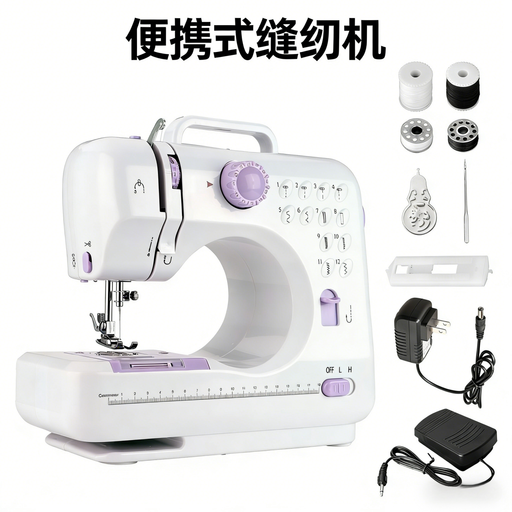
This compact machine is a choice to examine for straightforward apron seams and hems. Check its settings and handling against the group’s pattern before relying on it for repeated batches or layered joins.
 No image available
Consider this mini machine for straightforward apron seams and hems, provided it handles the group’s planned cotton and pattern.
The named variant has 12 stitches, dual power and an LED light.
Before using it for a batch, check adjustable stitch length and how it handles layered straps and pocket joins.
Not necessarily: a domestic machine with the construction settings needed for the pattern may suit ordinary panels and hems. If the group will repeatedly sew layered straps, pockets or hems, check those joins on the intended model; the Singer Heavy Duty 4432, for example, lists adjustable presser-foot pressure and an extra-high presser-foot lift.
It may help when users need a maximum-speed control or easier access to particular settings. Janome UK & Ireland lists a speed controller, needle threader and top-loading bobbin for the 230DC, but the group should judge those conveniences against how often the machine will be shared.
If the sewing machine is provided for use at work, the Health and Safety Executive says the Provision and Use of Work Equipment Regulations 1998 require suitable equipment that is safe, maintained and used by people with adequate information, instruction and training. Whether that work setting describes a particular theatre group depends on how it operates; do not assume the same position for an entirely voluntary, non-work activity.
Switch off the power before changing needles or making adjustments, as the Health and Safety Executive advises in its sewing-machine guidance. Give each volunteer instructions for the particular machine and check guards, needles, lighting and the work area as part of the shared-use routine.
Check the exact model’s warranty route, servicing arrangements, compatible consumables and access to operating instructions. Janome UK & Ireland directs warranty work to local retailers, Juki UK states that it offers UK-based servicing and support, and Singer Sewing UK says its support line covers machine functions rather than sewing tuition.