What should you check?
Measure the space available for sewing and storage, then check the stitches your case pattern uses. Treat thicker materials as a separate model-and-needle decision.
| Concern |
What to check |
Who this matters to |
| Space and storage |
Compare the exact model’s dimensions and weight with your clear table area and storage shelf; allow working room around the machine. |
If I have to clear a shared table after sewing, I need a machine I can position and put away without crowding the work area. Around 33% of consumers put space and moveability first. |
| Case-making controls |
Check for the straight, zigzag and reverse functions your pattern needs, plus any stitch adjustment or foot required for its closures. |
When I make regular fabric cases, I want to secure seams and finish edges without paying attention to a long stitch list I may not use. For around 27% of consumers, usable sewing controls are the primary concern. |
| Layered materials |
Read the model’s fabric and needle guidance, then test a seam through the actual padding and seam crossings. |
If my cases have foam, dense interfacing or faux leather, I need to know whether the complete seam can be sewn with a suitable needle. Handling those layers comes first for around 20% of consumers. |
| Learning and support |
Check the manual, threading instructions, supplied feet and the seller’s warranty and service route. |
For my first machine, I need to get started and know where to ask about a fault or an unfamiliar control. Around 20% of consumers prioritise setup and after-sales support. |
Brands to consider
These model-specific references can help you compare features and support arrangements; they do not describe every machine made by each brand.
Brother
The Brother L14S is a reference point for a small mechanical machine with beginner-oriented controls.
- Brother lists 14 built-in stitches, free-arm conversion, a drop-in bobbin, LED lighting and a metal chassis for the L14S.
- Brother positions the L14S for basic alterations and repairs. Check its model-specific material and needle guidance before planning heavily padded cases.
Janome
The Janome 2200XT is a dial-operated domestic model to compare if stitch adjustment and a documented retailer support route matter to you.
- Janome lists 22 built-in stitches, adjustable stitch width and length, free-arm sewing and a weight of 6.0 kg for the 2200XT.
- If you intend to move the machine after each session, assess that weight alongside your storage arrangement. Janome advises UK customers to use official retailers for warranty care.
SINGER
The SINGER M2105 gives you published dimensions to compare against a narrow table or shelf.
- SINGER lists dimensions of 38.5 × 18.7 × 29 cm, eight stitches, a free arm and an extra-high presser-foot lifter for the M2105.
- A higher foot lift is not a general rating for padded seams. Check the precise model guidance, regional version and seller’s support terms.
Joybuy product choices
This small electric machine is a choice to examine if putting it away after fabric-case projects matters to you. Confirm that its stitches and material guidance suit your intended pattern before buying.
 No image available
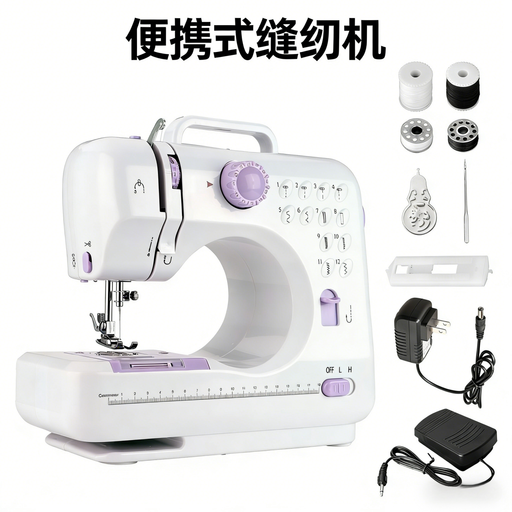
IAGREEA Mini Portable Electric Sewing Machine, 12 Stitches, Purple
Consider this model if you need a machine to store between small sewing projects. Its product name specifies 12 stitches and an LED light; check that the stitch selection includes those your glasses-case pattern requires. For padded or layered cases, confirm the model’s fabric and needle guidance, and check its dimensions, stable placement, electrical-product information and support terms with the seller.
View on Joybuy
Common questions
Do I need a handheld machine because my table is small?
No: a compact domestic machine is worth considering if it fits securely on your table and offers the stitches your case pattern needs. Measure both the working area and storage space against the exact model’s dimensions, allowing room to guide fabric and use the pedal.
Can a compact machine sew a padded glasses case?
Possibly, but the answer depends on the machine and the complete seam stack, not its compact size. Check its material and needle guidance and test the outer fabric, lining and padding together, including any bulky seam crossings; do not force the fabric through the needle area.
Should I use a leather needle for faux leather?
A leather needle may be appropriate for faux leather if it suits the particular material and machine. SCHMETZ specifies leather needles for leather, faux leather, paper and heavy non-woven synthetics, but advises against using them on woven or knitted fabric; test on an offcut first.
What electrical-product details should I check with a UK seller?
Ask for the machine’s product identification, instructions and applicable conformity information for its destination. Great Britain and Northern Ireland can have different arrangements, so confirm which information applies to the machine being supplied rather than assuming one marking answers every UK purchase question.
How can I check the after-sales route before ordering?
Confirm the exact model’s warranty terms, instructions and service contact with the seller. If considering a Janome machine, check the retailer’s status: Janome UK & Ireland directs customers to official retailers for warranty care.


