Small-space cover makers
You need to store the machine or work on a narrow table while keeping enough room to guide a long cover seam.


Choose a sewing machine for pet-bed covers by the thickest seam you expect to sew, then consider the room needed for both the machine and the moving fabric. A compact machine can suit a small table if it feeds a sample of your cover fabric reliably; frequent bulky seams call for closer attention to presser-foot clearance, feeding and pressure adjustment, even if that means a less convenient machine to store.
You need to store the machine or work on a narrow table while keeping enough room to guide a long cover seam.
You expect canvas, fleece layers, piping or bulky seam intersections, so feeding and clearance matter alongside the machine’s size.
You want a manageable setup for removable covers, particularly when starting seams, controlling speed and turning corners.
Make a sample of your thickest cover seam before judging a machine by its footprint or stitch selection. Allow space on the table for the fabric as well as the machine.
| Concern | What to check | Who this matters to |
|---|---|---|
| Layer feeding and bulky seams | Test your thickest seam under the presser foot. Check clearance, pressure adjustment and walking-foot compatibility for the exact model. | If my cover has piping and several layers, I need them to feed together without the seam catching at an intersection. Around 42% of consumers would put layered-seam handling first. |
| Table space and storage | Measure the table and storage space, allowing room for the pedal and fabric behind and beside the needle; consider how often you must lift the machine. | When I have to clear the table after sewing, I need a machine I can move and store while still supporting the cover as I sew. Roughly 33% of consumers would make space and storage their primary concern. |
| Speed and setup control | Check how slowly you can sew and whether needle positioning helps with corners; consider bobbin setup if you are new to the machine. | As I learn to sew covers with corners and closures, I want time to guide each turn without rushing the stitches. About 25% of consumers would prioritise control and setup. |
A small footprint does not establish whether layered fabric will fit under the presser foot or feed evenly across piping.
Make a sample with the outer fabric, lining and seam allowances you plan to use, then try an intersection as well as a flat seam.
The Sewing Directory explains that a walking foot helps layers feed together, but the attachment must suit the machine. It cannot add clearance beneath the presser foot.
Check the exact machine model and the foot maker’s compatibility information before ordering one.
A separately purchased foot that does not fit cannot be used for the intended cover seams.
A high stitch-rate specification does not tell you how comfortably you can start a seam slowly or pivot at a corner.
If precise turns matter, try the low-speed control and check needle positioning. Assess feeding and clearance separately for heavy layers.
GOV.UK advises checking for appropriate marking and the manufacturer’s name and address when buying electrical products.
Check the supplied plug, instructions and product identification before purchase, and keep your order documentation.
The Heavy Duty 4423 is a mechanical model to examine if bulky cover seams are a recurring part of your projects.
The Innov-is A16 is a compact computerised model to examine when storage and controlled sewing are priorities.
The HD2200 is a conventional domestic model to examine if the machine can stay on a stable work surface.
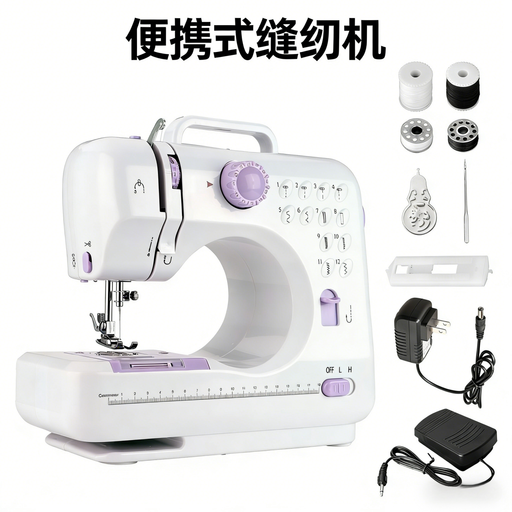
This compact machine is a choice to consider for basic cover seams where storage space is tight. Check your thickest layered seam before relying on it for bulky construction.
 No image available
Consider this machine if you need a compact setup for basic cover seams rather than assuming it will handle thick seam intersections.
It has 12 stitches, dual power and an LED light. For layered covers, check presser-foot clearance and compatible foot options, and try your intended fabric stack.
Not necessarily: a domestic machine is worth considering if it feeds a sample of your actual cover fabric and clears the thickest seam. For frequent bulky intersections or piping, check presser-foot lift, pressure adjustment and compatible feeding accessories rather than choosing by size alone.
No. A walking foot can help fabric layers feed together, as The Sewing Directory explains, but it does not create more room beneath the presser foot. Confirm that the foot fits your machine and test a bulky seam before depending on it.
Allow space for the cover to move without pulling sideways at the needle, as well as for the machine and pedal. If you put the machine away after each session, compare its dimensions and weight: Direct Sewing Machines lists the Brother Innov-is A16 at 6.6 kg, while Janome lists the HD2200 at 8.0 kg.
Check for appropriate marking and the manufacturer’s name and address, as GOV.UK advises for electrical products. Confirm the supplied plug and instructions; if delivery is to Northern Ireland, ask the seller which product documentation applies there.