First-time pocket makers
You want to make occasional fabric organisers or storage pockets and would rather learn a manageable set of controls than choose from a large stitch library.


For occasional fabric storage pockets, start with a straightforward domestic machine that can sew the stitches you need and accommodate your thickest planned seam. Consider a heavy-duty model if bulky layers are the main challenge, or a computerised model if speed control and needle positioning matter more for repeated pocket panels. Neither label replaces a check of the actual fabric stack.
You want to make occasional fabric organisers or storage pockets and would rather learn a manageable set of controls than choose from a large stitch library.
Your pocket edges, dividers or bindings bring several layers together, so presser-foot clearance and fabric handling are central to the choice.
You plan to make multiple pocket panels and value controls for stopping at corners, setting stitch dimensions and securing seams consistently.
Choose it when: You make occasional pockets and want straightforward utility-stitch controls.
Bear in mind: The electronic speed and needle-position controls available on some computerised models are not part of this route.
Choose it when: Bulky pocket edges or repeated layered seams are your main concern.
Bear in mind: A heavy-duty label does not establish how your particular combination of fabric, interfacing and binding will sew.
Choose it when: You expect to sew many pockets and want controls for repeated starts, corners and seam finishes.
Bear in mind: Extra controls do not establish suitability for bulky seams; check fabric handling separately.
For storage-pocket projects, let the feature that most affects your work lead the choice: layer handling, control during repeated sewing, or the closures and finishes your design calls for.
| Concern | What to check | Who this matters to |
|---|---|---|
| Layer handling | Check the stated presser-foot lift and whether pressure is adjustable. If possible, try a seam made from every layer in your thickest pocket edge. | If my dividers and bound edges bring several layers together, I need room under the foot without assuming a machine will feed every stack well. Around 40% of consumers would put layer handling first. |
| Setup and stitch control | For frequent corners and parallel seams, check the exact model for speed limiting, needle up/down control and adjustable stitch settings. | When I sew several matching panels, I want to stop accurately at corners and keep the stitching consistent. That control would be the leading need for around 40% of consumers. |
| Closures and finishes | Decide whether your design needs buttonholes or other finishing stitches, then check the stitch functions and compatible presser feet. | If my pockets need button closures or a particular edge finish, those functions matter more to me than a long list of unrelated stitches. Around 20% of consumers would prioritise closures and finishes. |
More stitch options do not show whether a machine can accommodate a bulky pocket edge.
Build a sample with the outer fabric, lining, interfacing, binding and trim you intend to use. Check clearance-related features and try that full stack if possible.
A free arm is relevant to tubular pieces, but it does not address the main sewing demands of a flat organiser panel.
Give it weight in your choice if you also plan to sew cuffs, hems or other tubular items; otherwise focus on your pocket seams.
Model features do not establish results for every combination of fabric, stabiliser, needle, thread and seam thickness.
Use a needle and thread appropriate to your fabric, and test a sample through the full planned stack rather than forcing a bulky seam through.
GOV.UK provides separate product-compliance guidance for Great Britain and Northern Ireland, so the delivery destination matters when checking a mains-powered machine.
Ask the seller which market the product is intended for and request the applicable marking and documentation for that destination.
Janome has mechanical and computerised domestic models relevant to different storage-pocket projects.
Singer offers domestic mechanical machines, including the Heavy Duty 4423 for buyers considering layered work.
The computerised Innov-is A16 is a Brother option to examine when repeatable stitch control is the priority.
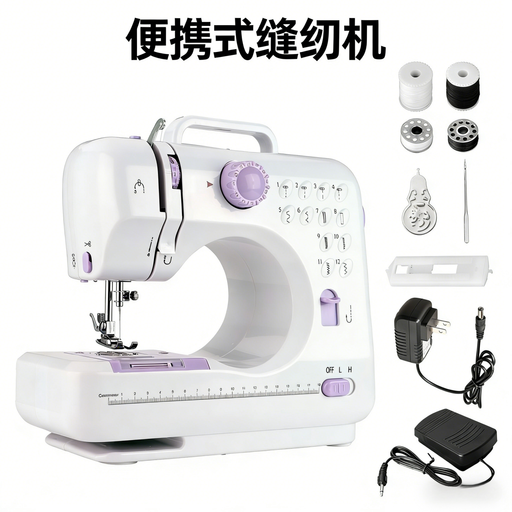
This compact machine is a choice to examine for occasional, straightforward pocket projects; check its fit for your planned seams and closures before deciding.
 No image available
Consider this compact model for occasional pocket projects where its listed stitches meet your design needs.
The product title specifies 12 stitches, dual power and an LED light. Before choosing it for layered edges or button closures, check presser-foot clearance, the buttonhole function and which presser feet are supplied.
No, not for every pocket design: an ordinary domestic machine may suit simpler fabric pockets if it has the stitches you need and can accommodate the planned seam. For bulky edges, check clearance and fabric handling on the exact model, then try your full fabric stack if possible.
No. A free arm is more relevant when sewing tubular pieces such as cuffs or hems; for flat pocket panels, give priority to the seams, layers and stitch controls your design needs.
Check that the machine is intended for the Great Britain market and ask the seller for the marking and documentation applicable to that product. GOV.UK’s Great Britain electrical-equipment guidance covers England, Scotland and Wales; the product listing alone should not be treated as confirmation of compliance.
No. GOV.UK directs readers to separate Northern Ireland guidance rather than applying its Great Britain electrical-equipment guide there. Ask the seller for compliance information specific to a machine supplied to Northern Ireland.