First-time placemat maker
You want to make occasional cotton or reversible placemats and need manageable threading, stitch selection and seam reinforcement rather than an extensive stitch selection.


A basic mechanical machine can be enough for simple placemats if it offers the seam controls your pattern needs. For quilted fabric-and-batting layers or bound edges, check foot clearance and walking-foot compatibility for the exact model; speed control and automatic thread cutting may make repeated sessions easier, but they are not essential to a simple placemat.
You want to make occasional cotton or reversible placemats and need manageable threading, stitch selection and seam reinforcement rather than an extensive stitch selection.
You plan to sew fabric and batting together, quilt through the layers and bind the edges. Craftsy’s quilted placemat instructions use a walking foot, making model-specific foot compatibility worth checking.
You will repeatedly set up and put away the machine. Its weight and storage space may matter as much to your routine as speed control or needle positioning.
Decide whether your placemats will be simple or quilted before comparing stitch selections and convenience features. Then check how the machine will fit your table and storage routine.
Choose when: You expect to sew occasional, straightforward placemats and prefer direct controls.
Check: Included feet and suitability for your planned layers vary by model; a walking foot may be a separate accessory.
Choose when: You want a manual adjustment to consider for changing layers and seam intersections; Janome lists this control on the 423S.
Trade-off: Janome lists the 423S at 7.4 kg, which matters if you lift it onto the table for each session.
Choose when: You value controlled speed, needle positioning and automatic thread cutting for repeated sewing sessions; Janome lists these on the DKS30.
Check: Convenience controls do not replace suitable needles, feet and settings for the layers you intend to sew.
| Concern | What to check | Who this matters to |
|---|---|---|
| Layered construction | Check foot clearance and model-specific walking-foot compatibility for fabric, batting and binding. | If I want to quilt through batting and finish bound edges, I need to know how the machine handles the layers in my pattern. Around 33% of consumers put layered construction first. |
| Setup and seam control | Check the threading instructions, bobbin system, adjustable stitch length and reverse sewing. | For my first placemats, I want to set up the machine confidently and reinforce simple seams. Easy setup is the primary need for around 25% of consumers. |
| Kitchen-table routine | Compare machine weight with your lifting and storage needs; decide whether speed and needle-position controls matter to you. | If I must put the machine away after every session, moving it comfortably takes priority. Around 25% of consumers place the table-to-storage routine first. |
| Decorative range | Match stitches and compatible guides or feet to your planned finishes and other projects. | When I also want decorative stitching or future craft projects, I care about options beyond a plain seam. That range comes first for around 17% of consumers. |
A quilted placemat involves sewing layers and attaching binding; a larger stitch selection does not establish how a particular machine will handle that construction.
Start with your pattern, then check the exact model’s seam controls, foot clearance and compatible feet.
A compatible walking, quilting, guide or binding foot may need to be obtained separately.
Brother and Janome describe quilting-related accessories, but an accessory listing does not establish what is included with a particular machine.
Compare the offered machine’s included-accessory list with the manufacturer’s compatibility information for its exact model.
Electrical Safety First advises checking for a standard UK three-pin plug and fuse and buying from a reputable retailer. Great Britain product-safety guidance should not be assumed to cover Northern Ireland unchanged.
Check the supplied plug and documentation before use, and keep your proof of purchase.
The Brother AE1700 weighs 6.65 kg, while Janome lists the DKS30 at 6.8 kg and the 423S at 7.4 kg. These figures matter for carrying and storage, not as measures of stitch quality.
Measure your table and storage space, and check the exact model’s weight and carrying arrangement.
The AE1700 is an example of a mechanical machine to consider for straightforward placemat construction.
The 423S offers mechanical adjustment, while the DKS30 offers computerised workflow controls.
The Tradition 2250 is a mechanical option for basic sewing and craft projects.
This compact machine is a choice to assess for straightforward placemat sewing at a kitchen table. If your pattern includes batting or quilted layers, check its foot clearance and compatible accessories before choosing it.
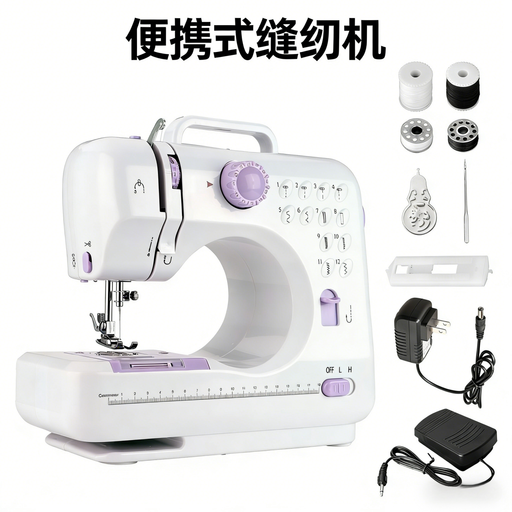 Image unavailable
For straightforward placemats, check that its seam controls suit your pattern. This purple model is described with 12 stitches, dual power and an LED light. If you plan to quilt fabric and batting, confirm foot clearance, walking-foot compatibility and whether the required foot is included. Check the supplied plug and fuse before use in the UK.
No overlocker is needed for the bound, quilted method described by Craftsy: it quilts fabric and batting together and attaches binding with a standard sewing machine. Check your chosen pattern if it uses a different construction.
Craftsy’s quilted placemat method uses a walking foot to sew through the layers. If you choose that method, confirm a foot compatible with your exact machine and check whether it is included or obtained separately.
For Craftsy’s layered approach, plan for front and backing fabric, batting or fusible fleece, binding, pins or clips, and cutting tools. Check your pattern’s quantities and your machine’s included accessories before gathering supplies.
Electrical Safety First advises buying from a reputable retailer and checking for a standard UK three-pin plug and fuse. The Office for Product Safety and Standards’ electrical-equipment guidance applies to Great Britain; do not assume that its regulatory treatment applies unchanged in Northern Ireland.
Follow the machine manual, inspect the cord before use and keep fingers clear of moving parts. Switch it off when threading or changing accessories; if you notice damage, sparking, an unusual smell or unusual noise, stop using it and contact the retailer or manufacturer.