Who each option suits

Shared-oven users wanting one reliable tray

If you can count on access to the communal oven, a fan setting is a useful starting point for even heat distribution without taking up more shared worktop space. You will still need to coordinate cooking time and clean the oven and tray afterwards.

Space-limited personal-appliance users

A compact mini oven may suit occasional, modest portions if personal appliances are permitted and there is a suitable place to use one. Check the tray dimensions, required clearance and electrical instructions before treating its small capacity as proof that it will fit your kitchen.

Frequent crisping and multi-cook users

If you expect to cook other foods regularly as well as onion wedges, an air-fryer oven with racks and multiple cooking levels may be worth considering. Those components and the appliance itself still need space and cleaning after use.

What matters when choosing

Existing shared fan oven

Choose it when: The oven works, you can get time to bake one tray and you would rather keep the shared worktop clear.

Allow for: Other residents may need the oven at the same time, and everyone shares responsibility for its settings and cleanliness.

Compact convection mini oven

Choose it when: You want your own appliance for modest portions and have permission and a suitable place to use it.

Allow for: A stated capacity in litres cannot tell you whether your preferred tray fits.

Larger air-fryer oven

Choose it when: You expect to use air-fry or multi-level cooking often enough to make those functions useful beyond an occasional tray of wedges.

Allow for: A larger appliance and extra racks take up shared space and add to the clean-up.

Concern What to check Who this matters to
Permission and electrical setup Check house rules, the model’s power requirements and its instructions for the intended socket. Do not overload or daisy-chain extension equipment. If I want my own oven, I need to know I am allowed to use it and can power it safely. Around 33% of consumers put permission and electrical setup first.
Worktop space Measure the appliance’s footprint and the clearance required by its instructions; consider where it will go when not in use. When several people need the counter, I do not want my oven to occupy their preparation space. For around 27% of consumers, worktop space is the primary concern.
Tray fit and browning Check usable tray dimensions and fan or convection settings, rather than relying on capacity in litres alone. I want enough room to spread my portion across a tray and heat it evenly. Tray fit and browning come first for around 20% of consumers.
Cleaning after use Check whether trays and other parts can be removed and how the manufacturer says to clean them. If I cook in a communal space, I need a routine that lets me clear residue after each use. Around 20% of consumers prioritise that clean-up.

Shared-kitchen pitfalls

  • Using an extension lead without checking its rating

    A portable oven can draw substantial power. Electrical Safety First warns that extension equipment can overheat if the combined load exceeds its marked rating.

    Check the oven’s power requirement and instructions against the electrical arrangement you plan to use. Do not connect one extension lead to another.

  • Choosing by litre capacity alone

    Capacity does not establish whether an oven accepts your tray, fits the available worktop or has the required ventilation clearance.

    Measure the proposed location and check both the appliance’s external dimensions and its usable tray or rack dimensions.

  • Assuming advertised speed or energy results apply to onion wedges

    Russell Hobbs and Tefal publish comparisons for particular models, foods and test conditions. Those results do not establish how an onion-wedge batch will cook in your shared kitchen.

    Compare the functions and the stated test conditions, then follow the instructions for the oven and the portion you actually use.

  • Leaving clean-up to the next person

    Residue and unattended cooking create avoidable problems where other residents also use the kitchen.

    Stay nearby while cooking, keep flammable items away from hot surfaces and agree on a clean-after-use routine. Let the appliance cool before cleaning it.

Relevant brands to consider

Russell Hobbs

Its Express Mini Oven 26090 is a 12.6 L countertop convection model for small-scale cooking.

  • Russell Hobbs lists four cooking modes for this model.
  • Its faster-preheat and energy comparisons use specified tests against a conventional electric oven; they are not a promise for onion wedges.

Tefal

Its cited range includes the 19 L Optimo mini oven and a 20 L Easy Fry air-fryer oven, offering different countertop formats.

  • Tefal specifies convection and a baking tray for the Optimo example; it lists air-fry and bake modes, two racks and three cooking levels for the Easy Fry example.
  • Compare usable tray space and cleaning requirements for the particular model. Tefal’s cooking-speed and energy claims depend on its stated test conditions.

Indesit

Relevant if you are using an existing built-in oven or the property owner is considering a replacement, rather than buying a personal countertop appliance.

  • The product information lists a 66 L cavity, fan heating and five shelf positions for the IO 253 X UK.
  • A replacement built-in oven calls for checks on dimensions, electrical connection and property permission.

Hotpoint

Its cited built-in model is relevant where the shared kitchen needs a larger installed oven for cooking on multiple levels.

  • The product information describes the 71 L HO 258HZ X UK as cooking on three levels and having a steam-assisted cleaning cycle.
  • Hotpoint’s stated energy reduction comes from tests of particular dishes cooked together rather than in separate batches; it is not a general saving for onion wedges.

Countertop oven option on Joybuy

This air-fryer oven is a personal countertop option to consider if your shared kitchen permits one. Check its usable cooking area, siting requirements and electrical instructions against your kitchen before choosing it for onion wedges.
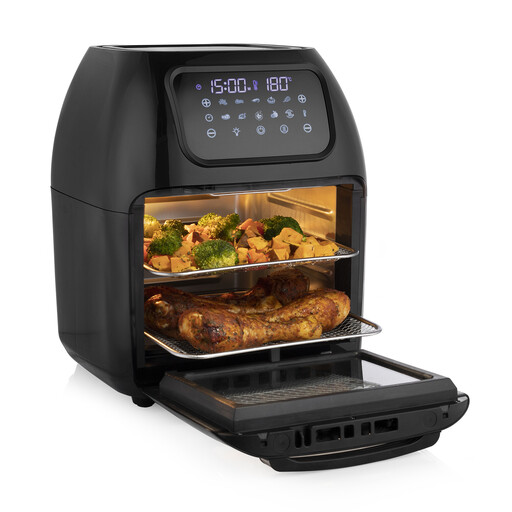
Tristar Multi Crispy FR-6964 10 L air-fryer oven

Tristar Multi Crispy FR-6964 10 L air-fryer oven

A countertop option for someone who wants a personal oven, provided its cooking area accommodates their portion and its use is permitted in the shared kitchen.

  • 10 L stated capacity and 1800 W stated power rating.
  • Touchscreen controls, 10 programmes, a non-stick coating and dishwasher-safe parts are stated in the product name.
  • Check usable tray dimensions for your onion wedges, and confirm the required clearance, plug and socket arrangements in the manufacturer’s instructions.
View on Joybuy

Common questions

Can I bring a mini oven into a rented shared kitchen?

Check your tenancy agreement, house rules and any instructions from the landlord or managing agent before buying or using one. GOV.UK guidance on fire safety in shared or rented accommodation does not itself give permission for a tenant-owned countertop oven.

Can I run a mini oven from an extension lead?

Only use an electrical arrangement that meets the oven manufacturer’s instructions and the extension equipment’s marked rating. Electrical Safety First warns against exceeding an extension lead’s maximum current rating; do not daisy-chain leads, and check the combined load of everything connected.

What should I check for evenly browned onion wedges?

Look for fan or convection heating and check that a suitable tray has room for your portion without crowding. Electrical Safety First describes fan ovens as distributing heat evenly, but the result also depends on the oven, tray, loading and cooking instructions.

How should I clean an oven after making onion wedges?

Let it cool, then clean the tray and any removable parts according to the manufacturer’s instructions. Clear food residue after use and keep tea towels, oven gloves and other flammable items away from hot surfaces.