People prioritising a quieter shared office
If colleagues work nearby, a stated quiet mode may matter more to you than motor wattage alone. You still need to check where and when your workplace permits blending.


Choose a compact mains-powered blender with a quiet-mode feature if you have permission to use a kitchenette socket and reducing disruption is your main concern. Choose a cordless model if socket access or carrying the blender matters more, but plan around its usable fill line, charging routine and instructions for the ingredients you intend to blend. A quiet-mode claim does not replace workplace permission or guarantee that blending will be unobtrusive.
If colleagues work nearby, a stated quiet mode may matter more to you than motor wattage alone. You still need to check where and when your workplace permits blending.
If you carry a blender between home and work or cannot count on an available socket, a cordless single-serve model shifts the practical question to charging, carrying and usable cup volume.
If your apricot smoothie may include frozen fruit or ice, check the exact model’s ingredient instructions and maximum fill line. A nominal cup capacity does not tell you how much you can blend at once.
Choose it when: You can use an approved kitchenette socket and a model-specific quiet mode matters more than carrying the blender around.
Trade-off: It needs mains power; Tefal’s quiet-mode comparison is relative to its own maximum speed, not a workplace noise measurement.
Choose it when: You need one modest serving away from a socket or want to carry the appliance between locations.
Trade-off: You must manage charging and the working fill limit; permitted ingredients vary by model.
| Concern | What to check | Who this matters to |
|---|---|---|
| Noise and permission | Ask where and when blending is allowed. Check for a model-specific quiet mode without treating it as a promise of low workplace noise. | If colleagues work close to the kitchen, I want to make a drink without unnecessary interruption. Around 31% of consumers would put limiting disruption first. |
| Power access | Check whether a socket is available and permitted, or how a cordless model charges between uses. | When I cannot rely on an office socket, I need to know the blender will be ready when I am. For around 23% of consumers, socket-independent use would be the primary concern. |
| Serving and ingredients | Compare the maximum fill line with your portion, and consult the exact instructions before adding ice or frozen fruit. | I want a single apricot drink with the ingredients I actually use, without exceeding the safe fill line. Ingredient suitability and working volume would come first for around 23% of consumers. |
| Clean-up | Check how the cup, lid and blades are cleaned and which parts the manufacturer says are dishwasher-safe. | In a shared kitchen, I need to clear away fruit residue and leave the equipment ready for its next use. Around 23% of consumers would make ease of clean-up their main concern. |
According to nutribullet UK, its Portable Blender has a 475 ml cup but a 350 ml maximum fill line. The cup size is therefore not the amount to put in for blending.
Size your fruit and liquid portion to the model’s maximum fill line.
nutribullet UK states that its Portable Blender can blend frozen fruit and ice. Salter describes ActiBoost for fruit, protein powders and soft ingredients; those descriptions do not establish the same ingredient guidance.
Check the instructions for your exact model before adding ice, frozen fruit or other hard ingredients.
Tefal describes the Blend Up BL19H4G0 Silence mode as up to twice as quiet as the model at maximum speed. That manufacturer comparison does not establish how unobtrusive it will be near colleagues.
Confirm permission with your office manager or facilities team, then use the permitted kitchenette and times.
The mains-powered Blend Up BL19H4G0 is a compact option for a fixed kitchenette.
The Portable Blender offers a cordless, single-serve format with USB-C charging.
Salter presents its cordless ActiBoost, with a 0.45-litre cup, for office use and simple fruit drinks.
These choices include a mains-powered quiet-mode option and portable models for a single smoothie. Choose according to permitted power access, your portion and the ingredients you plan to use.
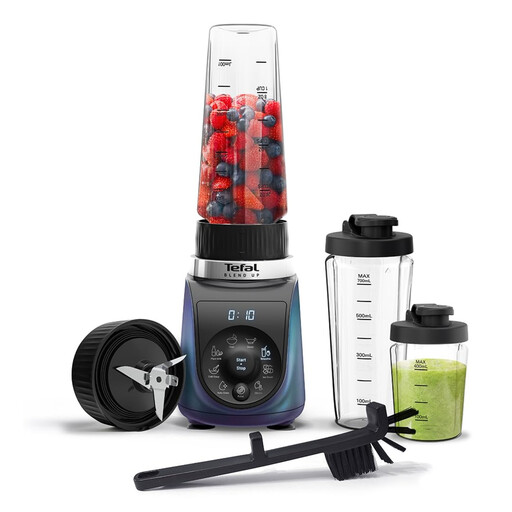 Image unavailable
Consider this model for a permitted office kitchenette where reducing disruption matters. Tefal lists a Silence mode, auto-clean programme and dishwasher-safe bottles; the quietness claim is relative to its maximum speed, not a workplace sound measurement. It requires a mains socket.
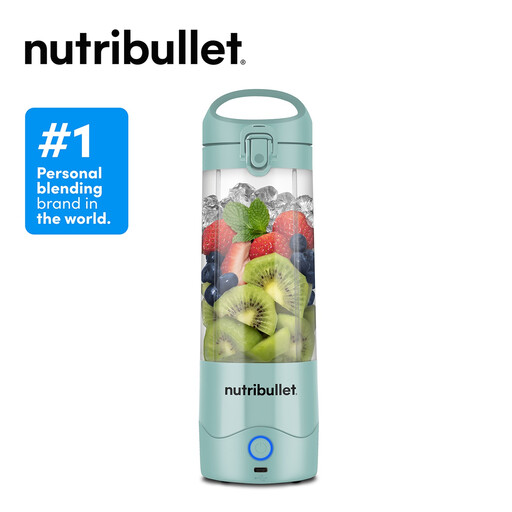 Image unavailable
Consider this cordless model for a small drink when an office socket is inconvenient. It has USB-C charging; nutribullet UK specifies a 350 ml maximum fill line despite the 475 ml cup. Recharge it between uses and check where blending is permitted at work.
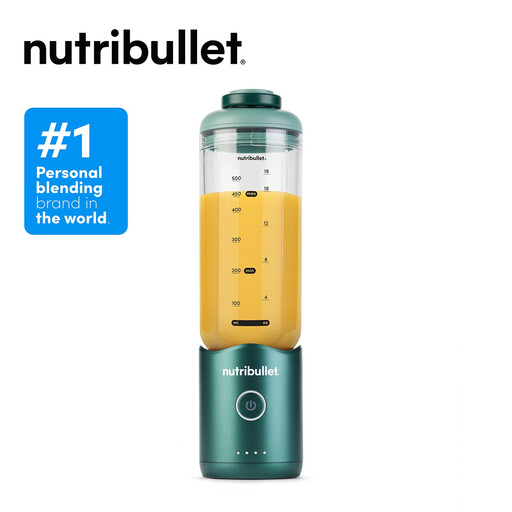 Image unavailable
Consider its detachable vessel if carrying a single smoothie between locations matters. Before choosing it for office use, confirm the charging arrangements and usable fill line, and follow the exact model instructions for ice or frozen fruit.
It can be, if your recipe fits the model’s maximum fill line and follows its ingredient instructions. For example, nutribullet UK specifies a 350 ml maximum fill line for its Portable Blender’s 475 ml cup; plan the serving around the line, not the cup’s nominal capacity.
A quiet mode may help you choose a model, but it does not establish whether blending is permitted or how colleagues will experience the noise. Tefal compares the Blend Up BL19H4G0 Silence mode with its own maximum speed; check your workplace’s rules on location and timing before using it.
Follow the instructions for the exact appliance and your workplace’s rules for the shared space. Tefal lists auto-cleaning, removable blades and dishwasher-safe bottles for the Blend Up BL19H4G0; keep the preparation area clean as well as the appliance.
Check your workplace’s rules for shared equipment and avoid cross-contact when preparing and cleaning up your drink. GOV.UK’s allergen guidance cited for retail and catering food businesses does not, by itself, set out a labelling requirement for an employee’s private smoothie.