
24/7 Customer Support

Free returns

Same-day & Next-day Delivery

Quality Guaranteed

Unlock Your Welcome Offers: FREE Delivery | Up to 80% OFF | Free 30-day JoyPlus trial
Download the APP
Sheer linen curtains can make a room feel brighter and more relaxed, but the wrong pair may leave you with too much glare, weak privacy or an awkward fit. UK homes also face practical concerns such as changing daylight, overlooked windows and varying curtain pole systems.
Before choosing white curtains, beige curtains or botanical curtains, look beyond styled room photographs. A useful purchase starts with three questions: how much light should pass through, how will the curtains hang and what are they actually made from?
Voile curtains and sheer curtains can soften views during daylight, particularly when the room is brighter than the outside. After dark, interior lights can make the room more visible from outside. Product wording such as “privacy” or “non-see-through” should therefore be treated as a guide, not a guarantee for every lighting condition.
For bedrooms, nurseries or overlooked ground-floor windows, consider layering semi-sheer curtains with a blackout blind or lined curtain.
Linen-look curtains may be made entirely from polyester, while other styles use a linen-polyester blend. These materials offer different textures, care requirements and drape. A 100% polyester voile may be easier to wash, whereas a 30% linen and 70% polyester blend offers a more visibly natural texture.
Check the material specification rather than relying on words such as “natural”, “luxurious” or “linen style”.
A curtain pair measuring 140 cm wide may provide only 280 cm of total flat width. Once gathered across a pole, the fabric will cover less visually. Measure the curtain pole or track, not only the glass, and allow extra width for folds.
For a fuller appearance, many shoppers choose total curtain width around 1.5 to 2 times the pole width, depending on the fabric and preferred level of gathering.
Light-filtering curtains should soften direct sunlight without making the room unnecessarily dark. White and ivory voile curtains generally create a brighter appearance, while beige, taupe and green shades can produce a warmer filtered effect.
A semi-sheer fabric usually provides more visual coverage than a very fine voile, but it will still not offer the same night-time privacy as a lined curtain or blind. For living rooms and kitchens, light-filtering curtains can be suitable where daylight is important. For bedroom curtains, consider whether additional window covering will be needed.
The heading determines how the curtain attaches and how it will move:
Measure the pole diameter and inspect the stated inner eyelet diameter. For example, one listed eyelet design has 8 metal eyelets with a 4 cm inner diameter, which should be checked against your existing pole before ordering.
Measure from the top of the pole or track to the point where you want the curtains to finish. Common UK choices include just below the sill, below the window or close to the floor. Compare this measurement with the product’s stated drop, such as 220 cm or 245 cm.
Also check washing instructions. Some designs can be machine washed in cold water or at up to 30°C, while linen-blend curtains may require low-temperature drying and ironing or dry cleaning. Keep curtain fabric and packaging away from open flames and follow the product safety instructions.
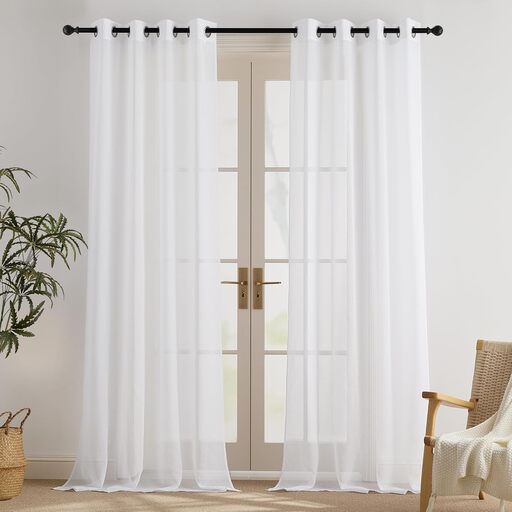
Why This Fits Their Persona: A practical option for renters or first-time decorators wanting white linen-look curtains for a living room, bedroom or kitchen without installing a track.
The listing identifies the fabric as 100% polyester with a linen-look finish, making the material specification clearer than a vague linen-style description.
Two 140 x 245 cm panels, 8 eyelets per panel and cold-water machine-wash guidance.
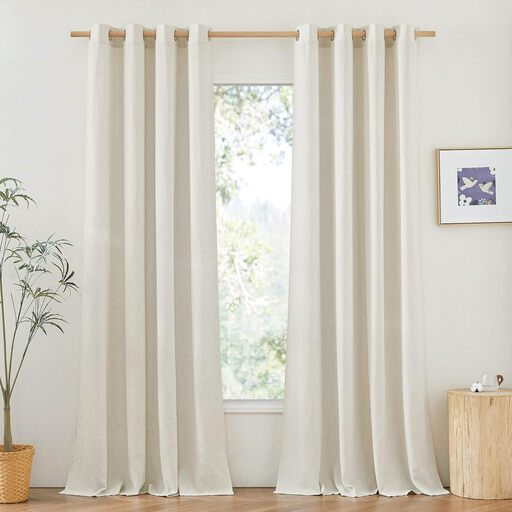
Why This Fits Their Persona: Suits shoppers who want a warmer, textured finish for a farmhouse, vintage or relaxed modern interior.
The composition is stated as 30% natural linen and 70% polyester, so shoppers can distinguish it from a fully synthetic linen-look option.
Semi-sheer construction, eyelet hanging and stated low-temperature care instructions.

Why This Fits Their Persona: A flexible choice for households changing between curtain poles, rails or tension systems across living rooms and bedrooms.
The pencil pleat heading supports hanging with hooks and rings, reducing the risk of buying a style that does not suit the existing fitting.
30% linen and 70% polyester blend, two suspension methods and cold-wash or dry-clean care options.
We have compiled a complete, real-time list of products that fully satisfy these strict selection criteria and UK safety regulations.
For curtains for living room spaces, botanical, floral or linen-look designs can soften large windows without blocking all daylight. Taupe, sage green and blue floral curtains work with natural wood and neutral upholstery.
For bedroom curtains, prioritise the drop, privacy level and compatibility with a blind. Ivory white lace sheer curtains can suit vintage or country interiors, while plain beige or off-white styles are easier to coordinate with changing décor.
In kitchens, studies and nurseries, washable polyester voile or semi-sheer curtains may be convenient. Check the care label and keep all window coverings away from open flames and heat sources.
They can provide daytime privacy and soften sunlight, but they may not prevent silhouettes being seen after dark when lights are on. Pair them with a blind or heavier curtain if night-time privacy is important.
Usually, yes. Measure the curtain pole or track and allow additional fabric for gathering. The exact amount depends on whether you prefer a lightly gathered or fuller appearance. Remember to check whether the listed width applies to one panel or the complete pair.
Follow the product’s care instructions. Some polyester designs specify cold-water or 30°C machine washing, low-temperature ironing and no bleach. Linen-blend curtains may also permit dry cleaning. Remove hardware where appropriate and avoid high heat, which can affect the fabric and shape.