
24/7 Customer Support

Free returns

Same-day & Next-day Delivery

Quality Guaranteed

Unlock Your Welcome Offers: FREE Delivery | Up to 80% OFF | Free 30-day JoyPlus trial
Download the APP
Whether you are organising a garage, furnishing a student room or creating extra kitchen storage, the right shelving units can make unused space more useful. However, attractive photographs and impressive load figures do not always tell the full story.
This guide explains the practical details to check before buying storage shelving units, including dimensions, materials, load capacity, adjustability and installation requirements.
A listing may advertise a high total load figure, but that does not necessarily mean every shelf can carry the same weight. Check whether the stated capacity applies per tier, to the complete unit or only under evenly distributed static loading.
For example, a shelving unit advertised with 650 kg total capacity may specify 130 kg per shelf. Heavy items should still be distributed evenly, and the unit should not be loaded beyond the manufacturer’s stated limit.
A shelving unit that looks compact online may be too deep for a narrow utility room or extend further into a garage walkway than expected. Measure the available space, including:
Remember to check whether the listed measurements are shown as width × depth × height or in a different order.
Boltless or interlocking designs can reduce assembly time, but they still require careful installation. Uneven floors, incorrectly fitted shelves or overloading one side can affect stability. Tall freestanding shelving should generally be secured using the supplied anti-tip kit, particularly in homes with children, pets or regular foot traffic.
For wall-mounted shelves, the wall type and fixing method matter. Plasterboard, brick and masonry require different anchors or installation approaches. Always follow the supplied instructions and check that the fixings are suitable for the wall.
For garage shelving, workshops and cellars, look for a clearly stated static load capacity. Static capacity refers to weight that remains stationary, rather than forces created by dropping items or moving the shelf.
Metal shelving units with steel frames can suit tools, paint containers and storage boxes, but MDF shelves may have different moisture limitations from the frame. Avoid placing damp items directly on board shelves unless the product instructions allow it.
The intended room should influence your choice:
A rust-resistant finish can be useful in areas where humidity varies, although no shelving should be exposed to persistent damp unless specifically designed for that environment.
An adjustable shelving unit is more useful when you store items of different heights. Check how shelf levels are changed and whether the shelf supports lock securely into place.
Some five-tier shelving products can also be divided into two shorter units. This can provide more flexibility in a garage, workshop or utility room, but confirm that both configurations are assembled and secured according to the instructions.
For bedrooms and living rooms, a bookcase or floating shelf may be more appropriate than industrial-style storage. For small kitchens, a kitchen storage shelf can add vertical capacity without occupying a full cabinet footprint.
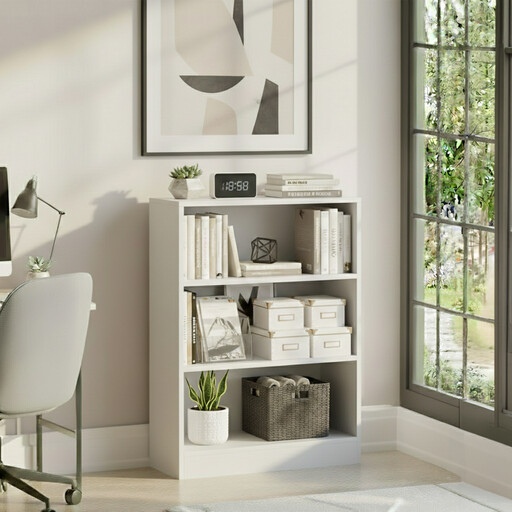
Why This Fits Their Persona: Its 75 cm height and 60 cm width suit compact bedrooms, student accommodation, home offices and smaller living areas where a full-size storage rack may be excessive.
The clearly stated 3 kg capacity per shelf helps prevent buyers from assuming that a decorative bookcase is suitable for heavy tools or bulky boxes.
Three shelves, a 60 × 24 cm footprint and a white paper veneer finish provide straightforward indoor book and display storage.
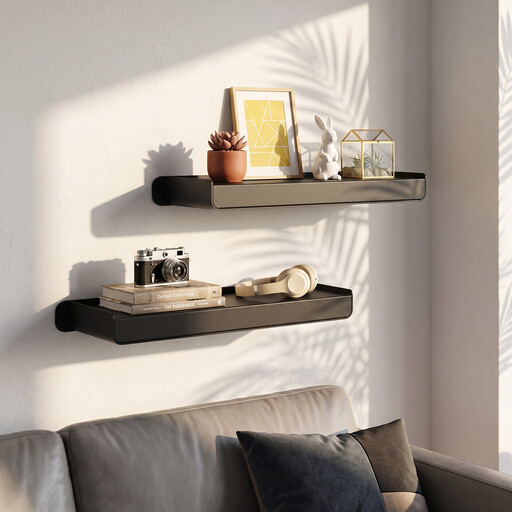
Why This Fits Their Persona: The aluminium construction and floating format suit buyers wanting a clean, wall-mounted look for living rooms, kitchens, bathrooms, offices or hallways.
The stated 44 lb capacity makes the intended load clearer, while the included mounting hardware and wall-protective rubber pad address common installation concerns.
Water-resistant, rust-resistant aluminium and a minimalist design combine display use with everyday organisation.
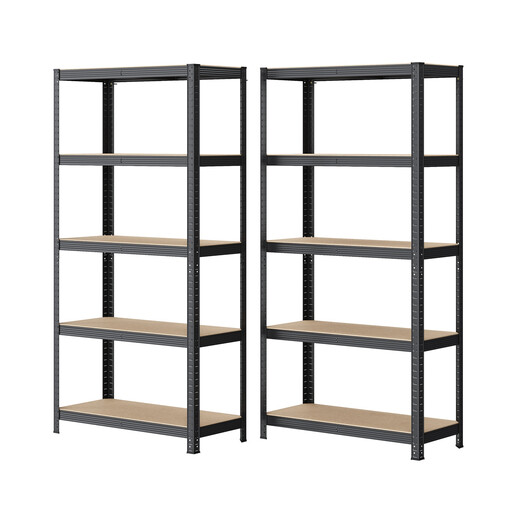
Why This Fits Their Persona: Designed for garages, sheds, workshops and utility spaces, the two-unit set can be arranged separately to create distinct storage or work areas.
The listing separates per-tier and total static capacity, and includes two anti-tip kits. Shelves are adjustable for different box and equipment sizes.
Power-coated steel frames, five adjustable tiers per unit and a stated 175 kg per-tier static capacity support demanding storage tasks.
Before loading your new shelving units:
They can be suitable for garages when the dimensions, finish and stated load capacity match the environment. Check the product’s moisture guidance, keep shelves away from leaks and secure tall units to the wall where advised.
Choose a bookcase when you need freestanding storage for books, files or household items without drilling into a wall. Floating or wall-mounted shelves are useful where floor space is limited, but they depend on suitable wall fixings and careful installation.
Lifespan depends on load, assembly quality, humidity and how often the unit is moved. Avoid exceeding the static capacity, protect board shelves from moisture and check connections periodically. A well-maintained unit is more likely to remain stable and usable over time.