
24/7 Customer Support

Free returns

Same-day & Next-day Delivery

Quality Guaranteed

Unlock Your Welcome Offers: FREE Delivery | Up to 80% OFF | Free 30-day JoyPlus trial
Download the APP
That familiar pile of shoes by the front door or at the bottom of the wardrobe is a common sight in many UK homes. A good shoe rack seems like a simple solution, yet many of us have been disappointed by a purchase that promised order but delivered only frustration. Before you buy another, it pays to know the common pitfalls that lead to wasted money and a wobbly, impractical mess.
As a Joybuy Product Recommendation Officer, my role is to help you see past the marketing hype and focus on what truly matters. Here are the three most common traps to avoid when choosing a shoe organiser, and how to select one that will genuinely serve your home for years to come.
To avoid these issues, focus on a few core parameters. These non-negotiable details are the difference between a lasting solution and a temporary fix.
The longevity of a shoe rack depends entirely on its build quality. For open-shelf designs, a metal shoe rack constructed from steel tubes offers a significant advantage in strength over all-plastic models. However, the key is in the details:
Before browsing, grab a tape measure. Know the exact width, depth and height of the area you plan to use.
Instead of a one-size-fits-all approach, the right shoe organiser depends on your specific living situation. Here are a few options matched to common UK household profiles.
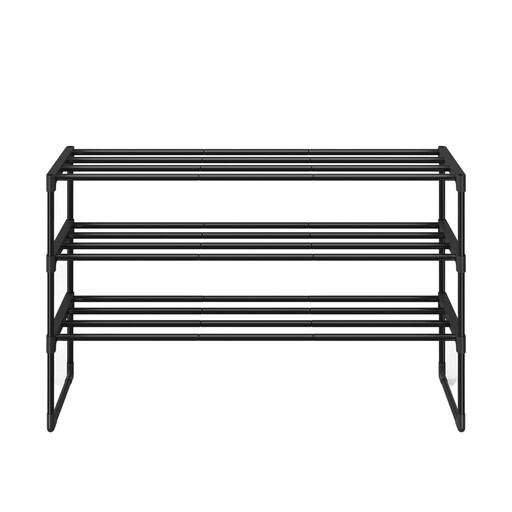
Why This Fits Their Persona: Ideal for a first flat or student accommodation, this rack is affordable, requires no tools for assembly and its narrow, stackable design is perfect for making the most of limited space without a large initial investment.
The sturdy metal tube construction provides reliable stability, steering clear of the "Wobbly Wonder" issue common in cheap racks. Its open-shelf design is more versatile for different shoe heights than enclosed cabinets.
Tool-free assembly is a major plus for renters. The ability to stack another unit on top provides a clear, affordable upgrade path as their shoe collection grows.
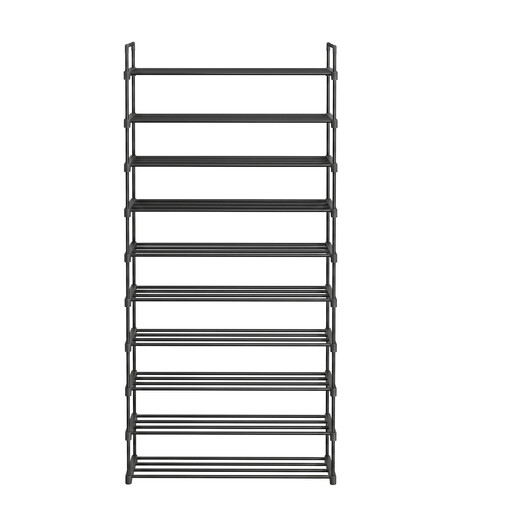
Why This Fits Their Persona: For a family, capacity is everything. This tall, slim unit provides storage for up to 50 pairs of shoes, from trainers to boots, using vertical space to keep the hallway clear. It's a practical solution for managing footwear chaos.
It directly counters the "Space Invader" pitfall by offering huge capacity with a minimal floor footprint. The ability to remove shelves solves the "One-Size-Fits-None" issue for boots, and the included anti-tip kit ensures family safety.
Exceptional space efficiency and adjustable height for storing bulky winter boots. It can also be split into two smaller racks, offering great versatility.
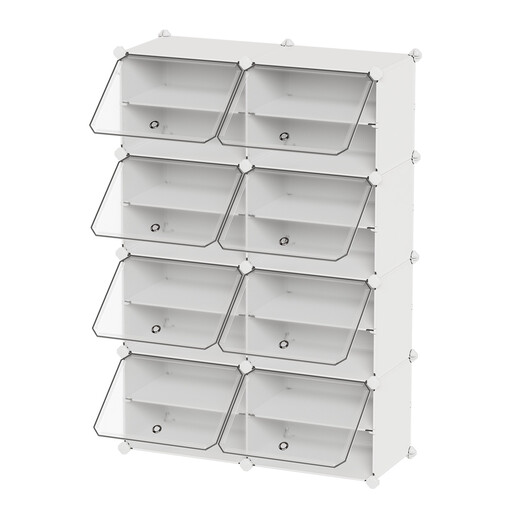
Why This Fits Their Persona: For those who value a clean, uniform look, this modular system is perfect. It's a great **closet shoe organiser** that can be customised to fit a specific space, and the doors keep shoes hidden and dust-free for ultimate tidiness.
Its DIY modularity is the ultimate counter to the "One-Size-Fits-None" problem, allowing you to build it to your exact needs. The steel frame and quality connectors provide a robust structure, preventing any wobbling.
Fully customisable shape and size. The doors offer dust and moisture protection, keeping footwear in better condition while maintaining a neat, minimalist aesthetic.
We have compiled a complete, real-time list of products that fully satisfy these strict selection criteria and UK safety regulations.
This varies by model, so it's important to check the product specifications for the Max. Static Load Capacity. As a general guide, a well-built metal shoe rack with quality connectors should support between 5 kg and 10 kg per tier. This is more than enough to hold 4-5 pairs of standard adult shoes or a couple of pairs of heavy boots without any risk of bending or damage.
You can, but only if the product is specifically designed as a stackable shoe rack. These models include special connectors that securely lock the units together. For any stacked configuration, and especially for a tall shoe rack, it is crucial to use the anti-tip kit provided to anchor the unit to a wall. This prevents it from tipping over and is a vital safety measure.
For tight corridors, focus on models labelled as narrow shoe storage. Before you buy, measure your available depth and look for racks that are 30 cm deep or less. A slim, vertical design is often the most effective space-saving shoe shelf for these situations, as it draws the eye upwards and keeps the walkway clear.