
24/7 Customer Support

Free returns

Same-day & Next-day Delivery

Quality Guaranteed

Unlock Your Welcome Offers: FREE Delivery | Up to 80% OFF | Free 30-day JoyPlus trial
Download the APP
A mountain of shoes by the front door is a familiar sight in many UK homes. It’s not just untidy; it’s a daily obstacle course. Finding the right shoe storage solution promises a tidy entryway and a calm start to your day. However, the market is flooded with options that look good online but fail to perform in reality.
As a Joybuy Product Recommendation Officer, my role is to help you see past the marketing gloss. Many shoppers find themselves with a shoe organiser that cracks within months, doesn't fit their footwear or worse, damages their shoes. Before you buy, let's look at the common pitfalls to avoid.
shoe shelf.stackable shoe boxes. This leaves you with a product that can't store your most-worn footwear.To choose a durable and practical shoe tidy, focus on these core parameters instead of promotional claims.
The type of plastic used determines the longevity of your storage.
shoe organiser. It's flexible, resistant to cracking and relatively durable.clear shoe boxes. While it offers great visibility, it can be more brittle than PP.modular shoe rack, as this is where strength is most needed. For larger units like a shoe storage cabinet, a steel frame provides essential structural support and prevents the unit from bowing under load.How you access your shoes is as important as how you store them. For frequently used footwear in an entryway shoe storage setup, drop-front doors are far more convenient than boxes with lift-off lids, which require you to unstack everything to get to the bottom pair.
Crucially, inspect the design for ventilation holes or channels. These small openings allow air to circulate, preventing odour build-up and keeping your shoes fresh.
Ignore the "pair count" and check the internal dimensions of each compartment. Measure your largest pair of shoes—including bulky trainers or high heels—and ensure they will fit comfortably. A modular shoe rack or stackable shoe boxes offer the flexibility to build a system that fits your specific collection and the unique dimensions of your space, whether it's a narrow hallway or an alcove in your wardrobe.
We've matched some practical solutions to common UK household needs, focusing on products that address the pitfalls we've discussed.
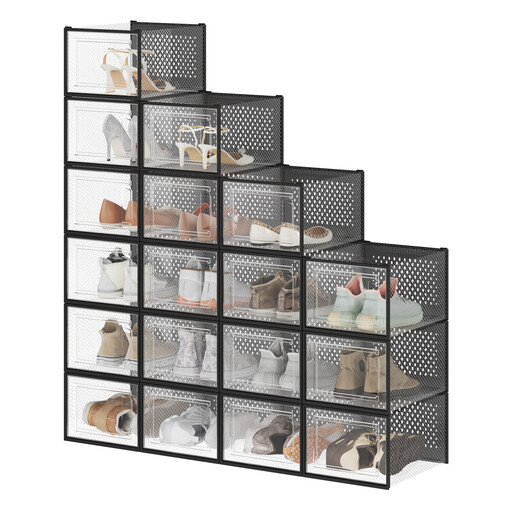
Why This Fits Their Persona: For those who see their footwear as a collection, these boxes offer protection, visibility and organisation. The uniform design allows for the creation of a clean, impressive "sneaker wall" that keeps valuable trainers dust-free and easy to admire.
It directly addresses the ventilation pitfall with built-in air holes to keep shoes fresh. The clear front door also means you don't have to unstack boxes to find the pair you want, avoiding the hassle of lift-top designs.
The large set of 18 provides excellent value and a consistent look for a growing collection. The stackable, interlocking design creates a stable structure.
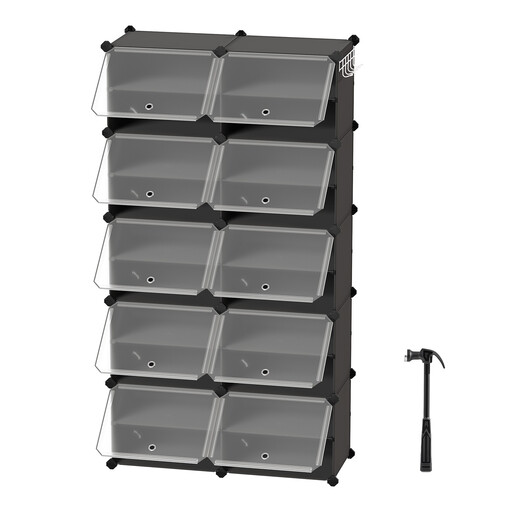
Why This Fits Their Persona: This unit is ideal for busy family homes where the entryway is a dumping ground for everything from school shoes to wellies. The doors conceal the clutter, creating a tidy first impression, while the modular design can be adapted to fit various shoe sizes.
It tackles the flimsy construction pitfall with a steel frame and durable ABS connectors. The customisable nature means you won't be stuck with compartments that are too small for boots, avoiding the misleading sizing trap.
The key benefit is its versatility. It can be assembled in different configurations to fit your space, and the included anti-tip kit provides essential safety for a household with children.

Why This Fits Their Persona: Renters need flexible solutions that don't require permanent installation and can adapt to new spaces. This DIY cube system can be built vertically to save floor space or horizontally to fit under a window or bed. It's also easy to disassemble and transport when moving house.
Its DIY nature puts you in control of the configuration, completely avoiding the "misleading capacity" trap. The robust plastic panels and metal frame offer more stability than all-plastic alternatives.
This unit is endlessly versatile. It can be used as a shoe rack, a bookshelf or even a wardrobe divider, making it a practical, long-term investment that can be repurposed as your needs change.
We have compiled a complete, real-time list of products that fully satisfy these strict selection criteria and UK safety regulations.
This depends on the design and material. Look for boxes with strong, interlocking rims designed for stacking. As a guideline, avoid stacking free-standing columns more than 8-10 boxes high to prevent instability. Always place heavier shoes at the bottom. For taller arrangements, it is safer to use a shoe storage cabinet with a supporting frame or ensure you use the anti-tip kits often supplied with modular units.
This is a very common issue. You must check the internal dimensions before you buy, as many "standard" boxes will not accommodate footwear larger than a UK size 8. Look for products specifically described as 'Large' or 'XL', or check that the internal length is greater than 30cm. A modular shoe rack with 30cm x 30cm cubes is often a more reliable choice for larger shoe sizes.
Firstly, always allow shoes to air out and dry completely before storing them. The most important feature for preventing odours is ventilation. Choose a shoe organiser with visible air holes, grilles or a slatted design. If you have an enclosed cabinet, you can add cedar blocks or activated charcoal pouches to each compartment to help absorb residual moisture and neutralise odours.