
24/7 Customer Support

Free returns

Same-day & Next-day Delivery

Quality Guaranteed

Unlock Your Welcome Offers: FREE Delivery | Up to 80% OFF | Free 30-day JoyPlus trial
Download the APP
A tidy home often starts at the front door. Yet for many of us in the UK, the entryway is a battlefield of stray trainers, work shoes and muddy boots. Finding the right shoe storage solution can feel overwhelming, but it's the key to transforming a cluttered space into an organised one.
As the Joybuy Product Recommendation Officer, my role is to help you navigate the market and find practical solutions that genuinely work for your home. Before you buy, it's crucial to be aware of a few common pitfalls that can lead to wasted money and continued frustration.
To avoid these issues, focus on a few core parameters. Getting these right ensures your chosen shoe organiser will be a lasting and effective addition to your home.
The foundation of any good storage unit is its construction. Don't just look at the photos; check the specifications for the materials used.
Always check the maximum static load capacity per shelf. A shelf rated for 10 kg is far more reliable for boots and heavy footwear than one rated for only 3 kg.
Measure your available space—height, width and depth—before you start browsing. Then, think about the types of shoes you own. A space-saving shoe rack designed for flats and trainers may not accommodate high heels or walking boots. Look at the height between shelves. A good shoe rack will offer varied spacing or enough clearance (typically over 15 cm) for bulkier footwear. For a truly organised closet shoe organiser, consider solutions that can handle different sizes and shapes.
Your storage needs may change over time. A modular shoe storage system, such as interlocking cubes, offers excellent flexibility. You can reconfigure it to fit a new space, add more units as your collection grows, or even split it into smaller organisers for different rooms. For enclosed units like shoe boxes or cabinets, look for designs that incorporate ventilation holes or breathable materials to allow air to circulate, keeping your shoes fresh.
Based on these practical criteria, here are a few options matched to different household needs.
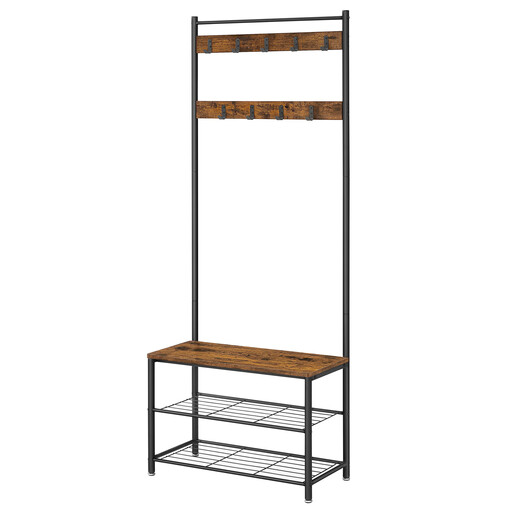
Why This Fits Their Persona: Ideal for busy UK households, this unit combines coat hooks, a sturdy bench for putting on shoes and two shelves for footwear. It's a complete hallway shoe storage solution that tidies up the most chaotic part of the home.
Its robust steel frame and particleboard bench directly counter the flimsy build pitfall. The bench has a stated weight capacity of 136 kg, providing a stable and functional surface.
3-in-1 functionality saves space and money. Includes an anti-tip kit for enhanced safety and adjustable feet for stability on uneven floors.

Why This Fits Their Persona: For those in flats or smaller rooms where floor space is at a premium, this over the door shoe organiser is a game-changer. It uses vertical, otherwise-wasted space behind a door, making it a perfect closet shoe organiser.
It sidesteps the "wrong size" pitfall by not taking up any floor space. The fabric construction is breathable, preventing the stale air and odour issue common in sealed units.
Requires zero tools for assembly and is foldable for easy moving or storage. It offers significant storage capacity without a permanent footprint.

Why This Fits Their Persona: For those with a large shoe collection or a family's worth of footwear, this modular shoe storage system provides high-capacity, customisable organisation. Each 30x30x30 cm cube is large enough for boots or multiple pairs of smaller shoes.
It defeats the "misleading capacity" myth by offering large, individual cubes. Its DIY nature means you build it to fit your space and needs, and the robust plastic panels with metal frames are far more stable than basic racks.
Endlessly expandable and customisable. The waterproof PP plastic panels are easy to wipe clean, and each cube can hold up to 10 kg.
We have compiled a complete, real-time list of products that fully satisfy these strict selection criteria and UK safety regulations.
The best prevention is to choose a unit with a sturdy frame, such as steel or solid wood. For any tall, free-standing unit, it is highly recommended to use the anti-tip kit that is often included to secure it to the wall. Also, ensure all connectors are fully inserted during assembly and place heavier shoes on the bottom shelves to lower the centre of gravity.
It depends on the organiser. Many basic shoe racks have shelves that are too close together for ankle or calf-high boots. Before buying, check the product specifications for the height between shelves. If this isn't listed, look for modular systems or shoe storage benches that typically offer more generous vertical space on at least one shelf.
This varies widely, and you should be sceptical of high numbers. The most reliable way to gauge capacity is to look at the width of the shelves. A shelf that is 70 cm wide will realistically hold about three pairs of adult men's shoes. A 117 cm shelf, like some of the larger models, could hold up to five pairs per tier. Always consider the mix of shoes you own, as boots and heels take up more space than flats.