Party hosts comparing sugar
Compare the sugars figures on current packs using the same per-100g basis, then work out how many packs or biscuits to serve.


For conventional shortbread, compare sugars on current packs per 100g, then choose a format that suits the number of guests: Waitrose lists Walker’s Wee Shorties at 16.2g sugars per 100g, while Dean’s lists its Traditional Fingers at 17.1g. Neither figure alone establishes a ‘reduced sugars’ claim. A sugar-free description for a sweetener-based shortbread is not, by itself, evidence that it qualifies for that separate claim.
Compare the sugars figures on current packs using the same per-100g basis, then work out how many packs or biscuits to serve.
Check each pack’s ingredients and allergen information. A sweetener-based biscuit and an all-butter shortbread may call for different checks.
For a birthday event at a school in England, establish how the food will be provided and check the school’s arrangements before planning the menu.
Start with comparable pack labels, then consider servings and guest requirements; a product name alone cannot settle the reduced-sugars question.
| Priority | What to check | Your needs |
|---|---|---|
| Sugars and energy | Compare sugars per 100g on current packs. Waitrose lists Walker’s Wee Shorties at 16.2g sugars and 533kcal per 100g; Dean’s lists Traditional Fingers at 17.1g sugars and 512kcal per 100g. A lower sugars figure here does not also mean lower energy. | I want to compare like quantities rather than choose by a lower-sugar impression. If a pack claims ‘reduced sugars’, I also want to know what similar product it is compared with. |
| Serving format | Check pack size and the number of servings you plan to offer. Waitrose lists Wee Shorties as six 25g packs; Walker’s lists its Mini Bag Rounds as 33 rounds in a 125g bag. | Individual packs may make distribution simpler at my party; for a shared bag, I’ll decide how to divide the biscuits before serving. |
| Ingredients and allergens | Read the exact pack’s ingredients, allergen declaration and any precautionary wording. The listed conventional shortbreads contain wheat and milk; check a sweetener-based product on its own terms. | If a guest avoids wheat or milk, I need the packaging available so they can check the biscuit being offered, not just its sugar claim. |
| School setting | For an event at an English school, establish whether the food is part of covered school provision or a celebration, and check the school’s arrangements. | If the birthday gathering is at school, I need to agree what can be brought and served before buying biscuits for the group. |
Two sugars figures do not establish that a shortbread meets the comparative claim. For Great Britain, the nutrition-claims rules published by legislation.gov.uk require a reduction of at least 30% against a similar product.
Use the exact per-100g figures for an ordinary comparison; use ‘reduced sugars’ only when the particular product’s claim is substantiated.
A sugar description does not tell you whether a biscuit contains an allergen or which sweeteners it uses.
Keep the current pack available for ingredient and allergen checks, and follow any serving warning on a sweetener-based biscuit.
England’s 2014 school-food regulations restrict biscuits in covered food provision other than school lunch, while Department for Education material distinguishes celebrations from provision covered by the standards. That is not a blanket rule for private birthday parties across the UK.
For a party at an English school, confirm the occasion and food arrangements with the school rather than assuming biscuits are either always permitted or always prohibited.
These examples identify particular products or ranges to compare; a figure for one biscuit does not apply to everything bearing the same brand.
Wee Shorties are a small-pack all-butter shortbread option listed by Waitrose.
Traditional Shortbread Fingers provide a conventional biscuit with a manufacturer-listed nutrition comparison.
A UK retailer describes Gullón Short Bread Biscuits 330g as sugar-free and sweetened with maltitol and isomalt.
Duchy Organic Highland All Butter Shortbread offers a labelled conventional comparator.
Its listed shortbread formats include an assortment and all-butter fingers, which offer different ways to serve guests.
Its shortbread category includes conventional fingers and assortments.
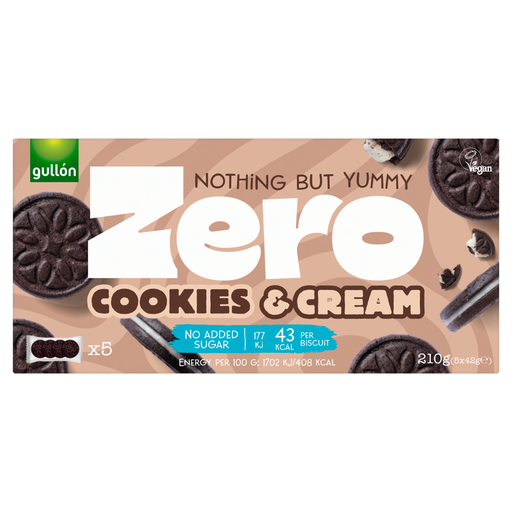
This Joybuy option is a no-added-sugar cookies-and-cream biscuit to consider alongside shortbread, not a traditional shortbread selection.
 No image available
This cookies-and-cream biscuit is an alternative to butter shortbread for a party, not a like-for-like shortbread choice. Compare its current pack’s sugars per 100g and check the ingredients and allergens before serving it. The product information warns that excessive consumption may have a laxative effect.
No. They are different claims. For Great Britain, the nutrition-claims rules published by legislation.gov.uk require a ‘reduced sugars’ comparison to show at least 30% less sugar than a similar product; a no-added-sugar or sugar-free description alone does not demonstrate that comparison.
No universal suitability follows from a sugar-free description. Check the exact pack’s ingredients and allergen information, as well as any warning about its sweeteners, before offering it to guests.
Plan the number of biscuits or packs from the servings you intend to offer, and keep the packaging available for ingredient checks. Walker’s advises storing its shortbread in a cool, dry place; Waitrose advises an airtight container once its Duchy shortbread is opened.
Not categorically. England’s 2014 school-food regulations restrict biscuits in covered provision other than school lunch, while Department for Education material describes celebrations as outside the standards. Check how the particular event is arranged and follow the school’s policy; this is not a UK-wide rule for private parties.
No. Department for Education guidance dated 14 September 2026 says changes proposed for September 2027 remain subject to parliamentary approval. For a school event now, check the currently applicable arrangements with the school.