Parents comparing holiday treats
If shortbread is an occasional treat, look at both the sugars per 100g and the amount in the biscuits you would serve. Biscuit size matters when turning a pack label into a serving decision.


Compare sugars per 100g on the exact shortbread packs, then check the sugars, energy and saturated fat in the number of biscuits you plan to serve. A sugar-free biscuit calls for a separate look at its ingredients and full nutrition label; if shortbread is optional, the NHS recommends fruit or vegetables as a snack for children. Choosing a household snack does not establish whether a biscuit meets the requirements of a school or holiday programme.
If shortbread is an occasional treat, look at both the sugars per 100g and the amount in the biscuits you would serve. Biscuit size matters when turning a pack label into a serving decision.
If avoiding sugars in the biscuit is your priority, compare the sweeteners, ingredients and full nutrition label. A sugar-free name alone does not describe the biscuit’s overall nutrition or establish whether it suits a particular child.
Check the requirements for your particular provision before choosing food to serve. The Department for Education’s England school-food guidance and its holiday activities and food programme guidance address different settings; a household snack choice is not a compliance assessment for either.
Start with the exact biscuit and the serving you have in mind. Keep a conventional shortbread comparison separate from a decision to buy a sugar-free biscuit or serve a different snack.
| Priority | What to check | Your needs |
|---|---|---|
| Sugars and serving | Compare sugars per 100g on the exact packs. Then check sugars per biscuit, biscuit weight and how many you would serve. Sainsbury’s lists 14.8g sugars per 100g and 3.0g per finger for its Highland All Butter Shortbread Fingers 200g; Walker’s lists 16.2g per 100g for its Shortbread Fingers 160g. | I want to compare recipes on the same basis without losing sight of how much shortbread goes on the plate. |
| Whole snack | Read energy and saturated fat alongside sugars for the same product and serving. If a biscuit is optional, consider a different snack: the NHS recommends fruit or vegetables for children. | A smaller sugar figure would not, by itself, answer my question about which snack to serve regularly. |
| Ingredients and allergens | Read the current pack’s ingredient and allergen information before serving it to a child with an allergy. For a sugar-free biscuit, identify its sweeteners and check for any applicable polyol warning. | If I’m choosing a sweetened alternative, I need to know what is in this particular pack, not just what its front label says. |
| Pack and storage | Check pack weight against the number of snack occasions you have planned. Read the storage directions, including what to do after opening. | For snacks across several holiday days, I want a quantity I can use while following the pack’s storage instructions. |
The checked conventional shortbread packs have different sugars-per-100g figures. That comparison does not establish a ‘low sugar’ or ‘reduced sugar’ claim, or settle the choice of snack overall.
Name the exact products and compare them on the same measurement basis. Check energy, saturated fat and the serving as well as sugars.
A sugar-free product can use sweeteners, while a listing for a different market need not describe the ingredients in the UK pack. A front-of-pack claim also leaves other nutrition and allergen information to check.
Read the UK pack’s current ingredients, nutrition and allergen information, including any applicable polyol warning. GOV.UK specifies a warning for foods containing more than 10% added polyols.
England’s retail HFSS promotion guidance, school-food guidance and holiday activities and food programme guidance address different activities. None makes the name ‘shortbread’ a product-specific compliance assessment.
For food served by a school or holiday programme, identify the setting and assess the requirements that apply to its provision. Keep that question separate from deciding what to serve at home.
These are starting points for comparing named packs and ranges, not a claim that every product from a brand has the same recipe.
Its Shortbread Fingers 160g provide a conventional all-butter comparison.
Its Shortbread Rounds 130g offer another conventional recipe to compare.
Its all-butter shortbread range includes an assortment as well as individual shapes.
Its shortbread range includes own-label fingers and products from other makers.
Its shortbread range includes fingers and other styles.
Its Highland All Butter Shortbread Fingers 200g show both per-100g and per-biscuit sugars.
A UK retailer lists Gullón Sugar Free Shortbread Biscuits 330g for those considering a sweetened alternative to conventional shortbread.
This cookies-and-cream biscuit offers a no-added-sugar option to consider alongside shortbread. It is not shortbread, so compare its own label rather than treating it as a like-for-like shortbread recipe.
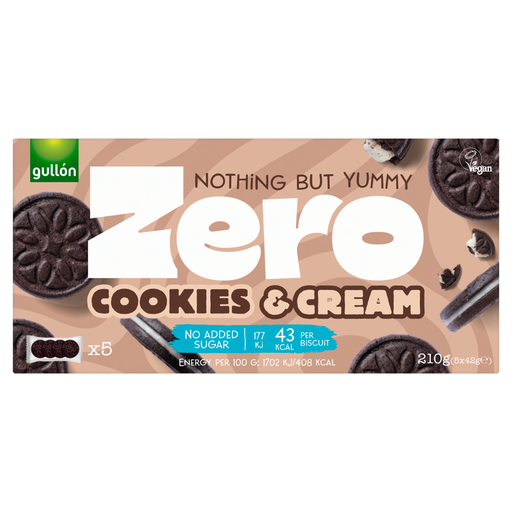 Image unavailable
For a family considering a no-added-sugar biscuit instead of shortbread, this is a cookies-and-cream product in a 210g pack. Before serving it to a child, compare its sugars, energy and saturated fat for the amount offered, and read its ingredients, allergen information and any sweetener warning on the pack.
A sugar-free name does not establish a lower energy figure. Compare energy, sugars, saturated fat and serving size on the exact pack; the UK listing for Gullón Sugar Free Shortbread Biscuits 330g identifies the sweeteners maltitol and isomalt.
Read the current pack’s ingredients and allergen information for the child concerned. The checked conventional shortbread includes wheat and milk, but allergen and precautionary information must be checked for the particular product you serve.
Follow the directions on that pack. For its Highland All Butter Shortbread Fingers 200g, Sainsbury’s advises a cool, dry place and an airtight container after opening.
No general household prohibition follows from the Department of Health and Social Care’s England HFSS retail guidance: it addresses promotion and placement by affected businesses. Food provided in schools or holiday programmes raises separate setting-specific questions, and a biscuit’s name or sugar figure alone does not establish its HFSS classification.
No. Department for Education guidance dated 14 September 2026 says the proposed changes are subject to Parliamentary approval and would come into force from September 2027. Do not treat those proposed changes as current requirements when assessing food for a school setting.