
24/7 Customer Support

Free returns

Same-day & Next-day Delivery

Quality Guaranteed

Unlock Your Welcome Offers: FREE Delivery | Up to 80% OFF | Free 30-day JoyPlus trial
Download the APP
A side table can solve a surprisingly specific furniture problem: somewhere to place a mug beside the sofa, a lamp next to an armchair or a book and phone within reach of the bed. However, attractive photographs do not always reveal whether a table will work in a real UK home.
Before buying a side table, watch for three common traps:
The right choice depends on the table’s dimensions, construction and intended position. The following guide explains the key details to check before comparing a round side table, square side table, bedside table or lamp table.
Measure the available floor area, then compare it with the table’s assembled height, width and depth. A side table beside a sofa is generally more convenient when its surface is close to the sofa arm, as this reduces awkward reaching. A bedside table should also leave enough space for opening drawers, walking around the bed and accessing sockets.
For narrow rooms or rented flats, a compact occasional table with a small footprint may be more practical than a wide cabinet. A round side table can help soften a tight corner because it has no projecting corners, while a square side table may use a corner more efficiently.
Also check:
Do not judge strength by appearance alone. Look for stated materials, product weight and any listed capacity. A pine side table can provide a warm, natural finish, while a black metal side table may suit industrial or contemporary interiors. The important point is whether the frame and tabletop are appropriate for your intended use.
For example, a table holding a reading lamp, books and drinks needs a stable base rather than simply a fashionable finish. If a product requires self-assembly, tighten every fixing evenly and recheck the joints after positioning it.
For UK household use, follow the supplied assembly and safety instructions. Place furniture on a flat, even surface, avoid overloading it and check that it does not rock before putting items on top. Product information should also clearly identify materials, dimensions, warnings and care instructions.
A side table with storage basket is useful for blankets, magazines, remote controls or children’s items, provided the basket can be removed or reached without moving the whole table. A side table with lower shelf is often better for books, ornaments and storage boxes that you want to see and access quickly.
Consider the maintenance needs too. Fabric baskets may require gentler cleaning than sealed wood or metal. Natural wood surfaces should generally be wiped with a soft, dry cloth unless the manufacturer provides different care advice. Avoid harsh chemicals that could mark the finish.
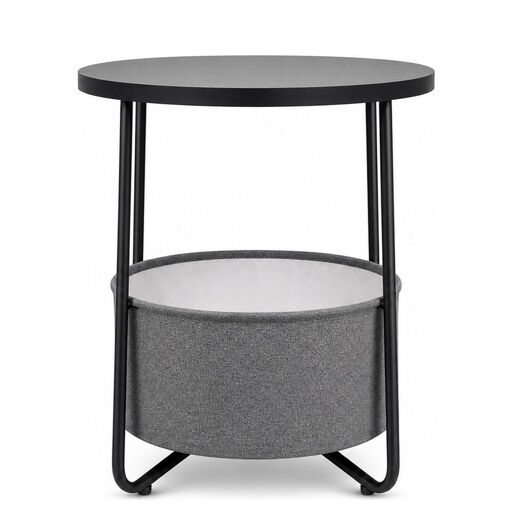
Why This Fits Their Persona: The 45 x 50 cm format is suited to first homes, rented rooms and compact living areas where a separate storage unit may take up too much floor space.
Its listed round shape and compact dimensions make it easier to assess for tight spaces, while the fabric basket provides a defined place for smaller items.
45 x 50 cm dimensions; integrated fabric storage basket; black colour suits neutral or industrial-inspired rooms.

Why This Fits Their Persona: Buyers who want a defined furniture style and practical construction may appreciate the combination of a rustic pine finish, geometric black frame and full-size lower shelf.
The stated 45 x 45 x 45 cm dimensions, materials and 50 kg capacity give shoppers clearer information than relying on styling photographs alone.
Pine and pine veneer surfaces; black metal frame; integrated lower shelf; stated 50 kg product capacity.
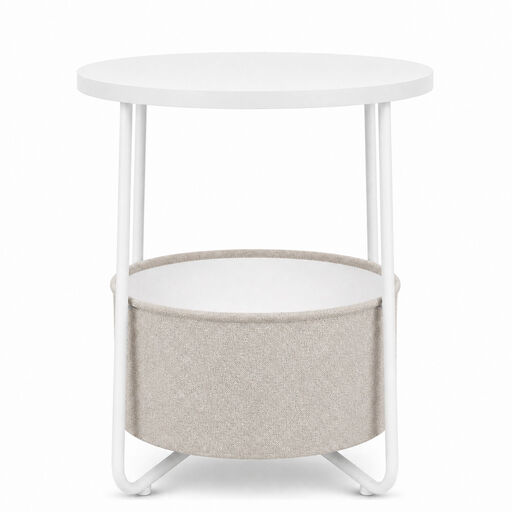
Why This Fits Their Persona: This option suits households needing a nearby surface and concealed storage for everyday living-room or bedroom clutter without selecting a square, hard-edged design.
The basket separates storage from the tabletop, helping keep frequently used belongings off the surface while the round footprint reduces corner impacts.
45 x 50 cm format; fabric storage basket; white finish can brighten a darker room or complement contemporary décor.
A rustic side table with pine tones works naturally beside leather seating, woven textures and warm lighting. An industrial side table combining wood and black metal can coordinate with shelving, dark window frames or simple monochrome décor. For a bedside table, prioritise surface height, cable access and enough room for a lamp rather than choosing solely by colour.
Assemble the table before placing it in its final position. Use the supplied instructions, tighten fittings securely and avoid dragging the furniture across flooring. Felt pads can help protect hard floors, but check that they do not make the table unstable. Wipe spills promptly, particularly on untreated or textured wood surfaces.
We have compiled a complete, real-time list of products that fully satisfy these strict selection criteria and UK safety regulations.
A practical starting point is to choose a tabletop close to the height of the sofa arm. Measure from the floor to the top of the arm, then compare this figure with the product’s assembled height. Your preferred reach and the sofa design also matter.
Yes, if its height, footprint and stability suit the bed. Check that the surface leaves room for a lamp, phone or glass of water, and confirm that the table does not obstruct walking space or drawers. A round design can be useful where corners would project into a narrow route.
Lifespan depends on materials, assembly, load and daily care. A stable frame, correctly tightened fixings and appropriate use can help maintain the table. Avoid exceeding the stated capacity, placing it on an uneven floor or using indoor furniture outdoors, where moisture and temperature changes may damage the finish.