
24/7 Customer Support

Free returns

Same-day & Next-day Delivery

Quality Guaranteed

Unlock Your Welcome Offers: FREE Delivery | Up to 80% OFF | Free 30-day JoyPlus trial
Download the APP
Sideboards can add useful storage and a finished look to a home, but an attractive photograph does not always reveal whether a piece will suit your room. The wrong depth can obstruct a walkway, shallow shelves may not hold dinnerware and a wood-effect finish can be mistaken for solid timber.
Before comparing sideboards, look beyond colour and styling. Focus on the construction, measurements, storage layout and installation requirements. This helps UK homeowners, renters and interior-conscious shoppers find a piece that works in everyday use rather than simply matching a room set.
Terms such as “oak finish”, “oak effect” and “wood grain finish” describe appearance rather than necessarily meaning solid oak. A solid wood sideboard will usually identify the timber used, while engineered wood, particleboard and fibreboard may be used for panels, shelves or drawer bases.
Neither option is automatically unsuitable. Engineered wood can offer a consistent finish and manageable price, while wooden sideboards made from pine or oak can provide visible grain and a more natural appearance. Check the full materials description instead of relying on the product title.
A sideboard may fit along a wall but still make a room difficult to use if it projects too far. Measure the available wall, skirting board position, sockets and nearby doors. Allow enough space for drawers and doors to open fully.
For a hallway sideboard, also check the remaining walking width. In a dining room, consider the clearance needed when chairs are pulled back. A compact sideboard cabinet can be more practical than a larger model that restricts movement.
Shelves, drawers and tops often have different weight limits. Dinnerware, small appliances and books can become heavy when grouped together. Always check the stated capacity and place heavier belongings in lower compartments where possible.
Tall or wide storage furniture should stand on a flat, level surface. Where an anti-tip kit is supplied, follow the manufacturer’s instructions and secure the unit to a suitable wall. Keep children away from climbing on doors or drawers during everyday use.
For a natural timber look, compare a solid pine sideboard, oak sideboard or other clearly specified wooden construction. Pine can show knots and grain variation, so each piece may have a slightly different appearance. Stained finishes can deepen the colour while still allowing some grain to show.
Engineered wood and particleboard models may offer a smooth, uniform surface. Look for details about veneer, melamine, paper finish or laminate, particularly if the sideboard will be used near kitchen splashes. Wipe surfaces with a soft, dry or lightly damp cloth according to the care instructions and avoid prolonged moisture.
Think about what the furniture needs to store:
For a dining room sideboard, measure plates, serving dishes and glassware before ordering. In a living room, consider whether the unit will hold media accessories, books or decorative pieces. A kitchen sideboard may need wipe-clean surfaces and enough ventilation around appliances.
Record the maximum width, height and depth, then compare those figures with your room measurements. Also check the delivery format. Many sideboards arrive flat-packed and require self-assembly, so allow floor space for construction and confirm that the finished product can pass through doorways and stairwells.
Instructions, labelled parts and included hardware can make assembly more manageable, but careful fitting remains important. Recheck hinges, drawer runners and shelf supports before loading the cabinet. If the manufacturer specifies a wall fixing, treat it as an essential safety step rather than an optional extra.

Why This Fits Their Persona: Its 78.4 x 39.8 x 74.2 cm size and dusty grey oak finish suit renters or first-home owners seeking flexible storage for a living room, kitchen or hallway.
The materials are identified as engineered wood, rather than implying solid oak. An adjustable shelf helps avoid wasted internal space.
One door, three drawers and adjustable shelving provide several storage zones; the product includes labelled parts and assembly instructions.

Why This Fits Their Persona: Shoppers seeking a Scandinavian sideboard with a light, natural appearance may prefer its oak construction, white contrasting fronts and gently curved edges.
The description identifies the construction and storage layout clearly, while the 115 cm width and 36 kg product weight help set realistic expectations before delivery.
Two drawers and one hinged cabinet separate smaller and larger belongings; the light oak and white combination works with modern interiors.
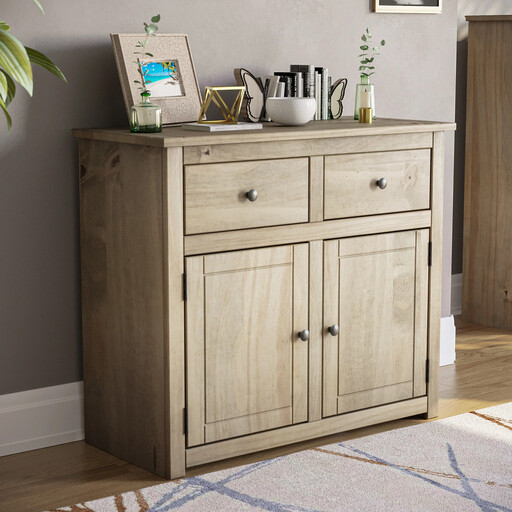
Why This Fits Their Persona: Its 93 x 40 x 80 cm format suits dining rooms, hallways and home offices where concealed storage and a usable display surface are required.
The listing specifies solid pine, an oak stain, two drawers and two lower cabinets. Each drawer and shelf has a stated 5 kg capacity.
Solid pine frame, doors and drawer fronts provide a timber-led design; the supplied anti-tip kit supports secure installation.
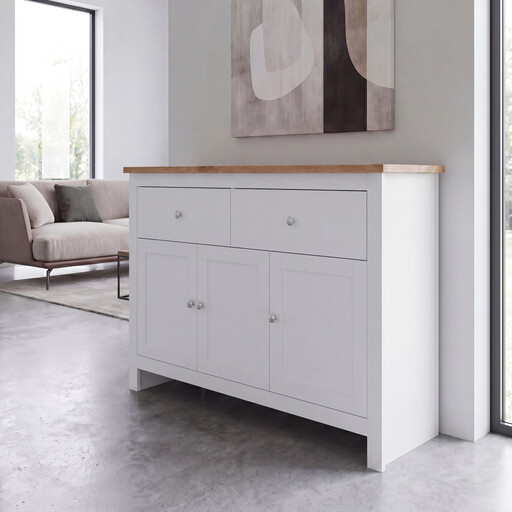
Why This Fits Their Persona: This 128 cm-wide unit is intended for a living-room media arrangement, including televisions up to 60 inches and related accessories.
The product is described as a white/oak-effect finish, so buyers can distinguish its appearance from solid timber. The 15 kg tabletop and 5 kg shelf limits are stated.
Enclosed compartments hide accessories, while open shelving provides access to consoles or media players; a cable cut-out supports tidier wiring.
We have compiled a complete, real-time list of products that fully satisfy these strict selection criteria and UK safety regulations.
Yes, provided the depth leaves comfortable walking clearance and doors or drawers do not obstruct entrances. A hallway sideboard with drawers can store keys, post and accessories, while a cabinet with doors hides larger household items. Measure the passageway and consider nearby door swing before buying.
Longevity depends on materials, assembly, loading and everyday care. Solid timber models can be maintained and may develop natural character, while engineered wood requires protection from moisture and excessive loads. Correct wall fixing, level positioning and regular inspection of hinges and drawer runners can help preserve safe operation.
Most sideboards have no running costs because they are passive storage furniture. A media-oriented model may hold electrical equipment, but the unit itself does not consume power. Keep ventilation and cable access in mind when placing consoles, routers or other devices inside or around a living room storage cabinet.