Late-night flat-film hosts
When a film has no dialogue to mask the projector fan, you want to check operating noise and find a listening arrangement that will not disturb flatmates.


For a shared room that cannot be fully darkened, consider a brighter Full HD mains projector; if you need to move it between rooms or put it away after each screening, consider a portable model instead. For silent-film nights, check fan noise in the mode you would use, alongside placement, private-listening options and compatibility with your film source.
When a film has no dialogue to mask the projector fan, you want to check operating noise and find a listening arrangement that will not disturb flatmates.
If you cannot leave equipment installed, carrying weight, temporary placement, projection angle and the need for a nearby socket affect how easily you can use it.
If the lounge cannot be fully darkened, stated brightness and picture detail deserve attention before you choose a projector for its small size.
Start with the room: decide how dark it can be and where a projector could sit. Then check the operating mode, listening arrangement and film-source connection that your screenings would require.
| Concern | What to check | Who this matters to |
|---|---|---|
| Late-night noise | Compare stated fan noise in normal and quieter modes, and check whether the quieter mode remains bright enough. Confirm an appropriate private-listening connection. | If I watch after my flatmates have gone to bed, fan sound and low-volume listening come before a larger picture. Around 31% of consumers would put considerate late-night operation first. |
| Temporary setup | Check carrying weight, whether a battery is included, projection-angle adjustment and the image size possible from your planned position. | When I have to clear the room after the film, I need a projector I can place and store without a permanent mount. For roughly 25% of consumers, that flexibility is the primary concern. |
| Ambient light | Check the stated brightness measure, usable operating mode and intended screen size; establish whether the room can be darkened. | If the communal room stays partly lit, I need to judge whether the picture will work there before choosing a compact unit. Picture usability in that light comes first for around 25% of consumers. |
| Picture and source | Distinguish native from supported resolution, and confirm a connection that works with the laptop, player or streaming device you intend to use. | For films with intertitles, I care about readable detail and a dependable route from my film source. Approximately 19% of consumers would make picture detail and connectivity their first priority. |
A small unit may be convenient to move, but that does not establish how its image will look with the room lights on. Brightness figures also need their measurement labels to be meaningful.
Decide how much you can darken the room, then compare clearly labelled brightness specifications for the screen size and operating mode you plan to use.
If you cannot sufficiently darken or use the available wall, you may need blackout blinds or a separate projection surface.
Without dialogue, projector noise can be more noticeable. Epson United Kingdom specifies 37 dB(A) in Normal mode and 29 dB(A) in Economy mode for the CO-FH02; those figures describe different operating modes.
Check noise for the mode you would actually use, and whether its picture remains suitable at your planned size and room lighting.
BenQ UK has published a GV31 recall notification, while ViewSonic United Kingdom labels its M1 Pro page archived. A specification that suits your setup does not settle a model-specific support or recall question.
Check the exact model on the manufacturer's support and recall pages before buying, and follow any applicable manufacturer instructions.
A projector's power arrangement and the identity of its seller matter as well as its picture specifications. Electrical Safety First advises buying electrical goods from reputable retailers.
Check the seller, the power supply and UK plug arrangement for the exact product, and keep its documentation and proof of purchase.
The CO-FH02 illustrates a mains-powered Full HD option to consider when a shared room has some ambient light.
The Freestyle 2nd Gen illustrates temporary, angle-flexible placement for renters moving a projector between rooms.
The M1 Pro provides a portable LED specification reference for a room that can be darkened.
These portable projector listings are relevant if temporary placement is important in your shared flat. Check noise, room-light suitability and the exact film-source connection before choosing among them.
 No image available
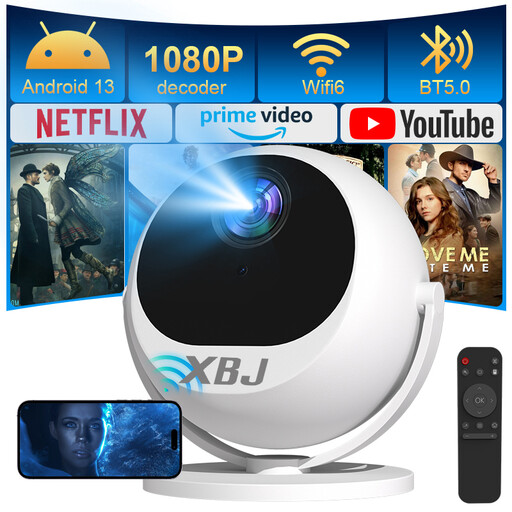
Consider this model if you need temporary wall or ceiling placement and want to check a Bluetooth listening option for late films.
 No image available
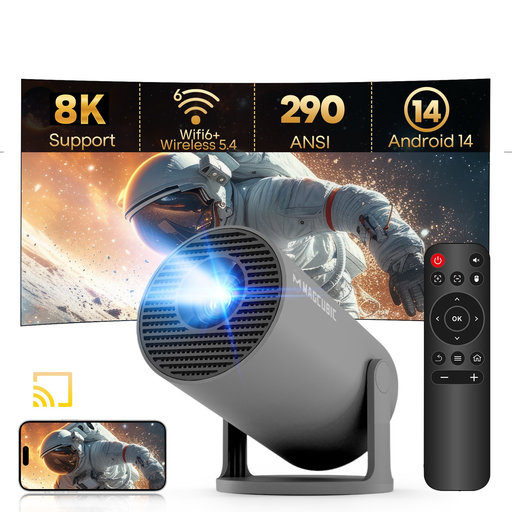
Consider this model when you need to move the projector and adjust its angle for a temporary screening spot.
 No image available
Consider this listing if native Full HD and a planned HDMI or USB film source are priorities, while checking that its placement suits your room.
 No image available
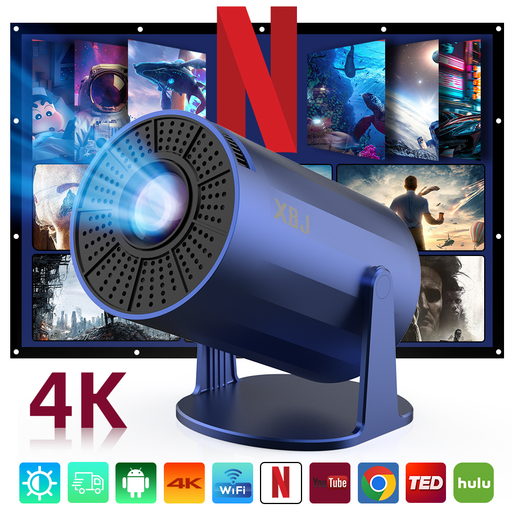
Consider this model for a temporary setup near a power socket, rather than for a screening position without one.
The projector itself does not determine whether you need a TV Licence. TV Licensing says a licence is required for watching or recording live TV on a TV or streaming service, or for using BBC iPlayer; watching only on-demand programmes on other services does not require one on that basis.
Check the seller, the exact model and its power arrangement before purchasing. Electrical Safety First advises using reputable retailers for electrical goods; also confirm the UK plug arrangement, check for a model-specific recall and retain the product documentation.
Check both your tenancy terms and the specific projector's installation instructions before drilling or mounting anything. An adjustable portable projector can offer temporary placement, but an adjustable stand does not establish that the unit is suitable for ceiling mounting.