What to prioritise
Choose the screen format for the space you can actually measure, then weigh wet-scene presentation against the care involved in long sessions.
27-inch QHD OLED
Choose it when: A compact single screen and OLED contrast for darker track scenes matter more to you than a wider view.
Accept: Static HUDs call for panel care, and a glossy model such as the ASUS ROG Strix OLED XG27AQDMG may require attention to room reflections.
27-inch QHD IPS
Choose it when: You want a compact high-refresh screen without OLED-specific static-image care.
Accept: IPS does not offer OLED's self-emissive black-level contrast; the refresh rate you can use may also depend on the connection.
34-inch 21:9 OLED
Choose it when: You have room for a wider single screen and value more horizontal track context.
Accept: A 3440 × 1440 image places more rendering demand on the PC than 2560 × 1440, while OLED HUD care still applies.
| Concern |
What to check |
Who this matters to |
| Physical fit |
Measure desk or rig width, depth and wheel-base clearance. Compare them with dimensions including the stand, or check a suitable mounting arrangement. |
I need to place one screen without crowding my wheel or viewing position. Around 38% of consumers put physical fit first. |
| Wet-scene detail and motion |
Check the intended resolution and refresh rate at your chosen input, plus monitor and graphics-hardware support for variable refresh rate. |
When braking references move through spray and reflections, I want the display mode to match what my game system can deliver; around 31% of consumers prioritise this visual need. |
| Long-session use |
For OLED, read the panel-care guidance for persistent HUDs. For any panel, confirm the source device, cable and input can provide your intended mode. |
I leave timing overlays or desktop windows open and want a screen I can use with an acceptable care routine. Long-session practicality comes first for around 31% of consumers. |
Compact-screen options on Joybuy
These 26.5- and 27-inch single-screen options cover OLED and IPS choices for a space-conscious racing setup. The LG 27G850A uses a 4K format rather than the QHD starting point, so check your PC's intended game settings as well as the screen's physical fit.
 Image unavailable
MAG 274QP QD-OLED X24 27-inch QHD monitor
Consider this single-screen OLED option if QHD detail and a high refresh rate matter for following moving track references. Its title specifies 2560 × 1440, 240Hz, 0.03ms response and Adaptive-Sync; check the mode your PC and chosen connection can deliver. Plan for OLED care if a static racing HUD stays visible for long periods.
View on Joybuy
 Image unavailable
Samsung Odyssey G6 S27DG612 27-inch QHD OLED monitor
This is another 27-inch OLED choice for a single-screen setup where contrast and motion are priorities. Its title specifies QHD, 240Hz and 0.03ms response. Compare the full stand footprint with your rig, confirm the mode available through your connection and follow OLED-care guidance for persistent HUDs.
View on Joybuy
 Image unavailable
Acer X Predator X27U W3 26.5-inch QD-OLED monitor
Consider this QHD OLED model if a 26.5-inch screen format suits your single-monitor rig. Its title specifies 2560 × 1440, 240Hz, 0.03ms response, FreeSync Premium Pro and G-SYNC Compatible support. Check its complete stand dimensions and per-input refresh limits before ordering, and account for care around static HUDs.
View on Joybuy
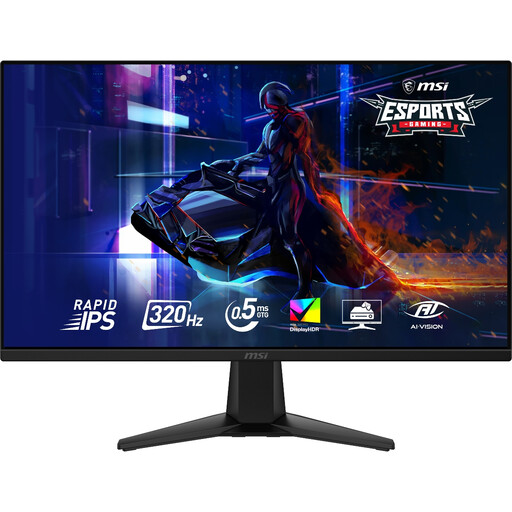 Image unavailable
MAG 275QF X32 27-inch QHD Rapid IPS monitor
The Rapid IPS panel makes this a compact route if avoiding OLED-specific HUD care matters more to you. Its title specifies 2560 × 1440, 320Hz, 0.5ms response and Adaptive-Sync. Check the refresh rate supported by your chosen input, cable and game system rather than assuming you can use the headline rate.
View on Joybuy
 Image unavailable
LG UltraGear G8 27G850A 27-inch 4K Nano IPS monitor
This is a 27-inch non-OLED alternative if you want to consider 4K rather than the QHD starting point. Its title lists dual-mode 240Hz/480Hz operation, FreeSync Premium Pro, DisplayPort 2.1 and HDMI 2.1. Check which resolution and refresh combinations your intended input and PC can run, and measure the complete stand footprint for your rig.
View on Joybuy
Questions before you buy
Will a high-refresh monitor automatically run at its advertised rate?
No: the available mode depends on the monitor input, cable and source device. Dell lists the Alienware AW2725DM at up to 180Hz through DisplayPort but up to 144Hz through HDMI. For variable refresh rate, ZOWIE also notes that the graphics card must output a compatible signal.
Does a persistent racing HUD rule out OLED?
Not necessarily, but static-image care should be part of an OLED purchase decision. PC Monitors identifies image retention and burn-in as potential OLED risks. Follow the chosen model's care guidance, or compare IPS if avoiding that routine is a higher priority than OLED contrast.
Should I choose a 34-inch ultrawide for a small racing rig?
Choose one only after measuring the rig and checking PC performance at its resolution. LG lists the 34GX900A-B at 3440 × 1440 in a 21:9 format, which gives a wider image but needs more physical clearance and involves more pixels than a 2560 × 1440 screen.
What should I do with an old monitor in the UK?
Check your local authority's or retailer's electrical-equipment collection options before disposing of it. GOV.UK identifies the Waste Electrical and Electronic Equipment Regulations 2013, as amended, as the UK legislation underpinning measures for recovering, reusing and recycling electrical equipment.


