What matters when choosing?
Decide whether assembly support or control over the exact components matters more to you, then assess either route against the same display and race-session workload.
Ready-made or configured PC
Choose it when: You want one seller to assemble the system and provide its stated support, and you can confirm the exact configuration before ordering.
Accept that: Component choices and service arrangements vary by system; a headline warranty duration does not tell you how faults are handled throughout its term.
Self-built desktop
Choose it when: You want to select the exact parts and are prepared to assemble a compatible system.
Accept that: Checking fit, connections and power—and identifying which component caused a fault—becomes your responsibility.
| Concern |
What to check |
Who this matters to |
| Existing display workload |
Note the native resolution, refresh rate and intended graphics settings. Seek game benchmarks at comparable settings rather than relying on minimum requirements. |
If I want to keep using my ultrawide at its native settings, a PC’s performance in a different display setup tells me little about my target. About 36% of consumers put matching the existing display workload first. |
| Populated race sessions |
Look for results from the intended sim under a comparable race load; assess the CPU alongside the GPU. |
Solo practice is not the session I care most about if I race with a full grid. For about 29% of consumers, consistent performance in populated races is the primary need. |
| Assembly and support |
For a ready-made PC, compare the exact system’s parts, labour, collection and upgrade terms. For a self-build, plan for assembly and component-level fault-finding. |
I would rather have a clear route for dealing with a fault than choose every part myself. That support-led decision comes first for about 21% of consumers. |
| Display compromises |
Decide whether lower rendering quality or a lower frame-rate target is acceptable before assessing a less demanding PC configuration. |
If I can accept a change to how games look or run on my current display, I can assess PCs against that revised target. Roughly 14% of consumers make that compromise their primary concern. |
iRacing explains that resolution scaling reduces graphics-card processing demand but lowers image quality and does not reduce CPU load. Changing the rendering target therefore does not, by itself, resolve a CPU limitation in a crowded race.
Brands to consider for a ready-made PC
These system builders offer different configuration and support arrangements; compare the terms attached to the particular PC you are considering.
Scan 3XS
A configured or ready-made desktop route for buyers who want a published system-support structure.
- Scan states that its 3XS desktop warranty includes first-year onsite parts and labour cover.
- Scan describes years two and three as return-to-base parts and labour cover, rather than continued onsite service. Check eligibility for the exact system and location.
Overclockers UK
A ready-made or configured-system route for buyers considering collect-and-return support or a seller-installed upgrade.
- Overclockers UK states that its standard PC-system warranty provides three years of collect-and-return cover including parts and labour, and offers a labour-free upgrade service during the warranty period.
- Its support information specifies UK Mainland for collection. Check the selected system’s terms and geographic eligibility.
PCSpecialist
A configurable desktop route for buyers who want to choose core parts before assembly.
- PCSpecialist publishes warranty tiers with separate parts, labour and collection periods. Its FAQ says its open-case warranty permits correctly installed customer components that do not cause damage.
- The selected warranty tier and its exclusions determine the cover; check them before planning an upgrade.
Chillblast
A ready-made or custom-PC route for buyers comparing longer stated support periods.
- Chillblast states that the first three years of its PC warranty include parts and labour, collection, repair or replacement, and return.
- Chillblast describes the final two years as labour-only, return-to-base cover. Check the exact system’s specification and terms separately.
Ready-made PCs on Joybuy
These ready-made desktops offer starting points for someone using an existing sim-racing display. Their listed parts do not establish a frame rate for your games, resolution or race conditions; check matching performance evidence and the connections you need before choosing.
 Image unavailable
CyberPowerPC JOYB1010 gaming desktop
Consider this ready-made desktop if you want to avoid assembly while assessing a discrete-GPU configuration for your existing display.
Listed configuration: Intel Core Ultra 7 265KF, NVIDIA GeForce RTX 5070 12GB, 32GB DDR5, 1TB NVMe SSD and Windows 11 Home. The monitor is not included. Confirm the graphics-card connections, system warranty and performance under your intended race conditions.
View on Joybuy
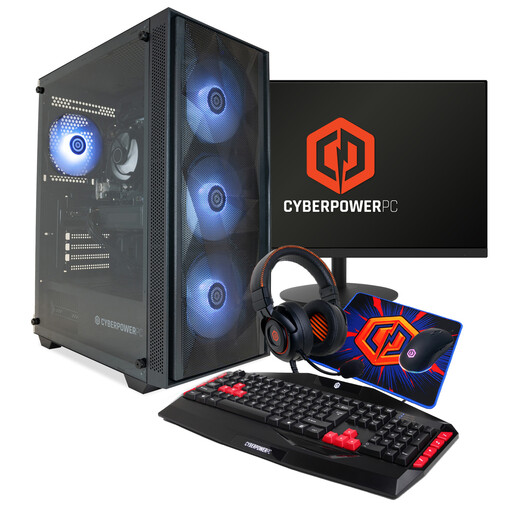 Image unavailable
CyberPowerPC JOYB1004 gaming PC bundle
Consider the bundle if you also need peripherals, but assess the PC against the ultrawide you already own rather than assuming the bundled monitor matches it.
Listed configuration: AMD Ryzen 5 7500F, NVIDIA GeForce RTX 5060 8GB, 16GB DDR5, 1TB NVMe SSD and Windows 11 Home, with a monitor, keyboard, mouse, headset and mousepad. Confirm the supplied monitor’s model and connections, the system warranty and performance at your intended settings.
View on Joybuy
 Image unavailable
Stormforce Defiance Ryzen 7 5700X, RTX 5070
Consider this ready-made desktop if its listed memory and storage suit your wider PC use, while assessing racing performance separately.
Listed configuration: AMD Ryzen 7 5700X, 32GB RAM, 2TB SSD, RTX 5070 and Windows 11. Check the exact display outputs, power-supply specification, case dimensions and warranty, then seek game results matching your display and race conditions.
View on Joybuy
Common questions
Can I choose an ultrawide sim-racing PC from minimum game requirements?
No: minimum requirements are a starting point for running the game, not proof of your chosen ultrawide frame rate. iRacing says its minimum specification produces minimum graphics in test mode, while Electronic Arts’ F1 25 requirements do not establish a result for your particular display resolution and refresh target.
Should I use solo-practice results to judge online races?
Use results from comparable populated races where possible. iRacing says a full grid can produce a lower frame rate than a solo test or time trial, so match the car count, game settings and display resolution as closely as you can.
Where do ultrawide or triple-monitor cables connect?
Connect them to the dedicated graphics card rather than the motherboard’s video outputs. For a three-monitor setup, also check that the exact card has the connections required by your displays; iRacing’s setup guidance describes both windowed spanning and combined virtual-display approaches.
What should I check before selecting parts for a self-build?
Check the exact graphics card’s dimensions, required power connections and the space available in the case, alongside the power supply’s rating and cables. NVIDIA’s RTX 5070 Founders Edition guide specifies a 244 mm × 112 mm × 41 mm card envelope and a 650 W minimum power supply for that model; use the documentation for your chosen card rather than applying those figures to every variant.
Does a longer PC warranty always mean more convenient repairs?
No. Scan 3XS describes first-year onsite service followed by return-to-base cover in years two and three; Chillblast describes three years including collection and return followed by two years of labour-only return-to-base cover. Compare the parts, labour, transport and location terms for the exact system you would buy.


