Solo weekend breakfast shoppers
For people who want one straightforward bowl at home and need to decide whether individual portions are worth buying instead of measuring from a smaller resealable bag.


Choose Alpen Original 45g sachets when you need a sealed, pre-measured portion and can use a 30-sachet box. Choose a 500g–550g standard bag when you are happy to measure your own bowl and prefer a smaller multi-serve pack; check the current label for gluten-containing cereals, milk and nuts before buying.
For people who want one straightforward bowl at home and need to decide whether individual portions are worth buying instead of measuring from a smaller resealable bag.
For occasional breakfasts or shared breakfast areas where sealed portions may be more convenient than keeping an opened cereal bag. Alpen sachets are individually wrapped in 45g portions.
For shoppers who need to compare cereal grains, milk, nuts and any trace-allergen statements before choosing a muesli recipe.
Choose this when: You want a sealed portion with no measuring and little need to store an opened pack.
Bear in mind: The available Alpen format is a 30-sachet box and contains wheat, oats, milk and nuts.
Choose this when: You prefer a conventional bag for occasional weekend breakfasts and have room to store it after opening.
Bear in mind: It is still multi-serve, so you will need to measure each bowl and reseal the pack.
Choose this when: Muesli is eaten regularly or shared with others and a compact pack is not essential.
Bear in mind: It needs storage and home portioning, and recipe allergens vary between products.
| Priority | What to check | Your needs |
|---|---|---|
| Portion format | Check whether the product is an individually wrapped sachet or a multi-serve bag. Compare the stated serving basis with the amount you plan to pour. | A sealed 45g sachet suits a one-bowl breakfast with no measuring. A 500g–550g bag is smaller than a 1kg format, but I would still portion it at home. |
| Ingredients and allergens | Read the current ingredient list and allergen statement. Check for gluten-containing cereals, milk, almonds, hazelnuts, other nuts and trace warnings where relevant. | I need a recipe that fits the ingredients I avoid, rather than assuming all muesli has the same cereal or nut content. |
| Nutrition comparison | Compare sugars and fibre using the same basis, such as per 100g and per serving. Treat no-added-sugar wording separately from the sugars value on the nutrition panel. | I want to compare the bowl I will actually eat, especially when products use different serving sizes such as 45g or 50g. |
A 500g–550g muesli pack is still a multi-serve bag. Unlike a 45g Alpen sachet, it needs measuring and resealing after opening.
Choose sachets only when sealed, pre-measured portions matter; otherwise, use the stated serving size as a practical starting point for a smaller conventional bag.
Muesli recipes may include wheat, oats, barley, rye, milk, almonds, hazelnuts and other nuts, and some packs carry trace-allergen warnings.
Read the current physical-pack ingredients and allergen statement before purchase and before eating, especially if an allergy or dietary exclusion is involved.
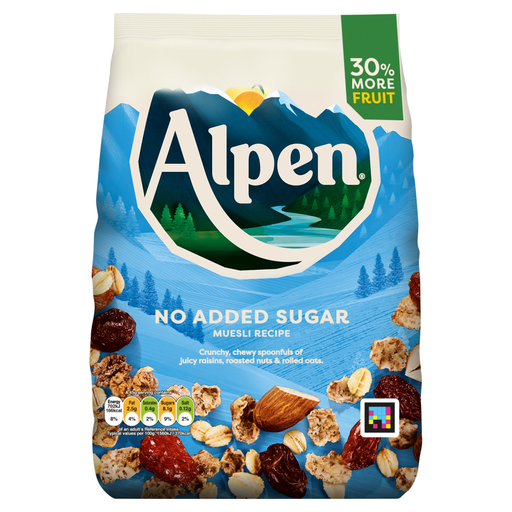
A no-added-sugar muesli can still contain sugars from ingredients such as raisins. Tesco Swiss Style No Added Sugar Muesli lists 6.7g sugars per 50g serving.
Compare sugars per serving and per 100g, keeping the serving basis consistent across the products you are considering.
Individually wrapped sachets can be practical for repeated breakfasts, but a catering-style box may be more than an occasional solo shopper needs.
Think about how many breakfasts you expect to make before choosing a portion-pack box instead of a standard bag.
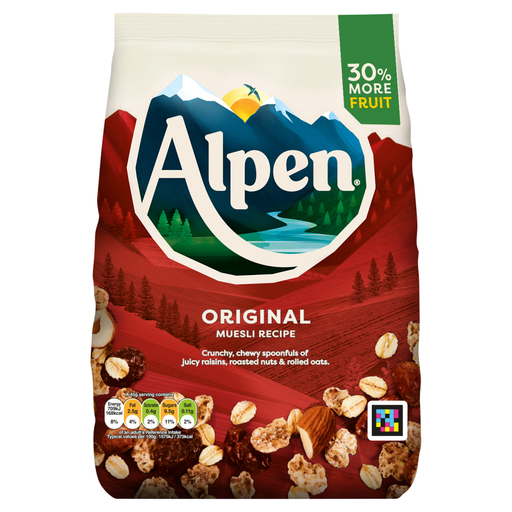
A relevant option for this topic because Alpen Original is sold both as conventional muesli and as 45g individually wrapped sachets in 30-packs.
A conventional-bag choice for shoppers comparing fruit, nut or toasted-flake recipes rather than looking for individually wrapped portions.
A standard-bag option for shoppers looking for a recipe with wholegrain cereals, dried fruit and nuts.
A recipe-led organic, plant-based muesli option with a broad mix of grains, fruit, nuts and seeds.
Own-label standard-bag options for shoppers willing to portion muesli at home.
A breakfast-cereal brand whose current online range is primarily presented around granola and lower-sugar cereal options.
These Joybuy options are standard multi-serve muesli bags for home portioning, rather than individually wrapped single-serve sachets.
 No image available
A standard bag for regular or shared weekend breakfasts when measuring portions and storing an opened pack are acceptable.
950g multi-serve muesli with a stated 45g serving reference; the listing names wholegrain wheat, rolled oats, raisins, almonds and hazelnuts.
Contains wheat, oats, milk, almonds and hazelnuts, and may contain other nuts. Check the current physical pack before consumption.
 No image available
A conventional muesli box for regular use or sharing when you do not need a sealed one-bowl portion.
950g multi-serve muesli with a stated 45g serving reference, combining wholegrain wheat and oats with raisins, almonds and hazelnuts.
Contains gluten from wheat and oats, milk, almonds and hazelnuts, and may contain other nuts. Check the current physical pack before consumption.
Yes. Alpen Original is sold by UK portion-pack retailers as a box of 30 individually wrapped 45g sachets. It is a bulk box, so it makes most sense when you will use several portions over time or serve more than one person.
No. A 45g sachet is Alpen Original’s stated serving size, but appetite and additions such as milk, yoghurt or fruit can change the total meal. Compare nutrition using the amount you actually plan to eat.
No. The Alpen, Jordans, Rude Health and Tesco examples include or may include one or more of gluten cereals, nuts and milk. Check the current pack’s ingredients and allergen statement every time.
No. Tesco Swiss Style No Added Sugar Muesli is labelled no added sugar but lists 6.7g sugars per 50g serving. Use the nutrition panel rather than treating the claim as sugar-free.
No. The Food Standards Agency’s guidance covers prepacked-food allergen labelling in England, Northern Ireland and Wales, while Tesco advises shoppers to read the product label because recipes and information can change. Check the physical pack before eating, particularly where an allergy is involved.