Who this may suit

Parents making a quick after-school snack

Suitable for households that want one measured portion made with milk or water and customised with toppings. Mornflake and Waitrose & Partners product information identifies plain 27g sachets as a smaller dry-portion option.

Parents managing sugar and flavour choices

Useful when choosing between plain oats with separate toppings and ready-flavoured sachets. Mornflake lists 0.3g sugars per 27g Original sachet and 8.8g per 36g Golden Syrup sachet, so compare the specific pack rather than the brand name alone.

Parents packing food for a child with school allergy arrangements

Relevant where an oat product may be sent into an English school or another supervised setting. Product allergen declarations and the individual school’s policy matter because precautionary statements differ between products.

What to check before buying

Start with the dry portion size, then compare the exact flavour label and any allergy or school requirements. A sachet can make serving easier, but it does not make every option the same.

Priority What to check Your needs
Portion size and preparation Compare sachet weight; 27g and 35g portions are not interchangeable. Check whether preparation needs milk or water, a microwave, a suitable bowl and adult supervision. A measured portion saves me from estimating a serving from a large bag. If appetite varies, I want flexibility rather than assuming every sachet is child-sized.
Sweetness and toppings Read ingredients and sugars per stated sachet. Compare serving weights as well as the sugars figure, and check whether sugar is included in the flavour recipe. I want to choose toppings and sweetness myself. Plain oats give me a different starting point from a ready-flavoured sachet.
Allergens and school arrangements Read the current allergen declaration and any precautionary statement on the physical pack. Check the individual school policy before sending food in. I need a product that fits the child’s medical requirements and the setting’s arrangements. In England, the Department for Education says schools must publish an allergy safety policy.
Convenience and repeat use Compare the shelf’s price-per-kilogram label across sachets, pots and bags. Consider whether measuring portions at home is practical for regular use. I may value a sachet on busy days, but I also want to decide whether pre-portioned packaging is worthwhile for a household staple.

Common buying mistakes

  • Assuming plain oats suit every gluten or allergy-related need

    A product may list oats as its only ingredient but still carry precautionary statements for wheat, barley, milk, nuts or other allergens because of manufacturing conditions.

    Read the exact current pack and match it to the child’s medical advice. Do not substitute an ordinary oat product for one specifically required to meet a gluten-free or allergen-managed need.

  • Treating every sachet as a child-sized portion

    Verified sachet sizes vary: Mornflake and Quaker Original are 27g, while Flahavan’s describes its 35g sachet as an adult serving.

    Use the sachet weight as a starting point, then adjust the prepared amount and toppings for the child’s appetite, age and dietary needs.

  • Choosing a flavoured option without checking the exact flavour label

    Flavoured porridge can have different ingredients and sugars from a brand’s plain version. Mornflake Golden Syrup lists sugar as an ingredient and 8.8g sugars per 36g sachet, compared with 0.3g per 27g sachet for Mornflake Original.

    Compare ingredients, sugars per serving and portion weight for the specific flavour. Plain sachets allow sweetness to be added separately.

  • Paying for portioning without comparing unit price

    Single serves reduce measuring and can simplify a busy routine, while bagged oats can be a more practical choice when porridge is used frequently.

    Use sachets for convenience-led occasions and compare the shelf’s price-per-kilogram label with a bag when buying for regular household use.

Relevant brand references

Mornflake

Relevant for plain and flavoured instant porridge sachets, including Original 10 x 27g and Golden Syrup 36g sachets.

  • Mornflake states that Original sachets contain 100% wholegrain oatflakes, with no added sugar or salt.
  • The manufacturer says Original is not suitable for nut, milk, wheat or barley allergy sufferers because of its manufacturing methods; Golden Syrup sachets contain sugar.

Quaker

Relevant for widely listed Original, flavoured, gluten-free and pot-format instant porridge products.

  • Waitrose & Partners lists Quaker Original as 10 x 27g microwaveable sachets made from wholegrain oats with no added sugar and a two-minute preparation claim.
  • The same listing says it may contain barley, soya and wheat; do not treat the standard Original product as specifically verified gluten-free or free from those allergens.

Flahavan’s

Relevant for organic plain porridge sachets and larger oat formats.

  • Flahavan’s states that its plain sachets contain 100% organic wholegrain rolled oats and are sold as eight 35g portions.
  • The brand describes 35g as an adult serving and notes possible traces of milk, so the portion and allergen declaration need individual consideration.

Jordans

Relevant primarily for traditional and organic bagged porridge rather than a single-serve sachet option.

  • Jordans’ Chunky Traditional and Organic Porridge products use wholegrain rolled oats.
  • The official product pages state that these products may contain other gluten sources and nuts, with manufacture in a location handling several nuts.

Waitrose

Relevant as a UK retailer and own-label source for bagged oats and single-serve porridge pots.

  • Its porridge range includes both larger bags and portioned pot formats, giving shoppers different preparation options.
  • Compare the pack size, preparation method and shelf unit label when choosing between bagged and portioned formats.

Dorset Cereals

Relevant to oat-based breakfast products, although the reviewed official range focuses on granola and muesli rather than plain single-serve porridge-oat sachets.

  • Dorset Cereals products use oat-based cereal combinations.
  • Its granola and muesli can include nuts, fruit and seeds, so they should not be substituted for plain porridge oats without checking the exact product and allergen declaration.

Joybuy product options

Joybuy product options for single-serve porridge at kids’ tea time, including a larger plain sachet and a flavoured sachet option.

Quaker Oat So Simple Big Bowl Original 6 Pack 231g

Quaker Oat So Simple Big Bowl Original 6 Pack, 231g

A plain single-sachet option where toppings can be chosen separately.

Each sachet is stated as 38.5g, with 100% wholegrain rolled oats and 0.4g sugars per dry serving.

The stated preparation time is 2½ minutes with milk or water. Check the physical pack’s allergen and precautionary declaration for a child with allergy, coeliac or school-policy requirements.

Joybuy
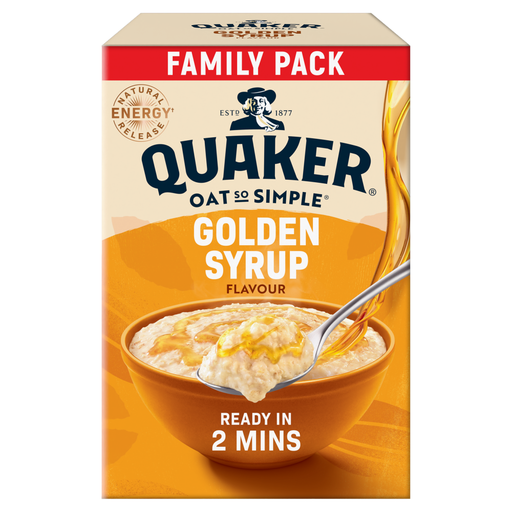
Quaker Oat So Simple Family Pack Golden Syrup 20 Sachets 720g

Quaker Oat So Simple Golden Syrup, 20 Sachets 720g

A ready-flavoured, individually measured option for convenience-led tea times.

The pack contains 20 separate 36g sachets. Sugar is listed as an ingredient, and the product states 6.4g sugars per 36g sachet.

Directions require milk, a microwaveable bowl and a one-minute standing period after heating. Check the exact pack for allergens, including the stated possible barley, wheat and soya.

Joybuy

Frequently asked questions

Are ordinary porridge-oat sachets suitable for a child who needs gluten-free food?

Not automatically. Standard Mornflake Original and Quaker Original product information includes precautionary or allergen information involving wheat, barley or other cereals. Choose only a product specifically labelled for the child’s medical requirements, and check the physical pack because formulations and precautionary statements can change.

Can I pack a porridge sachet for school?

It depends on the individual setting. In England, the Department for Education says schools must publish an allergy safety policy and manage known allergens; check whether the sachet may be brought in, where it can be prepared and which ingredients are acceptable.

Should I choose plain or flavoured sachets for tea time?

Choose plain when you want control over sweetness and toppings. For a flavoured option, compare the exact label: Mornflake Original lists 0.3g sugars per 27g sachet, while Mornflake Golden Syrup lists sugar as an ingredient and 8.8g sugars per 36g sachet.

Are single-serve sachets always better value than a bag of oats?

Not necessarily. Sachets can save measuring time, while bagged oats may suit regular use when measuring portions is practical. Compare the shelf’s price-per-kilogram label across packs instead of assuming a portioned format offers the better value.

How can prepared porridge fit into a child’s tea-time snack?

Treat porridge as one possible snack or small meal component, and use the pack label to compare packaged options. Plain porridge can be served with suitable toppings such as fruit where this fits the child’s needs and any relevant allergy arrangements.