Shoppers comparing fat content
If low fat is your main criterion, the per-100g nutrition panel lets you compare recipes on the same basis. A reduced-sugar label, by itself, does not tell you the fat content.


If fat is your main consideration, compare the per-100g figure before deciding whether you need a reduced-sugar-and-salt recipe. Tesco Groceries lists 0.3g fat, 3.0g sugars and 0.29g salt per 100g for its Reduced Sugar and Salt beans; its Heinz No Added Sugar listing gives 0.2g fat, 1.9g sugars and 0.40g salt per 100g, but is for a four-pack. If you need one tin, check the pack count as well as the nutrition panel.
If low fat is your main criterion, the per-100g nutrition panel lets you compare recipes on the same basis. A reduced-sugar label, by itself, does not tell you the fat content.
If either nutrient matters to your choice, read its listed amount separately from fat. A recipe can have a lower sugars figure than another tin but a higher salt figure.
If you want a single can rather than a multipack, check the number of tins in the listing. Consider how much you will use at once and follow the chosen tin’s instructions for leftovers.
Start with fat per 100g, then compare sugars and salt if they affect your choice; finally, confirm that the listing is for one tin and that its ingredients suit you.
| Priority | What to check | Your needs |
|---|---|---|
| Fat | Read fat per 100g on the current label. Department of Health and Social Care guidance gives 3g per 100g as the low-fat figure for solid foods; Tesco Groceries lists 0.3g per 100g for Tesco Reduced Sugar and Salt beans. | I’m choosing beans for a low-fat meal, so I want to compare the recipe itself before considering what I’ll serve with it. |
| Sugars and salt | Compare both per-100g entries. Tesco Groceries lists 3.0g sugars and 0.29g salt for Tesco Reduced Sugar and Salt, and 1.9g sugars and 0.40g salt for Heinz No Added Sugar. Its Heinz figures come from a four-pack listing. | If I’m also considering sugars or salt, I want to see both figures: choosing by the lower sugars figure alone would miss the difference in salt. |
| Recipe | Check what a reduced-recipe claim compares with. Waitrose & Partners says its Essential Reduced Salt & Sugar beans contain 30% less sugar and 30% less salt than regular Essential beans; that claim is not a comparison with every other brand. | I may prefer a reduced recipe, but I want to know which standard version the claim uses as its reference. |
| Pack and portion | Confirm the tin count and weight. Use per-100g values for comparing products, then check the serving information against the amount you expect to eat. | One tin is enough for my shop; I don’t want to mistake a four-pack or a half-can serving figure for a single-can comparison. |
| Ingredients | Read the current tin’s ingredient and allergen statements, particularly if you avoid sweeteners or need to distinguish plain beans from beans with sausages. | The recipe needs to fit the rest of my meal and any ingredients I avoid, not just my preferred fat figure. |
Those are separate entries on the nutrition panel. Tesco Groceries lists less sugar but more salt per 100g for Heinz No Added Sugar than for Tesco Reduced Sugar and Salt.
Compare fat, sugars and salt per 100g, then decide which differences matter to your choice.
A half-can serving and a per-100g value describe different amounts of food, so their numbers cannot be compared directly.
Compare tins per 100g first, then use the label’s serving information to work out the amount you plan to eat.
A listing for several 415g cans is not a single-tin purchase, even when each can has the recipe you want.
Check both the weight of each can and the number of cans before ordering.
Ingredients and nutrition information can change, which matters when you are choosing by a particular nutrient or allergen statement.
Read the label on the tin you receive before using it, especially when an ingredient or allergen affects your choice.
These product-line examples help distinguish standard, no-added-sugar and reduced-sugar-and-salt recipes; they do not indicate which brands are available on Joybuy.
Heinz No Added Sugar Baked Beanz is an option to compare when sugars matter alongside fat.
Tesco Reduced Sugar and Salt Baked Beans come in a 420g single-can listing.
Branston Reduced Sugar and Salt is listed as a 410g single tin.
Waitrose Essential includes standard and Reduced Salt & Sugar baked-bean recipes.
M&S Eat Well Baked Beans are listed in a 400g tin.
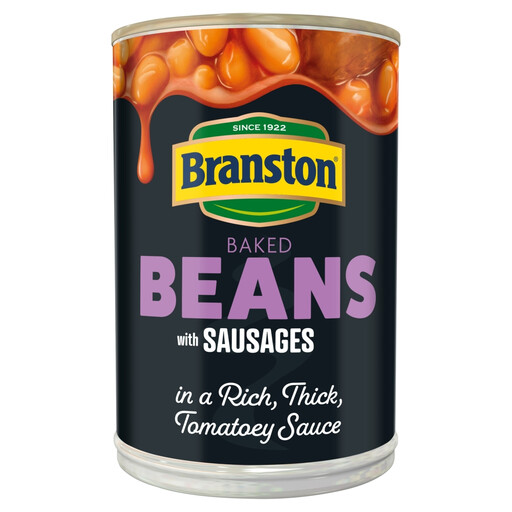
The Joybuy option here is one 405g can of baked beans with pork sausages, not plain baked beans. Check whether that difference suits the meal you are planning.
 No image available
This single can combines baked beans with pork sausages, so it is a different recipe from the plain-bean tins discussed above. Check the current nutrition and allergen label if you are choosing by fat content or need to avoid wheat or milk.
Check its fat content per 100g and consider the rest of the meal. Department of Health and Social Care guidance gives 3g fat per 100g as the low-fat figure for solid foods, while additions such as butter, cheese or cooking oil have their own ingredients and nutrition values.
Not on the basis of fat alone: compare the fat entries first, then choose a reduced recipe if its sugars or salt figures also matter to you. Tesco Groceries lists 0.3g fat and 0.29g salt per 100g for Tesco Reduced Sugar and Salt, and 0.2g fat and 0.40g salt per 100g for Heinz No Added Sugar in a four-pack listing.
Not necessarily. Check the serving size declared on your tin: if it gives nutrition for half a can and you eat the whole can, that serving figure describes only half the amount you ate. Use per-100g figures when comparing different products.
Transfer leftovers to a covered, non-metallic container and refrigerate them. Follow the storage and use-by-opening instructions on the particular tin, as directions can differ between products.
No. Those labels do not replace the ingredient and allergen statements. Read the current tin before eating, particularly if an allergy or an ingredient such as a sweetener affects your choice.