Households building a pantry reserve
Individual tins let you stock different flavours without committing to a multipack. Choose varieties you expect to use, and check each tin’s best-before date when planning how to rotate your cupboard stock.


For a ready-to-heat pantry meal, start with a single tin in a flavour and serving size you will use. A chunky vegetable or bean soup offers a different texture from smooth tomato soup, while condensed soup is worth considering if you also want an ingredient for recipes. Check the exact tin’s allergens, nutrition, preparation and storage instructions before stocking up.
Individual tins let you stock different flavours without committing to a multipack. Choose varieties you expect to use, and check each tin’s best-before date when planning how to rotate your cupboard stock.
A ready-to-heat tin can be prepared on the hob or in a microwave where its directions allow. Check the serving statement: Sainsbury’s Cream of Tomato is labelled as two servings per 400 g tin, which may not match the portion you want for one meal.
Read the ingredients and allergen statement on the exact flavour. The listed soups include products containing milk, mustard, celery or wheat; a vegetarian or vegan description does not replace an allergy check.
Decide how you will use the tin, then compare its portion, label and storage instructions with your plans.
| Priority | What to check | Your needs |
|---|---|---|
| Soup format | Check whether the soup is ready to heat or condensed, and read the preparation directions. Look at the named ingredients if you prefer a smooth or chunky texture. | I want a straightforward bowl of soup, not an ingredient that needs preparing differently. If visible beans or vegetables matter to me, I’ll check the exact recipe. |
| Portions | Read the net weight and serving statement; do not assume a tin equals one labelled serving. Tesco lists Campbell’s condensed soups in 295 g tins, while Sainsbury’s labels its 400 g Cream of Tomato as two servings. | For a meal on my own, I need to know whether I’ll use the whole tin or store some for later. |
| Ingredients and allergens | Check the current tin’s highlighted allergens and suitability statement. ASDA lists milk and mustard in Just Essentials Tomato Soup; Campbell’s UK lists milk and celery in its condensed Cream of Tomato. | An ingredient restriction means I need to check the exact flavour, even when another soup from the same brand suits me. |
| Nutrition label | Compare declarations using the same basis, such as per 100 g or per serving. Check the stated serving size when looking at salt or fibre. | I want to compare what the labels actually measure, rather than treating different portions as equivalent. |
| Pantry and leftover storage | Check the best-before date and unopened-storage directions. Read the exact tin’s instructions for transferring, refrigerating and using any leftovers. | If I only use part of a tin, I need an opened-storage period that fits when I plan to finish it. |
A 295 g condensed soup and a 400 g ready-to-heat soup have different intended uses; tin size alone does not tell you how to prepare a meal.
Decide whether you want a ready-to-heat bowl or soup for cooking, then check the preparation directions and serving statement.
Listed tomato and vegetable soups differ: ASDA Just Essentials Tomato contains milk and mustard, Campbell’s condensed Cream of Tomato contains milk and celery, and Heinz Vegetable contains wheat.
Read the ingredients and allergen statement on the exact current tin, particularly when changing flavour or pack size.
Instructions change after opening. Sainsbury’s Cream of Tomato and ASDA Just Essentials Tomato specify use within two days after refrigeration, while Tesco Cream of Tomato specifies four days.
Follow the product’s directions for transferring and refrigerating leftovers, and use its own opened-storage period.
A smooth tomato recipe will not provide the visible beans or vegetable pieces you may be expecting from a chunky soup.
Check the ingredient list and texture description, then compare the flavour, allergens and nutrition label for the tin you choose.
These examples show how soup formats vary; check each individual product rather than applying one flavour’s label to a whole range.
Tesco lists Heinz Cream of Tomato and Vegetable as 400 g tins; Heinz also describes a chunky vegetable Big Soup.
Campbell’s UK presents its condensed soups for meals and recipes; Tesco lists several condensed flavours in 295 g tins.
Tesco Cream of Tomato is a 400 g own-label tin suitable for vegetarians.
Sainsbury’s Cream of Tomato is a 400 g tin labelled as two servings and suitable for vegetarians.
ASDA lists 400 g Cream of Tomato and Just Essentials Tomato soups as individual tins.
M&S lists smooth tomato soup alongside chunky vegetable and bean recipes.
These individual 400 g soups cover bisque, broth, creamy mushroom, chunky meat and bean recipes. Choose by the flavour and texture you want, then check the current label for portions, allergens and preparation.
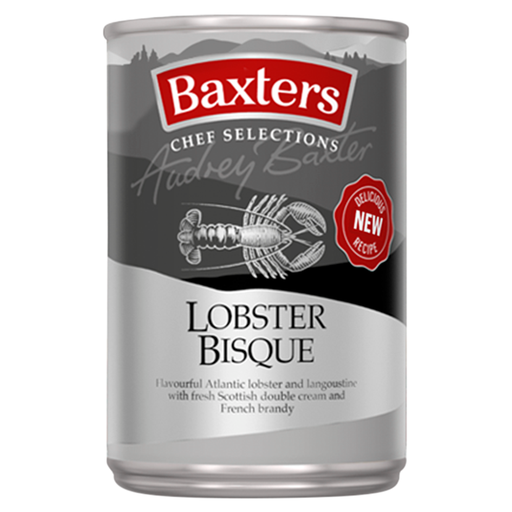 Image unavailable
A lobster bisque to consider if you want that flavour in an individual pantry tin. Check the current label for crustaceans, milk, sulphites and celery, and follow its preparation and storage directions.
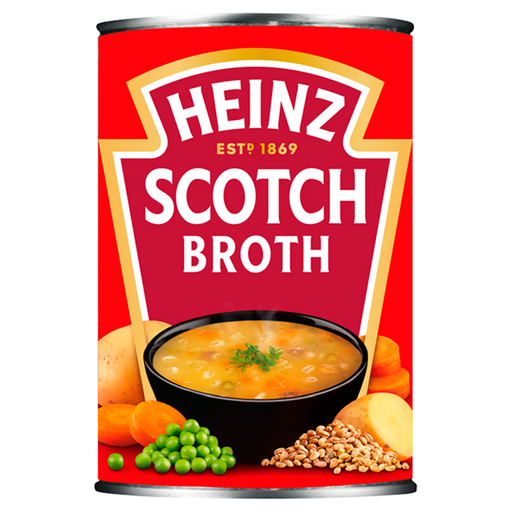 Image unavailable
Choose this broth style if it is the flavour you want to keep on hand. Check the label for barley and wheat if gluten matters to you, and use its serving and heating directions to plan your meal.
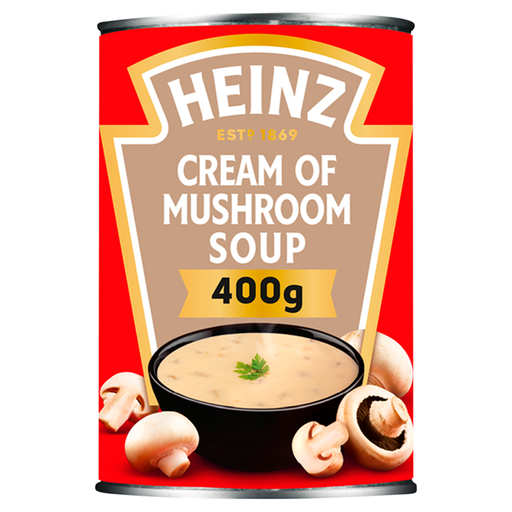 Image unavailable
A creamy mushroom option for a ready-to-heat pantry tin. Check the current label for milk and wheat, and read its serving and heating instructions before deciding how much to prepare.
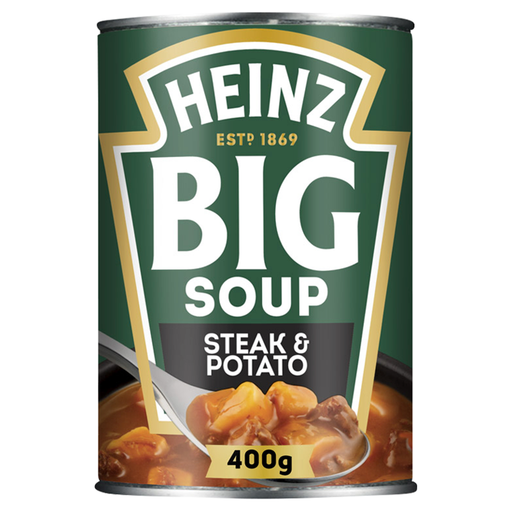 Image unavailable
Consider this steak-and-potato soup if you prefer a chunky style to a smooth soup. Check the can’s serving guidance, ingredients and heating directions before using it as a meal.
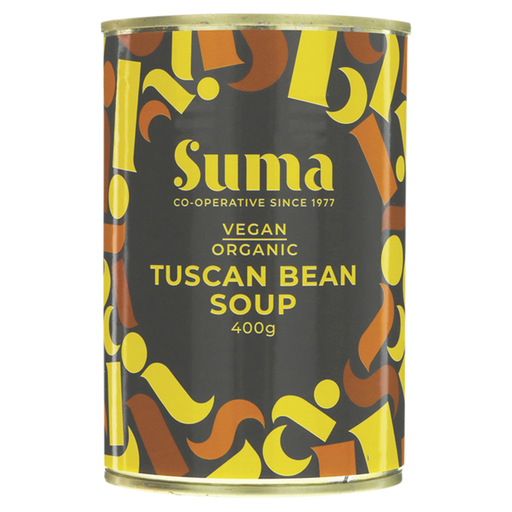 Image unavailable
A bean soup to consider when you want a change from smooth tomato recipes. Check the exact label for celery, portion guidance and preparation directions; follow its instructions for any leftovers.
Not always: Sainsbury’s labels its 400 g Cream of Tomato Soup as two servings. Check the serving statement on your chosen tin, then decide whether to use the whole tin, add another food or store leftovers according to its instructions.
Choose smooth soup if you want that texture; choose a chunky recipe if you want visible vegetables or beans. Heinz describes its Big Soup Chunky Vegetable as containing vegetable pieces, while M&S lists a chunky chilli-and-bean soup. Check flavour and allergens as well as texture.
It can work if its preparation suits your plans, but do not assume the formats are interchangeable. Campbell’s UK presents condensed soup for recipes as well as serving as soup, and Tesco lists Campbell’s condensed varieties in 295 g tins. Read the preparation directions and the basis used for nutrition figures.
Follow that product’s directions for transferring and refrigerating unused soup. The listed Sainsbury’s Cream of Tomato and ASDA Just Essentials Tomato soups specify use within two days; Tesco Cream of Tomato specifies four days. Do not apply one tin’s period to another.
No. Check the exact product’s current ingredient and allergen statement as well as its dietary label. M&S marks its Chunky Mexican-style Chilli and Bean Soup vegan and vegetarian but states that it is not suitable for people with milk or egg allergy.