
24/7 Customer Support

Free returns

Same-day & Next-day Delivery

Quality Guaranteed

Unlock Your Welcome Offers: FREE Delivery | Up to 80% OFF | Free 30-day JoyPlus trial
Download the APP
Single wall cardboard boxes are a practical choice for UK households, offices, online retailers and small businesses that need lightweight packaging without filling a storeroom. They can be used as shipping boxes, packing boxes, moving and storage boxes or everyday e-commerce packaging boxes.
However, choosing by price or a photograph alone can lead to wasted money. The important details are usually hidden in the dimensions, board construction and pack quantity.
A box listed as 9 x 6 x 6 inches may refer to its internal capacity, but not every listing makes this clear. External measurements include the cardboard walls and folded flaps, so the usable space is smaller.
Always compare the internal dimensions with the item you intend to pack. Allow room for protective paper, bubble wrap or other cushioning without forcing the flaps closed.
Single wall corrugated cardboard boxes offer a balance between low weight, easy handling and everyday protection. They are suitable for many lightweight products, documents, accessories, clothing and household goods.
They are not automatically suitable for very heavy, sharp-edged, fragile or high-value items. Overfilling can distort the panels and place pressure on the base. For demanding consignments, consider whether a double wall construction, additional internal padding or stronger outer packaging is more appropriate.
A cardboard boxes pack of 5, 10, 25, 50 or 100 can appear economical when the unit price is lower in larger quantities. Yet unused stock still needs a dry, flat storage area. Damp conditions can weaken paperboard, while leaning large stacks may cause creasing.
Flat-packed cardboard boxes reduce storage volume before assembly, but measure your available shelving or cupboard space before ordering a bulk pack.
Measure the product at its widest, longest and highest points. Then compare it with the box’s internal length, width and height. Common options include:
The listed dimensions should be treated as a guide rather than a precision engineering measurement where a manufacturing tolerance is stated. For example, some Triplast products specify a tolerance of ±10mm.
The flute is the shaped paper layer between the outer liners. B-flute cardboard boxes typically have an approximate wall thickness of 3mm. This construction provides rigidity while keeping the box relatively light and easy to handle.
Look for a clearly stated board grade rather than vague wording such as “extra strong”. The referenced Triplast boxes use 125K/T board grade and a FEFCO 0201 format. FEFCO 0201 is the familiar regular slotted carton with four folding flaps, making it straightforward to assemble and seal with packing tape.
Brown cardboard boxes made from recycled fibre can be a sensible option for routine packaging. The Triplast range is described as using up to 90% recycled content, with no plastic content, and as fully kerbside recyclable.
“Recyclable” does not mean the box should be placed in the recycling bin while heavily contaminated with food, oil or excessive tape. Flatten used boxes where possible and follow your local council’s collection guidance. Reusing a box before recycling can also reduce packaging waste.

Why This Fits Their Persona: A manageable quantity for households, new online sellers and small offices testing a packaging size before committing to bulk stock.
The stated internal dimensions and pack size make it easier to check capacity and avoid buying an unnecessarily large quantity.
178 x 127 x 127mm internal size; flat-packed, B-flute and FEFCO 0201 construction.
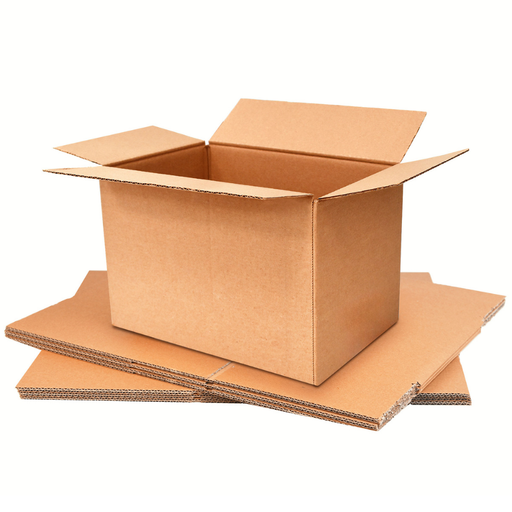
Why This Fits Their Persona: Suitable for shoppers who want a clearly specified, compact carton for repeatable packing tasks and a tidy presentation for customer orders.
The internal and external measurements are both provided, reducing the risk of confusing usable capacity with the outside footprint.
229 x 152 x 152mm internal size; approximately 3mm B-flute wall and 125K/T board grade.

Why This Fits Their Persona: A practical format for offices, warehouses, movers and sellers dispatching wider or multiple lightweight items in regular batches.
The larger footprint is paired with a stated 25-box quantity, helping frequent users plan stock rather than repeatedly purchasing small packs.
305 x 229 x 152mm internal size; flat-packed single wall B-flute design for space-conscious storage.
We have compiled a complete, real-time list of products that fully satisfy these strict selection criteria and UK safety regulations.
They can be suitable for lightweight, non-fragile items when the contents fit securely and the carton is sealed properly. Add internal cushioning for products that may move or be marked during handling. Check the carrier’s size and weight rules before dispatch.
Their lifespan depends on moisture, stacking pressure, handling and how often they are reused. Store them flat in a clean, dry location. A box with crushed corners, softened board or torn flaps should not be relied on for transit.
A larger pack can reduce the cost per box, but only if you use the stock and have suitable storage. For occasional packing, a pack of 5 or 10 may prevent surplus. Businesses with regular dispatch volumes may find packs of 25, 50 or 100 more convenient, subject to current pricing and available space.