Regular milk users
If milk goes into porridge, cereal or other meals throughout the week, a 2.272L bottle may fit your routine—provided you can use it within the time stated on the pack after opening.


Choose a fresh 4-pint skimmed milk bottle for regular breakfasts and post-run snacks if your household can keep it chilled and finish it within the pack’s opened-life instructions. If you use milk more slowly, a smaller format may be more practical; a 2L filtered option has different stated storage instructions, while the Joybuy option below is a 1-litre UHT carton rather than a 4-pint bottle.
A 4-pint bottle makes most sense when repeated use at home fits the bottle’s refrigeration and opened-life instructions.
If milk goes into porridge, cereal or other meals throughout the week, a 2.272L bottle may fit your routine—provided you can use it within the time stated on the pack after opening.
Skimmed cow’s milk is an option if you want to reduce milk fat while continuing to use dairy. The NHS identifies milk and dairy products as sources of protein and calcium; compare the nutrition panels of the bottles you are considering.
If a large fresh bottle often lasts longer than its opened-life instructions allow, consider how much milk you actually use. Arla states different storage periods for its filtered 2L Cravendale skimmed milk, although it is not a 4-pint bottle.
Start with the amount you can use after opening, then compare the pack’s nutrition and storage instructions for the meals you have in mind.
| Priority | What to check | Your needs |
|---|---|---|
| Bottle size and storage | Check volume, refrigeration temperature and the time allowed after opening. Sainsbury’s says to keep its 2.272L/4-pint bottle below 5°C and use it within 3 days of opening; check other packs individually. | Will a 4-pint bottle be used up at home within its stated opened life, or would a smaller format fit my routine better? |
| Post-run snack | Read the protein and carbohydrate amounts per serving. Sainsbury’s lists 7.2g protein and 10g carbohydrate per 200ml of its 4-pint skimmed milk. The UK Sports Institute suggests food containing both carbohydrate and protein after a run. | For a snack after a run, I might have milk with porridge, cereal or toast rather than plan around the milk alone. |
| Milk choice | Compare the nutrition panels of the particular bottles. The NHS describes skimmed milk as an option for people reducing milk fat while continuing to use dairy. | I want skimmed cow’s milk for everyday meals, and I need to check the nutrients in the pack I buy. |
| Dietary suitability | Read the ingredients and allergen declaration before buying. Ordinary skimmed cow’s milk still contains dairy; skimmed does not mean lactose-free. | If I need to avoid lactose or cow’s milk, I’ll check for a product that meets that requirement rather than rely on the word “skimmed”. |
Sainsbury’s 4-pint skimmed milk provides both protein and carbohydrate per serving, but its label describes the milk—not the rest of a meal.
The UK Sports Institute suggests having food containing carbohydrate and protein after a run. Consider milk alongside oats, cereal, toast or fruit according to what you normally eat.
Sainsbury’s says its 4-pint bottle must be kept below 5°C and consumed within 3 days of opening. An unfinished bottle means some of what you bought goes unused.
Estimate household use before choosing 2.272L, and follow the instructions on the actual pack. For slower use, compare smaller formats and their stated storage periods.
Discarding an unfinished bottle also means another shopping trip may be needed sooner than planned.
Skimmed cow’s milk remains dairy. The NHS distinguishes lactose intolerance from milk allergy, so a lower-fat label does not answer either suitability question.
Check the ingredients and allergen declaration. If you need to avoid lactose or cow’s milk, choose a product appropriate to that need and seek individual advice when necessary.
These are references for comparing pack formats and label details, not an indication that every range appears in the Joybuy selection below.
Sainsbury’s lists British Skimmed Milk in a 2.272L/4-pint bottle for repeated use at home.
Tesco lists British Skimmed Milk in a 2.272L/4-pint format.
Waitrose lists Essential British Free Range Skimmed Milk in a 2.272L/4-pint bottle.
Arla’s filtered skimmed milk is a 2L alternative when a 4-pint fresh bottle does not fit normal use.
M&S lists British Skimmed Milk in a 2.272L format and describes its milk as sourced from M&S Select Farms.
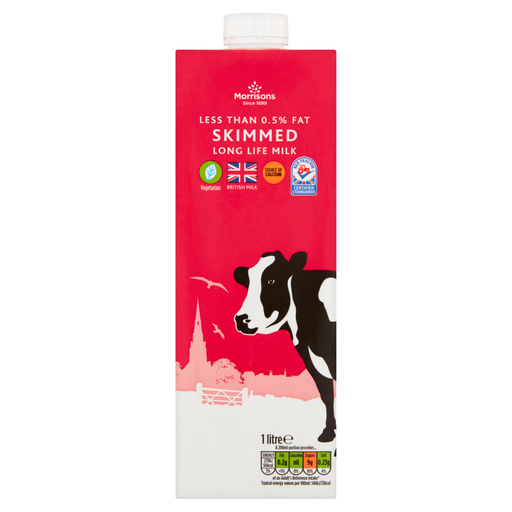
This Joybuy option is a smaller UHT skimmed milk carton for shoppers considering an alternative to a fresh 4-pint bottle.
 No image available
The 1-litre UHT carton is a different format from a fresh 2.272L/4-pint bottle and may suit a smaller amount of regular milk use. Check its pack for nutrition and storage instructions, particularly after opening.
Milk can be part of a post-run snack, but it need not be the whole snack. The UK Sports Institute suggests food containing carbohydrate and protein after a run; Sainsbury’s lists 7.2g protein and 10g carbohydrate per 200ml of its 4-pint skimmed milk. Oats, cereal or toast are ways to include other carbohydrate-containing food.
Follow the instructions on the bottle you buy. Sainsbury’s says to refrigerate its 4-pint skimmed milk below 5°C and consume it within 3 days of opening; do not assume another brand gives the same period. Arla states up to 7 days after opening at 0–5°C for its different, filtered 2L Cravendale product.
Do not assume it is: skimmed cow’s milk is still dairy, and skimmed does not mean lactose-free. The NHS distinguishes lactose intolerance from milk allergy. Check the pack and choose an alternative that meets your needs; seek individual medical advice if you are unsure what you must avoid.
Yes, milk and dairy products are sources of protein and calcium, according to the NHS. For a specific example, Sainsbury’s lists 7.2g protein per 200ml of its 4-pint skimmed milk; check the nutrition panel for the calcium amount and serving size of the bottle you choose.