Christmas bakers using skimmed milk
If skimmed milk is what you normally buy, check whether your chosen cake, muffin or pancake recipe allows it. Freshways’ baking guidance notes that milk fat can affect the finished texture.


For Christmas baking, use skimmed milk when the recipe permits it. A large fresh bottle suits baking soon after purchase; filtered milk offers a longer stated life while still needing refrigeration, and separate UHT cartons suit staggered cupboard storage before opening. Freshways’ baking guidance notes that milk fat can affect texture, so do not assume skimmed milk will give the same result in a recipe written for whole milk.
If skimmed milk is what you normally buy, check whether your chosen cake, muffin or pancake recipe allows it. Freshways’ baking guidance notes that milk fat can affect the finished texture.
Several baking sessions may call for milk on different days. Compare the pack size with the amount you expect to use, the fridge space available and the opened-life instructions on each product.
If the milk is also intended for a lunchbox, storage matters as much as pack format. UK government guidance says dairy products should be refrigerated, so fresh milk needs appropriate chilling rather than an unchilled journey.
Start with the milk named in the recipe, then choose a pack whose contents and storage instructions fit your baking schedule.
| Priority | What to check | Your needs |
|---|---|---|
| Recipe suitability | Check the specified milk type and whether the recipe allows substitutions. Freshways’ baking guidance says milk fat can affect texture, particularly where moisture and tenderness matter. | For this bake, I want to follow the recipe rather than assume skimmed and whole milk will give the same result. |
| Pack format | A 2.272L fresh bottle is one large container, not individual portions. Tesco also lists skimmed UHT milk as six separate 1-litre cartons; check how much each baking session will use. | If I am baking on several days, separate cartons may fit the plan better than opening one large bottle. |
| Storage and timing | Read the date and instructions on the pack. Tesco says its fresh 2.272L milk is best within 5 days of opening; Sainsbury’s says to consume its 4-pint bottle within 3 days. Arla states that Cravendale filtered skimmed milk lasts up to 3 weeks unopened and 7 days opened when kept at 0–5°C. | I may buy ingredients ahead, but I still need room to refrigerate fresh or filtered milk and a plan for using it after opening. |
| Allergens and lunchboxes | Check the received pack’s allergen and storage label. The Food Standards Agency identifies milk as an allergen; UK government guidance says dairy products should be refrigerated and recommends a fridge temperature of 0–5°C. | For a packed lunch, I need to know whether the milk can stay chilled and whether the person receiving it can have milk. |
Freshways’ baking guidance says milk fat can affect texture and moisture. A recipe developed for whole milk may give a different result with skimmed milk.
Use the milk type specified by the recipe, or check that the recipe explicitly allows skimmed milk.
Opened-life instructions differ: Tesco says its fresh skimmed milk is best within 5 days, while Sainsbury’s says to consume its version within 3 days.
Estimate the milk needed for baking and other household use, then read the instructions on the bottle you buy.
Any milk left unused beyond its label-directed opened life may be wasted.
UK government guidance says dairy products should be refrigerated and recommends keeping a fridge at 0–5°C.
Keep fresh milk chilled. For cupboard storage before opening, compare UHT cartons and follow the exact carton’s instructions, including those for after opening.
Skimmed dairy milk still contains milk, which the Food Standards Agency identifies as an allergen.
Check the label on the product received, particularly when buying for someone with a milk allergy or intolerance.
Tesco listings illustrate the difference between a single 2.272L fresh skimmed-milk bottle and a six-carton UHT skimmed-milk bundle.
Sainsbury's lists a single 2.272L, 4-pint fresh skimmed-milk bottle.
Arla’s Cravendale 2L is filtered fresh skimmed milk, rather than UHT milk.
Waitrose lists an Essential British Free Range Skimmed Milk 4-pint fresh bottle and a separate 1-litre long-life skimmed-milk option.
M&S describes its Scottish Skimmed Milk 2.272L as suitable for use in recipes.
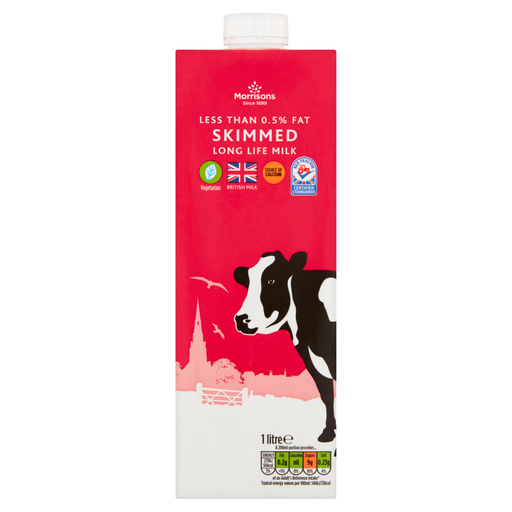
This single UHT carton is an option for buying skimmed milk ahead of a baking session when the recipe permits it; it is not a multipack of individual portions.
 No image available
A single 1-litre UHT carton for baking when the recipe permits skimmed milk, rather than a multipack. The product description says to refrigerate after opening and use within 3 days. Its product information also advises that it is not suitable for children under 5; check the carton label if considering it for a packed lunch.
Yes, when the recipe permits skimmed milk. Freshways’ baking guidance says milk fat can affect texture, so follow the specified milk type rather than assuming skimmed milk will give the same result as whole milk.
No. The 2.272L Tesco and Sainsbury’s fresh-milk examples are each one large bottle. If you need separate cartons for use on different days, a six-carton UHT pack is a different format.
Filtered milk can work when you have fridge space: Arla states that its Cravendale skimmed milk lasts up to 3 weeks unopened and 7 days opened at 0–5°C. Separate UHT cartons offer cupboard storage before opening; check the exact pack’s date and storage instructions. A standard fresh bottle suits milk you expect to use promptly.
Only with appropriate chilling. UK government guidance says dairy products should be refrigerated, recommends a fridge temperature of 0–5°C and advises keeping chilled food out of the fridge for as little time as possible.
Yes. Skimmed dairy milk contains milk, which the Food Standards Agency identifies as an allergen. Check the label on the product received when buying for someone with a milk allergy or intolerance.