People managing diabetes who prefer lower-fat milk
Diabetes UK notes that skimmed milk has fewer calories than full-fat milk. If you include milk in drinks or cereal, its carbohydrate content and the amount you pour remain relevant to your choice.


Skimmed milk suits a preference for lower-fat dairy, but it still contains carbohydrate from lactose; Diabetes UK advises paying attention to the total amount of carbohydrate consumed. If you want a fuller taste, Arla B.O.B is marketed as tasting like semi-skimmed milk, although that is a product claim rather than an independent taste comparison. For everyday use, also choose a fresh, filtered or UHT format whose storage instructions fit how quickly you use milk.
Diabetes UK notes that skimmed milk has fewer calories than full-fat milk. If you include milk in drinks or cereal, its carbohydrate content and the amount you pour remain relevant to your choice.
If “mild” means a fuller, semi-skimmed-style flavour to you, a product with an explicit taste claim is worth considering. Waitrose describes Arla B.O.B in those terms, but the claim does not establish how it will taste to everyone.
Opened-life instructions may matter more than buying a large bottle. The reviewed standard fresh, filtered fresh and UHT products have different storage instructions, so check both pack size and how soon you expect to finish it.
Start with the nutrition label and your usual portion, then decide what you mean by a milder taste and which storage format fits your routine.
| Priority | What to check | Your needs |
|---|---|---|
| Carbohydrate | Read carbohydrate per 100ml on the exact pack. Compare that figure with the amount you pour, rather than treating lower fat as lower carbohydrate. | I use milk in coffee, tea or cereal and want to account for the quantity I actually consume. Diabetes UK advises that total carbohydrate intake matters when managing blood glucose. |
| Flavour | Look for a specific taste description if a fuller flavour is important. Arla B.O.B is marketed as tasting like semi-skimmed milk; this is not an independent sensory comparison. | Ordinary skimmed milk tastes too thin to me, so I want to consider a product positioned for a fuller taste without assuming it contains less carbohydrate. |
| Storage | Check whether unopened milk needs refrigeration, then read its opened-life instruction. The reviewed Sainsbury’s fresh milk says 3 days after opening, while Arla Cravendale and Waitrose filtered milk state 7 days; ASDA UHT milk can be stored cool and dry unopened but needs refrigeration after opening. | I may take several days to finish a pack, or I want an unopened carton in the cupboard. The pack size and instructions need to fit how I use milk. |
| Milk ingredients | Read the current ingredient and allergen information. Skimmed cow’s milk still contains milk and lactose; the NHS distinguishes lactose intolerance from food allergy. | If milk causes symptoms or I need to avoid a milk allergen, choosing a lower-fat cow’s-milk product does not resolve that concern. |
Skimmed milk still contains lactose-containing carbohydrate. Diabetes UK advises considering total carbohydrate consumed, not just the fat content of a food or drink.
Use the carbohydrate figure per 100ml on the pack and the amount you actually pour when working out how milk fits into your usual intake.
Opened-life instructions differ: the reviewed Sainsbury’s and M&S fresh products say 3 days, while the reviewed Cravendale and Waitrose filtered products state 7 days.
Choose a pack size you can finish within its instructions, or consider filtered fresh milk or unopened UHT cartons when those storage formats suit your routine.
Waitrose describes Arla B.O.B as tasting like semi-skimmed milk, but its listing gives 4.9g carbohydrate per 100ml. The taste description does not establish a lower carbohydrate content or a particular effect on blood glucose.
Choose on taste preference separately from checking the nutrition label and your portion size.
Skimmed cow’s milk still contains milk and lactose. The NHS distinguishes lactose intolerance from food allergy and notes that food allergy can be life-threatening.
Read the current pack’s ingredient and allergen information. If symptoms recur or you suspect an allergy, seek advice from a healthcare professional rather than using skimmed milk as a substitute.
These examples show how particular skimmed-milk products differ in taste positioning and storage; a brand name alone does not establish those details for every product it sells.
A skimmed milk positioned for shoppers who prefer a semi-skimmed-style taste.
Filtered fresh skimmed milk for shoppers who need time to use a refrigerated bottle.
Standard fresh skimmed milk for a household that uses a chilled bottle regularly.
Long-life skimmed milk for unopened storage in a cool, dry place.
Filtered fresh skimmed milk with a stated longer refrigerated life.
Standard fresh skimmed milk for use from the fridge.
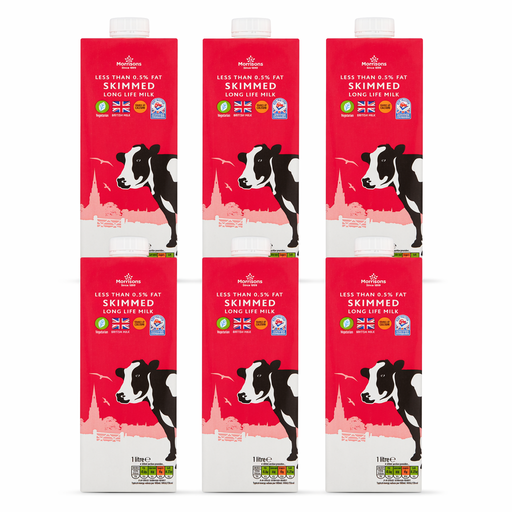
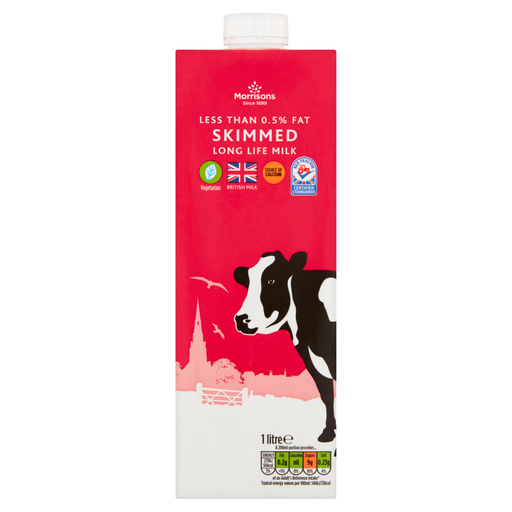
These Morrisons UHT skimmed milk packs suit the cupboard-backup route while unopened. If a fuller, semi-skimmed-style taste is your deciding factor, check the individual pack’s taste description rather than assuming it from the UHT format.
 No image available
Six 1-litre packs offer UHT skimmed milk for unopened cupboard storage. Refrigerate after opening and use within 3 days; check the pack’s carbohydrate figure against the amount you pour.
 No image available
This 1-litre UHT skimmed milk suits keeping an unopened pack in the cupboard. Once opened, refrigerate and use within 3 days; check its nutrition label for the carbohydrate in your usual portion.
No: choosing skimmed milk for its lower fat content does not remove its lactose-containing carbohydrate. Diabetes UK advises that total carbohydrate consumed matters when managing blood glucose, so check the exact product label and the amount you pour.
Look for an explicit description of the flavour you prefer. Waitrose describes Arla B.O.B as skimmed milk that tastes like semi-skimmed milk, but that is a product taste claim, not a guarantee that you will find it milder than another milk.
Choose according to where you can store it and how quickly you will finish an opened pack. The reviewed Sainsbury’s fresh milk says to consume it within 3 days of opening; Arla Cravendale and Waitrose filtered products state 7 days. The reviewed ASDA UHT milk can be stored cool and dry unopened, but needs refrigeration after opening and is best used within 3 days.
Do not assume that removing fat makes cow’s milk suitable for either condition: skimmed cow’s milk still contains milk and lactose. The NHS distinguishes lactose intolerance from food allergy, so check current allergen information and seek professional advice if you have recurring symptoms or suspect an allergy.