People managing diabetes who use milk regularly
Milk added to drinks, cereal or cooking contributes carbohydrate. Diabetes UK advises taking account of the amount consumed, rather than treating skimmed milk as carbohydrate-free.


Skimmed milk is not carbohydrate-free: Diabetes UK explains that milk contains lactose carbohydrate, so check the carbohydrate on the pack and the amount you pour. If one 6-pint bottle is essential, Tesco’s listed example is semi-skimmed, while its skimmed example is 4 pints; decide whether the skimmed specification or the single-bottle size matters more.
Milk added to drinks, cereal or cooking contributes carbohydrate. Diabetes UK advises taking account of the amount consumed, rather than treating skimmed milk as carbohydrate-free.
A single 6-pint bottle may be convenient for a household that uses a lot of milk, but Tesco’s listed 6-pint option is semi-skimmed. Its skimmed option is 4 pints, so the labels are not interchangeable.
A smaller pack may be easier to finish within its after-opening instructions. Check the date and storage directions on the exact pack, including when considering filtered milk.
Start with the carbohydrate in a typical pour, then check whether the pack meets your fat-content, quantity and storage needs.
| Priority | What to check | Your needs |
|---|---|---|
| Carbohydrate per pour | Read carbohydrate per 100 ml on the current pack. Relate it to the amount used in a drink, on cereal or in cooking. | I want to account for the milk I actually use, rather than assume skimmed milk has no carbohydrate. Diabetes UK notes that lactose in milk contributes carbohydrate. |
| Fat content | Check that the label says skimmed, not semi-skimmed. Tesco Groceries lists 0.1 g fat per 100 ml for its 4-pint skimmed milk and 1.8 g per 100 ml for its 6-pint semi-skimmed milk. | If skimmed milk is my priority, I do not want to change to semi-skimmed solely to get a larger bottle. |
| Pack format | Distinguish one 6-pint bottle from several smaller packs. Tesco lists a 2.272 L, 4-pint skimmed bottle; Ocado lists a 2 L Cravendale filtered skimmed product. | Would one large bottle suit our use, or would smaller packs be easier to manage? A multipack of cartons is not one 6-pint bottle. |
| Storage and dates | Follow the exact pack’s refrigeration, after-opening and date instructions. Tesco’s listed skimmed milk says best within 5 days of opening; Ocado’s M&S listing says within 3 days. | I need a quantity we can use within the pack’s instructions. The Food Standards Agency warns that food stored too long or at the wrong temperature can become unsafe. |
Skimming reduces fat, not the lactose carbohydrate in milk. Tesco Groceries lists 5.0 g available carbohydrate per 100 ml for its 4-pint skimmed milk.
Check the current nutrition panel and the amount you pour. If you follow a prescribed carbohydrate-counting plan, use the guidance from your diabetes-care team.
Tesco’s 6-pint semi-skimmed milk lists 1.8 g fat and 4.8 g available carbohydrate per 100 ml; its 4-pint skimmed milk lists 0.1 g fat and 5.0 g available carbohydrate per 100 ml. The larger bottle is not a skimmed substitute.
Decide whether a single 6-pint bottle or skimmed milk is the requirement you need to keep, then check the exact product label.
After-opening instructions differ: Tesco’s listed skimmed bottle says best within 5 days, while Ocado’s M&S listing says within 3 days. Milk also needs to be stored as its pack directs.
Choose a pack size that fits your usual use, refrigerate it as instructed and follow its date marking.
A bottle left unfinished beyond its stated instructions can mean wasted milk.
These examples show how pack size and label information vary; a brand name alone does not establish the nutrition or storage instructions for every pack.
Tesco Groceries lists a 4-pint British skimmed milk and a separate 6-pint British semi-skimmed milk.
Ocado lists a 4-pint British skimmed milk with nutrition and chilled-storage information.
Ocado lists Cravendale filtered fresh skimmed milk in a 2 L format.
Ocado lists an Arla B.O.B skimmed milk product in a 2 L format.
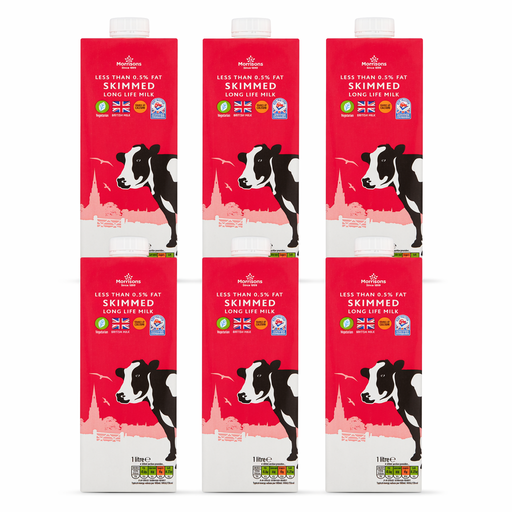
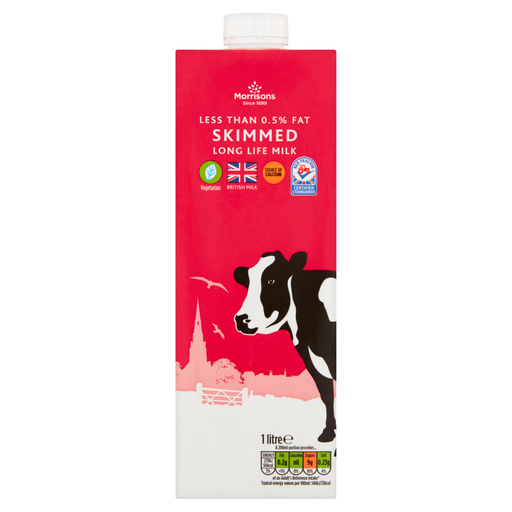
These Joybuy options are UHT skimmed milk in either six separate 1-litre cartons or one 1-litre carton. Neither is a single 6-pint bottle.
 No image available
Six separate 1-litre cartons may suit a household that wants to open its milk in stages, rather than use one large bottle.
Keep unopened cartons in a cool, dry place; once opened, refrigerate and use within 3 days. Check the carton’s printed date and carbohydrate value when planning portions.
 No image available
The single 1-litre carton is a smaller quantity for households that do not need a family-size bottle.
Store unopened in a cool, dry place; refrigerate after opening and use within 3 days. Check the carton’s printed date and carbohydrate value before use.
No: skimmed describes fat content, not an absence of carbohydrate. Diabetes UK explains that milk contains lactose carbohydrate, so use the pack’s nutrition panel, the amount you pour and any individual guidance you follow.
No. Tesco Groceries lists 5.0 g available carbohydrate per 100 ml for its 4-pint skimmed milk and 4.8 g per 100 ml for its 6-pint semi-skimmed milk. Compare the specific products and your serving size rather than using the fat-content label as a carbohydrate guide.
Check your local retailer’s current listing and confirm that the bottle itself says skimmed. Tesco’s listed 6-pint example is semi-skimmed, while its listed skimmed bottle is 4 pints; six separate cartons are not one 6-pint bottle.
Compare your usual use with the exact pack’s date, storage directions and after-opening instructions. The Food Standards Agency warns that food kept too long or at the wrong temperature can become unsafe; follow a use-by date where one is shown.