Skimmed milk is a lower-fat cow’s-milk option: Diabetes UK says it provides the same vitamins, minerals, calcium and protein as full-fat milk, with fewer calories. It still contains carbohydrate, so compare the total-carbohydrate figure for the amount you pour. Choose between standard fresh, filtered and UHT skimmed milk according to how quickly you use it and the storage instructions on the pack, rather than assuming one format is better for blood-glucose management.
Who is this choice for?
Shoppers choosing lower-fat cow’s milk
If you want to replace full-fat dairy milk, skimmed milk offers a lower-fat option. Diabetes UK says it has fewer calories than full-fat milk while providing the same vitamins, minerals, calcium and protein. Its carbohydrate content still matters when comparing portions.
People who count carbohydrate in drinks and cereal
A splash in tea and a larger pour over cereal contribute different amounts. Leeds Teaching Hospitals NHS Trust advises using total carbohydrate on the label, rather than only the ‘of which sugars’ figure, when counting carbohydrate.
Households that use milk gradually
Filtered fresh or UHT skimmed milk may fit a slower pattern of use. Compare each pack’s unopened and opened-life instructions, as well as its carbohydrate value; a longer-life format still needs appropriate storage after opening.
What should you check?
Start with the nutrition label and your usual portion, then choose a format you can store and finish as directed.
| Priority |
What to check |
Your needs |
| Carbohydrate |
Read total carbohydrate per 100ml or 100g, keeping the stated unit in mind. Work out the amount for the portion poured; Leeds Teaching Hospitals NHS Trust advises carbohydrate counters not to use only ‘of which sugars’. |
I want to account for the milk in my tea, coffee, cereal or glass, rather than treating a low-fat label as meaning carbohydrate-free. |
| Fat and nutrients |
Compare the pack’s fat figure and its stated unit. Diabetes UK says skimmed and semi-skimmed milk provide the same vitamins, minerals, calcium and protein as full-fat milk, with fewer calories. |
A lower-fat cow’s-milk option matters to me, but I still want the carbohydrate figure visible when choosing a serving. |
| Storage and use |
Check whether the milk is fresh, filtered or UHT, then read the unopened storage and after-opening instructions. For example, Marks & Spencer advises using its fresh skimmed milk within three days of opening; Waitrose states seven days for its filtered example and five days for its UHT example. |
I use milk slowly, so a bottle or carton I can finish within its stated opened life matters more than choosing a format by name alone. |
| Taste and protein |
If these distinguish two products for you, compare their own labels. Waitrose lists Arla B.O.B at 4.5g protein and 4.9g carbohydrate per 100ml; its semi-skimmed-style taste is product positioning, not an independent taste test. |
I may prefer a particular taste or listed protein value, but I would not assume that filtered skimmed milk is automatically preferable for managing carbohydrate. |
Mistakes to avoid
-
Choosing by the low-fat description alone
Low fat does not mean carbohydrate-free. Marks & Spencer lists 5.0g carbohydrate per 100g for one fresh skimmed milk, while Waitrose lists 5.0g per 100ml for its Essential long-life skimmed milk.
Read total carbohydrate and calculate it for the amount you normally pour. Keep the label’s per-100g or per-100ml unit when making that calculation.
-
Counting only ‘of which sugars’
That sub-line is not the total-carbohydrate value used for carbohydrate counting, according to Leeds Teaching Hospitals NHS Trust.
Use total carbohydrate and your actual portion. If you use insulin, follow your individual care plan and seek advice from your diabetes team about adjustments.
-
Buying more fresh milk than you can finish
Opened-life instructions differ between products. A larger bottle may not suit a household that uses only a little milk each day.
Choose a pack size and format that fit your use, and follow its refrigeration and after-opening instructions.
Milk left beyond its stated opened-life period may have to be discarded.
-
Assuming removing fat removes the milk allergen
Skimmed milk is still milk. The Food Standards Agency identifies milk as an allergen that can pose a risk to people with an allergy or intolerance to milk or milk constituents.
If you have a milk allergy, do not choose skimmed dairy milk as an alternative to full-fat dairy milk.
Brand and retailer references
These examples illustrate different labels and storage instructions; check the particular product and pack you intend to buy.
Arla Cravendale
A filtered fresh-milk range with skimmed, semi-skimmed and whole variants.
- Arla says Cravendale stays fresh for up to three weeks unopened and seven days after opening.
- The freshness claim does not establish the carbohydrate content of a particular variant; check its label.
Arla B.O.B
A filtered skimmed milk marketed as having a semi-skimmed-style taste.
- Waitrose lists 0.4g fat, 4.9g carbohydrate and 4.5g protein per 100ml for its Arla B.O.B product.
- The taste description is product positioning; its carbohydrate still needs to be counted where relevant.
M&S Food
An own-label fresh skimmed-milk option.
- Marks & Spencer lists 0.3g fat, 5.0g carbohydrate and 3.6g protein per 100g for its 568ml skimmed milk.
- That product specifies refrigeration at 0°C to +5°C and says it is best consumed within three days of opening.
Waitrose own label
Filtered fresh and UHT skimmed-milk products with different storage instructions.
- Waitrose lists 5.2g carbohydrate per 100ml for its filtered skimmed milk and 5.0g per 100ml for Essential Long Life Skimmed Milk.
- The filtered product states seven days after opening; the long-life product says to refrigerate after opening and use within five days. Check each pack separately.
Tesco own label
For a Tesco milk product, use the label on the specific pack to make your comparison.
- Tesco warns that food formulations and nutrition information can change, so a different milk variant’s figures should not be used in place of the skimmed product’s label.
UHT skimmed milk on Joybuy
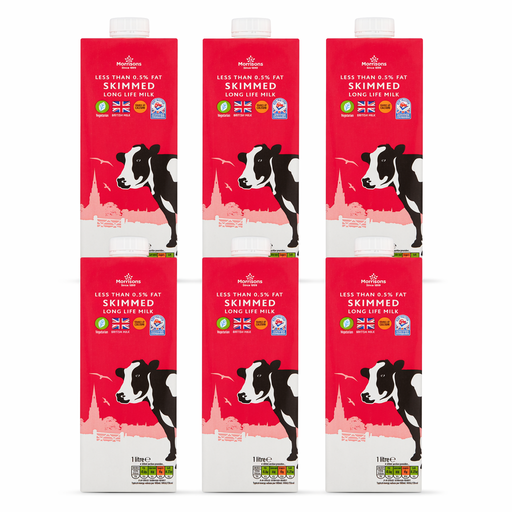
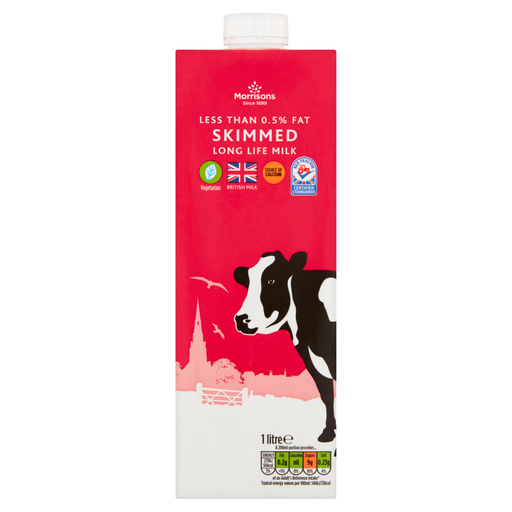
These Morrisons UHT skimmed-milk options are for shoppers considering unopened milk for cupboard storage. One listing is a six-pack of 1 litre cartons; the other is a single 1 litre carton. Compare the pack details and the label for the amount you will use.
 No image available
Morrisons British UHT Skimmed Milk, 6 × 1 litre
The six-carton pack suits keeping unopened UHT milk as a cupboard backup; check each carton’s best-before date and storage directions. After opening, refrigerate and use within three days. Use the total-carbohydrate label value for the amount poured. This is dairy milk, and the listing states that it is not suitable for children under five.
View on Joybuy
 No image available
Morrisons British UHT Skimmed Milk, 1 litre
The single carton offers a smaller UHT purchase for cupboard-backup use. Check its best-before date; once opened, refrigerate and use within three days. Compare total carbohydrate for your usual serving rather than relying on the skimmed description. It contains milk, and the listing states that it is not suitable for children under five.
View on Joybuy
Questions about skimmed milk
Is skimmed milk carbohydrate-free because it is low in fat?
No. Marks & Spencer lists 5.0g carbohydrate per 100g for its fresh skimmed milk, and Waitrose lists 4.9g per 100ml for Arla B.O.B. If you count carbohydrate, Leeds Teaching Hospitals NHS Trust advises using total carbohydrate for the portion you pour, not just ‘of which sugars’.
Which figures should I compare on a skimmed-milk label?
Start with total carbohydrate and its stated per-100ml or per-100g unit, then calculate the amount for your serving. You can compare fat and protein for other buying preferences, but do not treat a lower fat figure as a lower carbohydrate figure.
Is filtered skimmed milk automatically preferable for carbohydrate counting?
No. Filtering may affect the product’s stated freshness, but compare carbohydrate on the exact packs. Waitrose lists 5.2g per 100ml for its filtered skimmed milk and 5.0g per 100ml for a separate long-life skimmed product; those figures do not establish a general rule for either format.
How long can fresh, filtered and UHT skimmed milk be kept after opening?
Follow the individual pack rather than a single rule for all skimmed milk. Marks & Spencer says its fresh 568ml product is best consumed within three days; Waitrose states seven days for its filtered example and five days, refrigerated below 5°C, for its Essential long-life example.
Is skimmed milk suitable for someone with a milk allergy?
No. Skimmed dairy milk remains milk, which the Food Standards Agency identifies as an allergen. Removing fat does not remove that allergen.


