Bakers following a low-fat milk recipe
If your cake recipe specifies skimmed or low-fat milk, choose a product clearly labelled as skimmed milk rather than changing the milk type without a reason.


Choose skimmed milk when the cake recipe calls for skimmed or low-fat milk. If it was developed with whole milk, treat the swap as a recipe change rather than assuming the same result: research published in Food Structure identifies a role for fat crystals in stabilising air bubbles in cake batter. Standard fresh milk suits a bottle you will use promptly; filtered fresh milk offers a longer stated window for some products, while UHT milk can be kept as an unopened cupboard backup.
If your cake recipe specifies skimmed or low-fat milk, choose a product clearly labelled as skimmed milk rather than changing the milk type without a reason.
If you seldom bake, pack size and the instructions for storing milk before and after opening may matter as much as whether you prefer fresh or UHT milk.
If texture matters for a cake originally made with whole milk, test a skimmed-milk version before relying on it for a particular occasion. Food Structure research describes a role for fat crystals in stabilising cake-batter air bubbles; it does not predict the result of every recipe swap.
Start with the milk type specified by the recipe, then choose a pack and storage format that fit when you plan to bake.
| Priority | What to check | Your needs |
|---|---|---|
| Milk fat | Look for a skimmed-milk label and compare fat using the same per 100 ml basis. Check whether the product is plain skimmed milk or a different variant. | I want the milk ingredient to match a recipe calling for skimmed milk, without assuming that this determines the fat content of the finished cake. |
| Recipe texture | Check which milk the recipe specifies. For a whole-milk recipe, try a small test bake before depending on a skimmed-milk substitution; Food Structure research identifies a role for fat crystals in cake-batter bubble stability. | If I am making a cake for an occasion, I would rather test the changed recipe than assume its crumb and rise will be unchanged. |
| Storage | Compare pack size and the product’s before- and after-opening instructions. Sainsbury's lists three days after opening for its fresh and UHT examples; its Cravendale listing states seven days after opening for the filtered fresh product. | I bake occasionally, so I need a carton or bottle I can use within its stated storage period. |
| Milk ingredients | Read the current ingredients and allergen information when baking for someone who avoids milk. GOV.UK identifies milk as an allergen that must be declared when it is an ingredient in prepacked food. | When serving cake to someone else, I need to know whether the milk ingredient is suitable for them; skimmed dairy milk is still milk. |
Changing the milk changes the recipe’s fat contribution. Research published in Food Structure explains how fat crystals help stabilise air bubbles in cake batter, though it does not establish what will happen in every individual cake.
Follow the recipe’s specified milk for a predictable starting point. If you want to adapt it, make a small test bake before using the changed version for an occasion.
Opened-life instructions differ between products: Sainsbury's lists three days for its standard fresh example, while its Cravendale filtered fresh listing states seven days after opening.
Match the pack to your baking plans and follow the instructions on the carton or bottle you buy.
An unfinished pack may need to be discarded once its stated use period has passed.
Removing much of the fat does not remove the milk ingredient. GOV.UK lists milk among the allergens food businesses must declare when present as an ingredient.
Check the current allergen label before baking for someone who avoids milk, and use a suitable recipe and alternative ingredient where needed.
These product examples illustrate differences in format, labelling and storage instructions; a brand name alone does not establish how a milk will perform in a cake.
Its listed skimmed-milk examples include standard fresh milk and a separate UHT carton.
The listed filtered fresh skimmed milk is an option when a longer stated fresh-milk storage window would help.
The listed 2 L skimmed milk provides another composition to compare with standard skimmed milk.
Its listed fresh skimmed milk provides product-specific nutrition and storage information to check against a recipe and baking schedule.
Its skimmed-milk category includes standard and filtered own-label products alongside branded options.
These Morrisons UHT skimmed-milk options fit a cupboard-backup approach to baking with a recipe that calls for skimmed milk. Check the pack details and storage instructions for the option you choose.
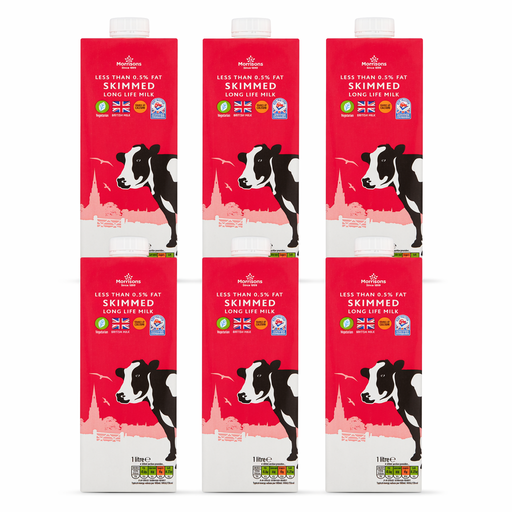 No image available
A UHT option to consider when your cake recipe calls for skimmed milk and you want an unopened cupboard backup. Check the carton count and total volume before ordering: the product title mentions six packs, while its description also refers to a 1-litre pack. Follow the current pack’s storage instructions.
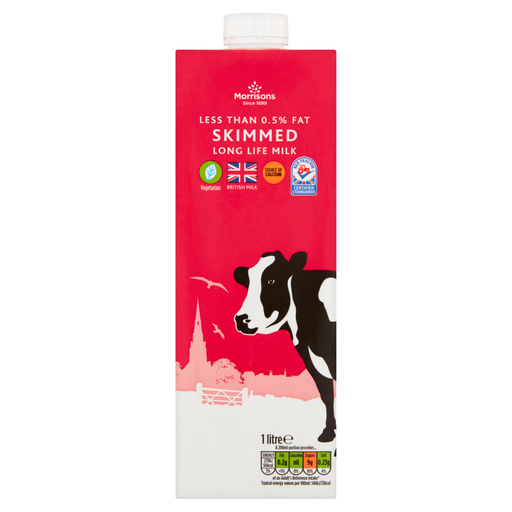 No image available
This 1-litre UHT option suits an occasional bake using a recipe that specifies skimmed milk. Check the carton’s storage instructions before and after opening; if you are changing a whole-milk recipe, test the cake rather than assuming an identical result.
Yes, when the recipe specifies skimmed or low-fat milk. Replacing whole milk is a change to the recipe, not a guaranteed like-for-like swap: research published in Food Structure describes how fat crystals help stabilise air bubbles in cake batter. The outcome depends on the full recipe, so test a changed version when the result matters.
Choose according to when you expect to use the milk. The Cravendale filtered fresh product listed by Sainsbury's states seven days after opening and up to three weeks unopened. Sainsbury's UHT skimmed milk can be stored cool and dry before opening, but must be refrigerated and used within three days afterwards.
Not by itself. Skimmed milk changes the milk ingredient, while the finished cake also depends on the amounts and types of other ingredients, such as butter, oil, fillings and icing. Assess the whole recipe and serving size rather than describing the cake on the basis of its milk alone.
No: dairy skimmed milk is still milk. GOV.UK identifies milk as an allergen that must be clearly declared in the ingredients list when present in prepacked food. Check the current product label and choose an appropriate alternative recipe and ingredient if the cake needs to avoid milk.