Regular milk users
If you use milk daily in drinks, cereal or lunch recipes, standard fresh skimmed milk may fit your routine. Choose a carton you can finish within its stated period after opening.


Do not use ‘mature’ as a grade for choosing skimmed milk; compare the labelled format, storage instructions and nutrition instead. For a working-from-home lunch, standard fresh milk suits regular use within its opened-life, filtered milk is worth considering when you use milk less often, and unopened UHT milk can serve as a cupboard standby. A protein-enriched option is a separate choice if its labelled protein content matters to you.
How often you open and finish a carton matters more than the word ‘mature’ when choosing milk for lunches at home.
If you use milk daily in drinks, cereal or lunch recipes, standard fresh skimmed milk may fit your routine. Choose a carton you can finish within its stated period after opening.
If several days can pass between lunches that need milk, compare filtered milk’s opened-life with standard fresh milk’s. An unopened UHT carton is another option to keep for when fresh milk runs out.
If you use skimmed milk in coffee or cereal but want to compare its protein content or flavour, look at the exact nutrition panel. Protein-enriched skimmed milk is not identical to every standard product, and descriptions of taste are not a substitute for trying it yourself.
Start with how quickly you will use an opened carton, then compare the nutrition and label details that matter for your lunch.
| Priority | What to check | Your needs |
|---|---|---|
| Storage and opened-life | Read both the unopened storage instructions and the period after opening. Sainsbury's fresh and UHT examples say to use them within three days of opening; Waitrose says seven days for its filtered skimmed milk. Follow the instructions on the carton you buy. | I use milk at different rates each week, so I want a format and carton size I can manage once opened. |
| Everyday nutrition | Compare fat, protein and calcium using the same quantity on each label. Sainsbury's British fresh skimmed milk lists 7.2g protein and 260mg calcium per 200ml; figures for other products need their own labels. | I want skimmed milk for my usual drinks or food and need to know what a serving contributes. |
| Protein and flavour | Check whether the product is standard or protein-enriched and compare protein per 100ml. Waitrose lists Arla B.O.B at 4.5g protein per 100ml; its semi-skimmed-style taste description is a product claim, not an independent taste comparison. | If standard skimmed milk tastes too light to me, I can compare a protein-enriched option without assuming I will prefer its flavour. |
| Allergens and dates | Check the exact carton’s ingredients, allergen declaration, date mark and storage instructions. GOV.UK distinguishes a safety-related use-by date from a quality-related best-before date. | Milk must be suitable for everyone using it, and I need to follow the date and storage directions on the pack. |
| Carton quantity | Check the volume of each carton and, for a multipack, the number of cartons. Consider how many you will open during a normal working week. | I would rather choose a quantity that fits my routine than leave an opened carton unfinished. |
That term does not tell you whether a carton is fresh, filtered, UHT or protein-enriched, or how it should be stored.
Use the format named on the pack, its nutrition panel and its storage instructions to make the comparison.
An opened carton may not fit an occasional-use routine. Sainsbury's standard fresh example says to use it within three days of opening, whereas Waitrose’s filtered example states seven days.
Think about how much milk you use between lunches, and compare carton sizes and the exact product’s instructions before choosing.
Sainsbury's standard fresh example lists 3.6g protein per 100ml, while the Arla B.O.B listing gives 4.5g per 100ml. Those figures do not establish which flavour you will prefer.
Compare nutrition panels on the same per-100ml basis and try a suitable carton size if flavour in drinks or cereal is important to you.
These product-line examples illustrate differences in format and labelling; a brand name alone does not establish the storage life or nutrition of every carton it sells.
Its own-label examples include British fresh skimmed milk and UHT skimmed milk.
Its own-label fresh skimmed range includes standard and filtered products.
Its skimmed-milk listings include own-label standard and filtered formats, alongside branded filtered milk.
Its own-label skimmed milk provides product-specific nutrition and refrigeration instructions.
This is a protein-enriched skimmed-milk line for shoppers comparing the composition of skimmed options.
These Morrisons UHT skimmed-milk options fit the cupboard-standby route for home-working lunches. Choose between an individual 1-litre carton and the listing for six 1-litre packs according to how much you expect to use.
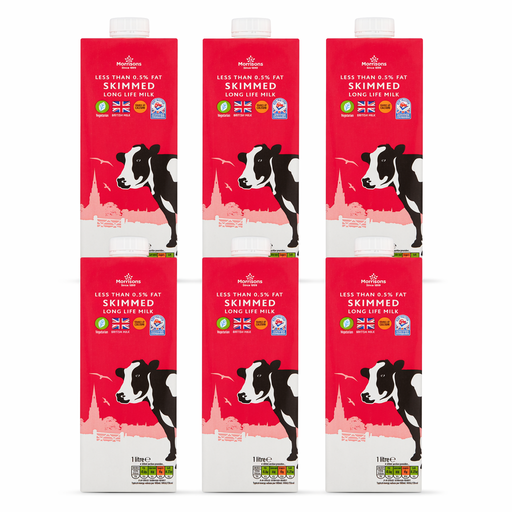 No image available
An option for keeping UHT skimmed milk available for lunches at home. The listing identifies six 1-litre packs; consider how quickly you will use each carton after opening, and check its date and storage directions.
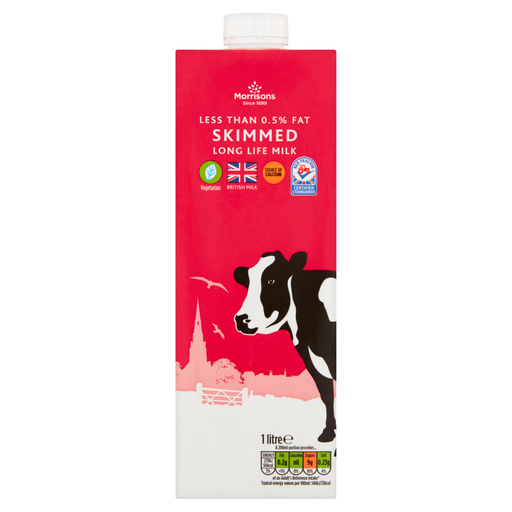 No image available
A single 1-litre UHT option for a lunch cupboard standby. Check the carton’s date, allergen information and instructions for storage before and after opening.
No: it does not identify the format or the storage and nutrition details needed for this choice. Compare cartons labelled fresh, filtered, UHT or protein-enriched, then read the exact pack.
Follow the carton’s instructions, because the cited products differ. Sainsbury's fresh and UHT skimmed milks specify use within three days of opening, while Waitrose states seven days for its filtered skimmed milk.
Do not use it after a use-by date. GOV.UK explains that use-by dates concern food safety, unlike best-before dates, which concern quality; follow the carton’s storage instructions as well.
No. Cow’s skimmed milk contains milk; check the exact product’s ingredients and allergen declaration before buying or serving it.
No. Milk can be one part of lunch, but it does not replace the other foods in a meal. For example, Sainsbury's British fresh skimmed milk lists 7.2g protein and 260mg calcium per 200ml; those figures describe the milk, not an entire lunch.