Hosts planning drinks and meals
If milk needs to cover visitors, hot drinks, breakfast and cooking, consider what you can keep chilled and what can stay unopened in the cupboard until needed.


Choose fresh skimmed milk if you can refrigerate it and expect to use it within the pack’s instructions; an unopened UHT carton is a different option for milk you want to keep in the cupboard until needed. Filtered, organic and taste-focused products address other preferences, but check each pack’s dates and storage directions. “Mature” is not a useful distinction in the skimmed-milk ranges considered here.
The useful format depends on when the milk will be opened, how much chilled space you have and what you expect to use during the Christmas shop.
If milk needs to cover visitors, hot drinks, breakfast and cooking, consider what you can keep chilled and what can stay unopened in the cupboard until needed.
If ordinary skimmed milk tastes too light to you in tea, coffee or cereal, compare it with a taste-focused skimmed product. A description on the pack cannot settle your own preference.
Match the pack size to likely use after opening. A larger chilled bottle is less practical if you cannot finish it within its labelled instructions.
Start with when you will open the milk and where it can be stored. Then compare pack size, label information and any taste or sourcing preference.
| Priority | What to check | Your needs |
|---|---|---|
| Storage format | Check whether the product is chilled fresh milk, filtered fresh milk or UHT milk. Read its unopened storage directions and date label; do not assume filtered products share one shelf life. | I need milk ready for near-term use, or an unopened carton I can keep in the cupboard until Christmas demand is clearer. |
| Use after opening | Read the individual pack’s refrigeration and opened-pack instructions. Sainsbury’s announced best-before labels for its own-brand milk range in 2023; that does not establish the label type for every product. | Once I open a bottle or carton, I want its labelled use period to fit our plans for drinks, breakfast and cooking. |
| Pack size | Compare the stated volume with fridge space and expected use. Tesco Groceries lists a 2.272L British skimmed-milk option; a larger pack is useful only if its contents can be used as directed. | A smaller pack may suit a quiet household, while more visitors could change how much milk we open. |
| Taste and nutrition | Compare nutrition panels on the same per-100ml basis. Sainsbury’s describes its British skimmed milk as 0.3% fat; Waitrose describes Arla B.O.B as skimmed milk intended to taste like semi-skimmed milk, which is a product claim rather than a taste guarantee. | I want to choose skimmed milk for our usual drinks or cereal without assuming that different products will taste the same. |
| Sourcing | If organic production matters, look for an explicitly labelled organic product. Check British or free-range claims on the particular pack rather than extending a retailer’s range statement to every brand it stocks. | Organic status or a stated sourcing approach may matter to me more than the storage format alone. |
The skimmed-milk options considered here are distinguished by features such as fresh or UHT format, filtering, organic status and taste positioning. “Mature” does not tell you how to store or use the milk.
Compare the actual pack’s format, date label, storage directions and size instead.
An opened bottle still has to be refrigerated and used according to its own label. Holiday plans can leave part of a large pack unused.
Think through likely drinks and recipes before choosing a size; an unopened UHT carton can serve as a separate cupboard backup.
Milk left beyond an opened-pack instruction may have to be discarded.
Filtered, organic and taste-focused describe different features. A taste description, for example, does not establish how you will find the milk in your own drinks.
Choose the feature that addresses your preference, and check the same storage and opened-pack details you would check on ordinary fresh milk.
Sainsbury’s stated in 2023 that it was moving its own-brand milk range to best-before labels. That announcement does not determine the wording on another retailer’s or brand’s pack.
Read the date and storage instructions on the milk you actually buy.
These examples illustrate different skimmed-milk formats and claims; inclusion here does not establish what will be available for a later Christmas shop.
A filtered fresh skimmed-milk option for shoppers who want chilled milk.
Tesco Groceries lists own-label British skimmed milk, including a 2.272L pack, alongside other skimmed-milk choices.
Sainsbury’s British skimmed milk is a fresh own-label option; its four-pint product is described as 0.3% fat.
M&S lists skimmed milk and describes filtered chilled milk as an option with a longer shelf life.
Waitrose lists an Essential UHT skimmed-milk carton as well as organic chilled skimmed milk.
Waitrose describes Arla B.O.B as skimmed milk intended to taste like semi-skimmed milk.
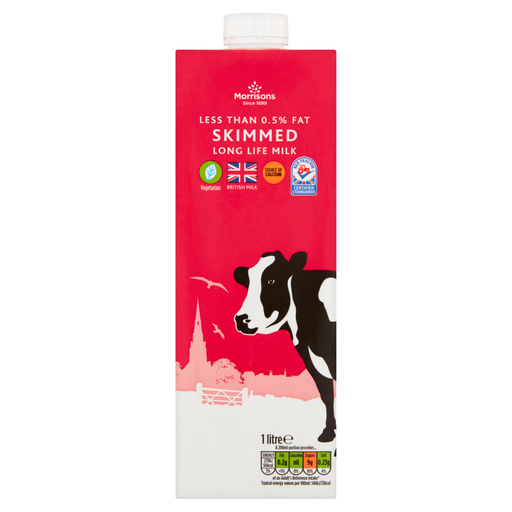
This UHT skimmed-milk option is relevant if you want an unopened carton for the Christmas food shop rather than another chilled bottle.
 No image available
The 1-litre UHT format is an option for an unopened cupboard backup. After opening, refrigerate and use within 3 days as stated for this product. Its listing carries an under-five warning; check the warning’s applicability before buying it for or serving it to a child under five.
“Mature” is not a useful selection category in the skimmed-milk ranges considered here. For a Christmas shop, compare fresh, filtered or UHT format, then check the pack’s date, storage directions and volume.
Choose fresh skimmed milk if you have fridge space and expect to use it within its instructions. UHT skimmed milk is an alternative for an unopened cupboard backup; refrigerate it after opening and follow the individual carton’s directions.
No. Sainsbury’s announced a move to best-before labels for its own-brand milk range in 2023, but another product may carry different wording. Read the date label and storage instructions on the pack you buy.
Use the period stated on the exact bottle or carton, rather than assuming one period applies to fresh, filtered and UHT milk. Refrigerate it as directed and choose a pack size you expect to finish within those instructions.