Families with children aged 5 or over
For lunches, cereal, drinks or cooking, the practical choice is how much milk the household will use and whether a fresh, filtered or UHT pack fits that pattern.


Ordinary fresh skimmed milk suits a household that will use it promptly; filtered fresh milk is worth considering when holiday routines vary, provided its stated storage period fits your plans. An unopened UHT carton offers another way to keep milk at home, but its instructions change once opened. For children under 5, the NHS advises against skimmed milk as a main drink because it does not contain enough fat.
For lunches, cereal, drinks or cooking, the practical choice is how much milk the household will use and whether a fresh, filtered or UHT pack fits that pattern.
Age changes the decision. The NHS says skimmed or 1% milk is not recommended as a main drink for children under 5 because it does not contain enough fat, although it may be used in cooking from age 1.
Days out can interrupt the usual milk routine. Compare the unopened date and instructions after opening before deciding between a chilled bottle, filtered milk and an unopened UHT back-up.
Start with who will drink the milk, then choose a format and pack size that fit how often your household will use it.
| Priority | What to check | Your needs |
|---|---|---|
| Child’s age | Identify who will drink the milk. The NHS advises against skimmed or 1% milk as a main drink for under-5s; it says either may be used in cooking from age 1. | If a child under 5 needs a main drink with lunch, I should not choose skimmed milk for that purpose. |
| Storage format | Check the date on a standard fresh bottle. Sainsbury’s lists up to 3 weeks unopened and 7 days opened for its named Cravendale filtered milk; Waitrose states up to one month unopened and 7 days opened for its named filtered milk. Follow the instructions on the pack you buy. | Our plans change from day to day, so I want a pack whose dates and opened-life instructions fit when we will actually use it. |
| UHT back-up | Check both the unopened date and the instructions after opening. Waitrose says its Essential Long Life Skimmed Milk must be refrigerated below 5°C and used within 5 days once opened. | I would like an unopened carton at home in case the fresh milk runs out, but I can refrigerate it after opening. |
| Pack size and label | Compare the volume with likely use, especially when buying several cartons. Read the current nutrition, ingredient and storage information on the particular pack rather than applying one product’s figures to another. | A smaller pack may fit our routine if we only use milk occasionally; for regular use, I can compare larger bottles or multipacks against their dates. |
| Milk allergy | Check the current allergen label and the child’s agreed dietary arrangements. The Food Standards Agency identifies milk as an allergen; removing fat does not remove milk from dairy skimmed milk. | If a child has a milk allergy, I need to follow their agreed plan rather than substitute dairy skimmed milk. |
The NHS says skimmed or 1% milk does not contain enough fat for use as a main drink by children under 5.
Check the age of the child who will drink it. The NHS distinguishes a main drink from use in cooking, where skimmed milk may be used from age 1.
Sainsbury’s Cravendale and Waitrose’s named filtered products each state 7 days after opening, while M&S says its cited fresh skimmed milk is best consumed within 3 days of opening.
Read the opened-life instruction before choosing a bottle size; do not apply a filtered product’s claim to a different milk.
A bottle larger than the household can use within its stated opened period may leave milk unused.
Skimmed dairy milk still contains milk, which the Food Standards Agency identifies as an allergen.
Read the current label and follow the child’s agreed dietary plan. For a meal provided by a school or holiday club, confirm any proposed substitution with the responsible provider.
These examples help distinguish formats and pack instructions; a brand name alone does not establish how long an individual bottle will keep.
A filtered fresh skimmed option for households comparing the stated life of individual chilled products.
An own-label range with standard British skimmed milk in several sizes and a filtered option.
Own-label British skimmed milk in standard fresh-bottle sizes.
A chilled skimmed milk example with specific nutrition and storage information.
Own-label skimmed products that include filtered fresh milk and a long-life UHT carton.
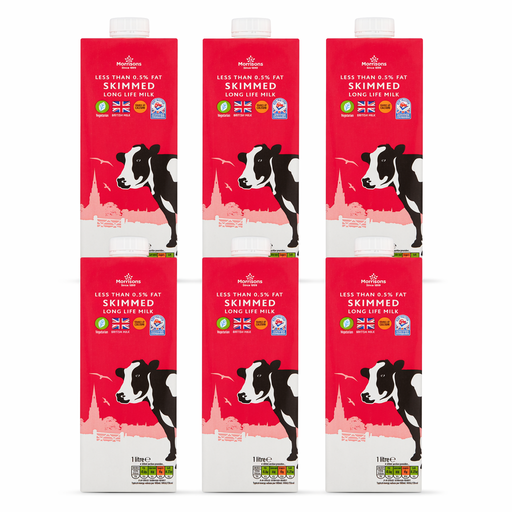
For an unopened household back-up during the school holidays, these Morrisons UHT skimmed milk options differ in pack size.
 No image available
Six 1 litre UHT cartons offer several unopened packs for household use. The product instructions say to refrigerate after opening and use within 3 days; check each carton’s best-before date. The NHS advises against skimmed milk as a main drink for children under 5.
No image available
This single UHT carton suits a household seeking one unopened back-up. Its instructions say to refrigerate after opening and use within 3 days; check the carton’s best-before date. The NHS advises against skimmed milk as a main drink for children under 5.
No. The NHS says skimmed or 1% milk is not recommended as a main drink for children under 5 because it does not contain enough fat. It says either may be used in cooking from age 1.
Consider it when irregular holiday plans make a product’s stated opened and unopened periods useful. Sainsbury’s Cravendale and Waitrose’s named filtered skimmed milks each state 7 days after opening, but their unopened claims differ. If milk will be used promptly, compare standard fresh bottles too, and check the dates on whichever pack you choose.
Follow the particular carton’s instructions. Waitrose says its Essential Long Life Skimmed Milk must be refrigerated below 5°C and consumed within 5 days after opening; the Morrisons UHT cartons shown here specify refrigeration and use within 3 days.
No: skimmed dairy milk still contains milk, an allergen identified by the Food Standards Agency. Follow the child’s agreed dietary plan and check the current label; confirm proposed substitutions with the school or holiday club when they provide the meal.