Bakers keeping the milk ingredient low in fat
Skimmed milk lets you include cow’s milk in a dough while choosing a milk with little declared fat. Check the full recipe too, particularly if it contains butter, oil or eggs.


Skimmed milk is a practical choice when a bread recipe calls for it, or when the dough already contains butter, oil or eggs and you want to keep the milk ingredient low in fat. If a recipe specifies a richer milk, check its other fat ingredients before changing it. Research published in Foods on a tested wheat-bread formula found firmer, lower-volume bread at higher levels of milk-for-water replacement; it does not establish how every skimmed-milk substitution will turn out.
Skimmed milk lets you include cow’s milk in a dough while choosing a milk with little declared fat. Check the full recipe too, particularly if it contains butter, oil or eggs.
If the recipe specifies semi-skimmed or another richer milk, consider what that milk contributes before swapping it. A recipe-specific trial is more useful than assuming the loaf will be unchanged.
A smaller pack may fit occasional baking. If you need a longer stated period after opening, compare the exact product’s chilled-storage instructions: Tesco’s Arla B.O.B listing, for example, says it is best used within seven days of opening.
Start with the recipe’s specified milk and the amount it uses, then choose a pack you can store and use as directed.
| Priority | What to check | Your needs |
|---|---|---|
| Recipe fit | Check the specified milk type, how much water the milk would replace, and whether butter, oil or eggs are already in the dough. In a tested wheat-bread formula, research published in Foods recommended less than 25% milk-for-water replacement to limit changes to the loaf; that is not a universal conversion rule. | I want to adapt a bread recipe without assuming that changing its milk or water will leave the crumb and volume unchanged. |
| Declared fat | Compare fat using the same quantity on current labels. Sainsbury’s and Waitrose list less than 0.5 g fat per 100 ml for their cited standard skimmed milks. Do not use the milk’s fat figure alone to predict the finished loaf. | Keeping the milk ingredient low in fat matters to me, but I also need to account for the rest of the recipe. |
| Pack and storage | Check pack size, the use-by date, refrigeration instructions and the period after opening. The cited Sainsbury’s and Waitrose fresh skimmed milks say to consume within three days of opening; Tesco’s Arla B.O.B listing says best within seven days when kept below 5°C. | If I bake only occasionally, I would rather choose a pack and stated storage window that fit how I will use the milk. |
| Milk format | Distinguish fresh, filtered and UHT products, then follow the exact pack’s storage directions. A freshness description does not establish how the milk will perform in bread. | I may want an unopened carton available for a later bake, or fresh milk for a recipe that specifies it. |
| Milk allergen | Read the ingredient and allergen label on the pack being used. Sainsbury’s declares milk as an allergen on its cited skimmed product; removing milk fat does not remove milk. | If someone eating the bread must avoid milk, skimmed cow’s milk is not a milk-free substitute. |
In a wheat-bread study published in Foods, higher milk-for-water replacement was associated with a firmer crumb, lower volume and lower porosity than the control.
Follow the recipe’s liquid instructions where possible. If adapting it, try a small batch rather than treating the study’s recommendation as a rule for every dough.
Several cited fresh skimmed milks instruct customers to consume them within three days of opening, even though bottles come in different sizes.
Choose a size that fits your expected use and follow the bottle’s refrigeration and use-by instructions.
Milk left after its stated opened-life may need to be discarded.
Skimmed cow’s milk remains a milk ingredient; the cited Sainsbury’s product explicitly declares milk as an allergen.
For a milk-free recipe, check the label of a suitable alternative and whether that alternative works in the particular recipe.
The carton you use carries the instructions and declarations relevant to that product.
Before baking, check its ingredients, allergen declaration, use-by date and storage directions.
These fresh-milk examples provide points of comparison for labels, pack sizes and storage; their inclusion does not indicate that they are among the Joybuy products below.
Tesco’s skimmed-milk range includes own-label fresh milk and a separately listed filtered Cravendale option.
Its British fresh skimmed milk is listed in a 1.136 L, two-pint pack.
Asda lists a British fresh skimmed milk in a 1.136 L, two-pint pack.
M&S lists a 568 ml fresh skimmed milk.
Waitrose lists an Essential British Free Range skimmed milk and a separate Duchy Organic skimmed line.
Tesco Groceries lists a 2 L filtered fresh skimmed Cravendale milk.
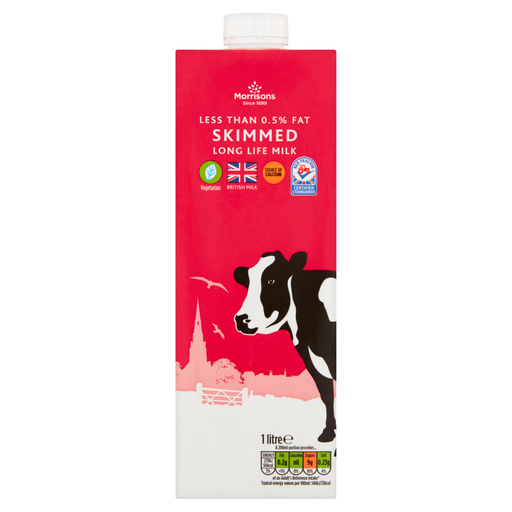
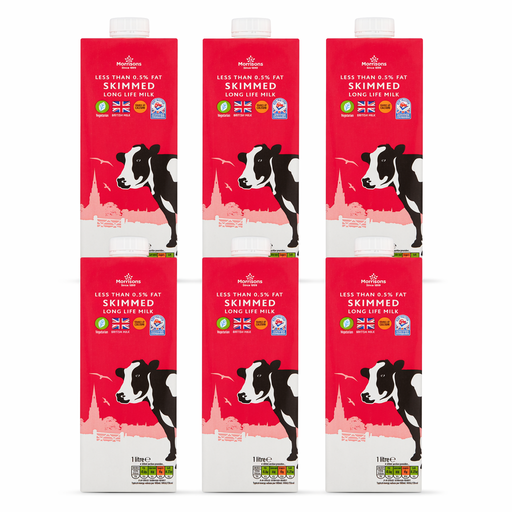
These Morrisons UHT skimmed-milk cartons offer a single litre or six separate one-litre cartons for bread recipes in which skimmed milk fits. Choose the quantity with your expected use and the carton instructions in mind.
 No image available
One 1-litre UHT carton may suit a recipe calling for skimmed milk without committing to a multipack. Check the recipe’s milk type and the carton’s use-by and storage instructions before baking.
 No image available
Six separate 1-litre UHT cartons may suit repeated baking or other planned uses of skimmed milk. Check each carton’s use-by and storage instructions and whether you will use the full pack.
Do not assume a full replacement will produce the same loaf. In a tested wheat-bread formula, research published in Foods associated higher milk-for-water replacement with a firmer crumb, lower volume and lower porosity, and recommended replacement below 25% to minimise those effects. Use the recipe’s instructions or test an adaptation in a small batch; the study is not a rule for every bread.
Choose it when the recipe specifies skimmed milk, or when you want to keep the milk ingredient low in fat and have considered the recipe’s other ingredients. The cited Sainsbury’s and Waitrose standard skimmed milks list less than 0.5 g fat per 100 ml, but that figure alone cannot tell you how a particular loaf will turn out.
Follow the exact pack’s instructions. The cited Sainsbury’s, Asda, M&S and Waitrose fresh skimmed products say to consume within three days of opening; Tesco’s Arla B.O.B listing instead says best within seven days when kept below 5°C.
No. Skimmed cow’s milk remains milk: Sainsbury’s declares milk as an allergen on its cited product, and Waitrose lists skimmed milk as the ingredient on its Essential product. Check the current label if someone eating the bread must avoid milk.
A filtered or longer-freshness description does not establish a bread-baking result. Check the exact product’s label and storage instructions, and choose the milk type that fits your recipe rather than expecting a particular crumb or rise from its freshness description.