People following a strict keto plan
A skimmed-milk serving needs to be counted against their carbohydrate allowance. The British Dietetic Association describes very-low-carbohydrate ketogenic diets as 20–50g carbohydrate per day.


For a strict ketogenic plan, do not treat family-size skimmed milk as an unrestricted everyday drink: Tesco and Sainsbury’s each list 5.0g carbohydrate per 100ml for their four-pint bottles, while the British Dietetic Association describes very-low-carbohydrate ketogenic diets as 20–50g carbohydrate per day. A larger bottle can still suit a household that uses skimmed milk regularly if the person following keto measures their portion; choose the pack size by how much the household can use after opening.
A skimmed-milk serving needs to be counted against their carbohydrate allowance. The British Dietetic Association describes very-low-carbohydrate ketogenic diets as 20–50g carbohydrate per day.
The household may use a larger bottle regularly, while one person measures the milk they add to drinks or recipes. Tesco and Sainsbury’s each list 5.0g carbohydrate per 100ml for their four-pint skimmed milks.
A four-pint bottle and a filtered 2L bottle offer different amounts and opened-pack guidance. Comparing that guidance with usual household use can help avoid buying more milk than will be used.
Start with carbohydrate per measured serving, then choose a format the household can use within its opened-pack guidance.
| Priority | What to check | Your needs |
|---|---|---|
| Carbohydrate per serving | Read carbohydrate per 100ml and measure the amount poured. Tesco and Sainsbury’s each list 5.0g per 100ml for their four-pint skimmed milks, equivalent to 10.0g per 200ml. | I need to know how much milk fits my own plan. The British Dietetic Association describes very-low-carbohydrate ketogenic diets as 20–50g carbohydrate per day. |
| Bottle size and storage | Compare the volume with likely use after opening. Tesco says its four-pint bottle is best within 5 days once opened; Sainsbury’s says to consume its four-pint bottle within 3 days. Arla says Cravendale filtered skimmed milk lasts up to 7 days once opened. | Will the household finish a four-pint bottle in time, or would a 2L filtered bottle better match how quickly we use milk? |
| Fat and carbohydrate labels | Check fat and carbohydrate separately, using each product’s stated nutrition basis. Tesco lists 0.1g fat and 5.0g available carbohydrate per 100ml; Arla B.O.B. lists 0.4g fat and 4.9g carbohydrate per 100g. | Skimmed milk suits our preference for less fat, but I cannot use its fat description to judge whether a serving fits a carbohydrate limit. |
Tesco and Sainsbury’s each list 5.0g carbohydrate per 100ml for their four-pint skimmed milks. A 200ml serving therefore accounts for 10.0g, which matters when compared with the British Dietetic Association’s 20–50g daily range for very-low-carbohydrate ketogenic diets.
Use the carbohydrate figure and the amount actually poured, rather than the fat description, to assess a serving.
Opened-pack guidance differs: Tesco says its four-pint skimmed milk is best within 5 days, while Sainsbury’s says to consume its four-pint bottle within 3 days.
Compare those periods with how quickly the household uses milk, and follow the instructions on the pack bought.
Milk left unused at the end of the opened-pack period may go to waste.
Arla’s stated longer opened life for Cravendale concerns storage, not carbohydrate content. Its Arla B.O.B. filtered skimmed milk lists 4.9g carbohydrate per 100g.
If considering filtered milk for a keto plan, check the carbohydrate value on that specific product’s current label.
Great Ormond Street Hospital NHS Foundation Trust describes the ketogenic diet as a medical therapy for drug-resistant epilepsy. General supermarket buying advice is not a substitute for an individual treatment plan.
Ask the clinical team before changing the milk or portion used in a prescribed diet.
These references cover four-pint skimmed bottles and filtered 2L options; each product’s label and storage instructions matter more than the brand name alone.
Tesco British Skimmed Milk comes in a 2.272L, four-pint bottle.
Sainsbury’s British Skimmed Milk is listed in a 2.27L, four-pint bottle.
Waitrose lists Essential British Free Range Skimmed Milk in a 2.272L, four-pint format.
M&S offers Scottish Skimmed Milk in a four-pint pack.
Arla Cravendale Filtered Skimmed Milk is a 2L option rather than a four-pint bottle.
Arla B.O.B. Skimmed Milk is a filtered 2L product.
This option is a multipack of smaller UHT skimmed-milk cartons, rather than one four-pint fresh-milk bottle. For a keto-oriented household, check the carbohydrate label and plan the amount used per serving.
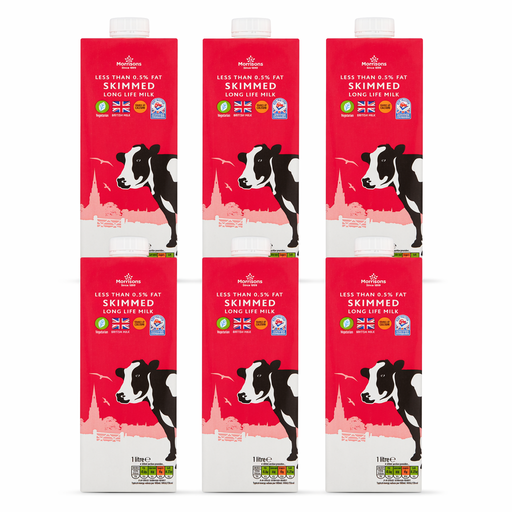 No image available
Six separate 1-litre UHT skimmed-milk packs may suit a household that uses milk across several cartons. Check the current carton’s carbohydrate value per 100ml and measure servings if someone is following a carbohydrate limit; the skimmed description alone does not establish keto suitability.
Do not treat it as an unrestricted drink. Tesco and Sainsbury’s each list 5.0g carbohydrate per 100ml for their four-pint skimmed milks, or 10.0g per 200ml; the British Dietetic Association describes very-low-carbohydrate ketogenic diets as 20–50g carbohydrate per day. Measure any serving you use and account for it within your own plan.
No: fat and carbohydrate are separate nutrition-label values. Tesco lists 0.1g fat and 5.0g available carbohydrate per 100ml for its four-pint skimmed milk. Read the carbohydrate figure on the specific product rather than relying on its skimmed description.
Choose according to how quickly the household uses milk after opening. Tesco says its four-pint skimmed milk is best within 5 days once opened, Sainsbury’s says to consume its four-pint bottle within 3 days, and Arla says its 2L Cravendale filtered skimmed milk lasts up to 7 days once opened. Follow the storage guidance on the pack you buy.
Check with your clinical team before changing it. Great Ormond Street Hospital NHS Foundation Trust describes the ketogenic diet as a medical therapy for drug-resistant epilepsy, so a general comparison of supermarket milk cannot determine what belongs in an individual treatment plan.
Check the current product’s ingredients and allergen declaration before buying. The Food Standards Agency identifies milk as an allergen; choosing skimmed or filtered milk does not change the need to check that label.