People following strict keto
Milk added to tea, coffee or cereal still contributes carbohydrate. Dairy UK lists 10.0 g carbohydrate in a 200 ml glass of conventional skimmed milk, so measure even the amounts you add to drinks.


Conventional skimmed milk is a difficult fit for a strict keto routine: Dairy UK lists 5.0 g carbohydrate and 0.3 g fat per 100 ml, so a 200 ml glass contributes 10.0 g carbohydrate. A measured amount may fit a broader low-carbohydrate plan if you count it within your own allowance; check the current carton’s carbohydrate figure and the amount you will use.
The same carton can call for a different decision depending on whether you are following strict keto, a broader low-carbohydrate plan or a medically supervised diet.
Milk added to tea, coffee or cereal still contributes carbohydrate. Dairy UK lists 10.0 g carbohydrate in a 200 ml glass of conventional skimmed milk, so measure even the amounts you add to drinks.
A measured serving may fit your own carbohydrate allowance. Compare the carton’s carbohydrate declaration rather than treating a skimmed or fat-free label as a statement about carbohydrate.
Medical ketogenic dietary therapy is supervised, according to NHS guidance. If you take an SGLT2 inhibitor or follow a prescribed ketogenic diet, speak to the clinician or specialist dietitian responsible for your care before substantially reducing carbohydrate intake; the Medicines and Healthcare products Regulatory Agency warns of a serious ketoacidosis risk associated with SGLT2 inhibitors.
Start with carbohydrate per 100 ml, then calculate what your usual pour contributes; processing and fat content do not replace that calculation.
| Priority | What to check | Your needs |
|---|---|---|
| Carbohydrate per serving | Read carbohydrate per 100 ml on the current carton and calculate it for the amount poured. Dairy UK lists conventional skimmed milk at 5.0 g per 100 ml and 10.0 g per 200 ml. | I add milk to drinks or cereal and want to count the amount I actually use, rather than overlooking several small pours. |
| Fat and milk type | Compare carbohydrate and fat separately. Dairy UK lists skimmed milk at 0.3 g fat per 100 ml; its tables list 5.0 g carbohydrate per 100 ml for skimmed milk and 4.7 g for whole milk. | A skimmed label matters to my milk choice, but I do not want to mistake lower fat for little or no carbohydrate. |
| Filtered or enriched milk | Check the particular carton’s carbohydrate declaration. Filtering or added protein does not, on its own, establish how much carbohydrate a serving contains. | If I choose a filtered or protein-enriched carton, I still need its serving to fit the carbohydrate amount I have planned. |
| Diet and medicine context | Distinguish a broader low-carb plan from medically supervised ketogenic therapy. Diabetes UK describes low-carb eating as below 130 g carbohydrate a day; that definition is not a personal target or a definition of strict keto. | If my diet is medically prescribed or I take an SGLT2 inhibitor, I need advice from my care team before making a major carbohydrate change. |
Skimmed describes fat content, not the absence of carbohydrate. Dairy UK lists 5.0 g carbohydrate per 100 ml of conventional skimmed milk.
Read carbohydrate per 100 ml and multiply it by the amount you will pour; a 200 ml serving contributes 10.0 g on Dairy UK’s figures.
Dairy UK lists 4.7 g carbohydrate per 100 ml for whole milk, compared with 5.0 g for skimmed milk. Changing the fat level does not remove the need to count milk carbohydrate.
Compare the complete nutrition labels and your intended serving rather than choosing by fat content alone.
Those descriptions identify processing or formulation, not the carbohydrate amount in a serving. Tesco also advises shoppers to read current food labels because nutrition information can change.
Use the carbohydrate declaration on the particular carton you are buying.
The Medicines and Healthcare products Regulatory Agency has warned about serious diabetic ketoacidosis in people taking SGLT2 inhibitors. NHS sources describe medical ketogenic dietary therapy as supervised.
If either situation applies, consult the clinician or specialist dietitian responsible for your care before substantially reducing carbohydrate intake.
These examples show different skimmed-milk formats and descriptions; none of those descriptions establishes suitability for a strict keto plan.
Tesco lists own-label British skimmed milk in several pack sizes.
Tesco lists a 2 L filtered fresh skimmed milk from Cravendale.
Tesco describes Arla B.O.B skimmed milk as filtered and enriched with protein.
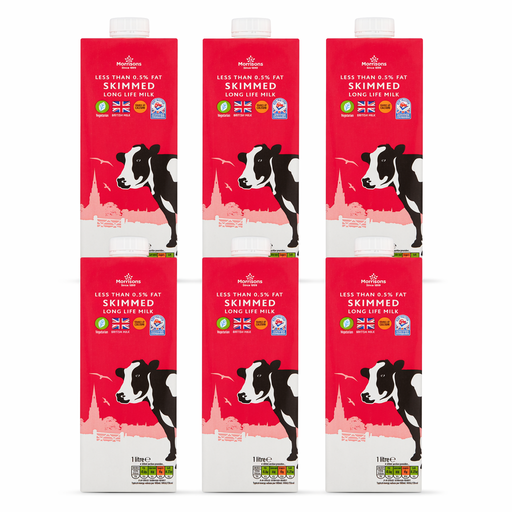
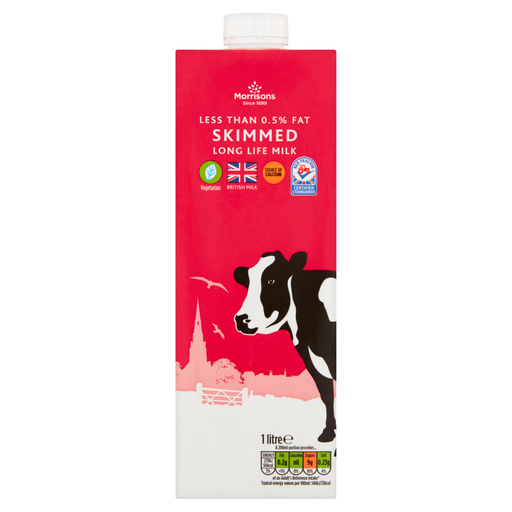
These Morrisons UHT skimmed milk options are for measured use within a broader low-carbohydrate plan, rather than routine servings in a strict keto plan. The choices differ by pack configuration.
 No image available
For measured use when skimmed milk fits your broader low-carbohydrate plan; check the carton’s carbohydrate declaration and count the amount poured. This option contains six 1 litre UHT packs. The product information says to refrigerate after opening and use within three days, and says it is not suitable for children under five.
 No image available
A single 1 litre UHT pack for measured use if its carbohydrate contribution fits your broader low-carbohydrate plan. Check the current carton and count the amount used. The product information says to refrigerate after opening and use within three days, and says it is not suitable for children under five.
It is a difficult fit unless that carbohydrate has been deliberately accounted for in your plan. Dairy UK lists 10.0 g carbohydrate in 200 ml of conventional skimmed milk; check the figure on your carton if you use a different product.
No. Dairy UK lists 4.7 g carbohydrate per 100 ml for whole milk and 5.0 g for skimmed milk. Count the serving of whichever milk you choose.
A measured serving may fit if you include its carbohydrate in your own plan. Diabetes UK describes low-carb eating as below 130 g carbohydrate a day, but that broad definition is not an individual target or the same as strict keto.
Speak to the clinician managing your medicines before making a major carbohydrate reduction. The Medicines and Healthcare products Regulatory Agency warns of serious diabetic ketoacidosis associated with SGLT2 inhibitors and advises discussion of risk factors and symptoms.
No. Skimmed milk is still dairy milk. The Food Standards Agency identifies milk and its constituents as an allergen risk; check the current label and do not use dairy milk if you have a diagnosed milk allergy.