Who is this choice for?
The deciding factor is whether regular milk fits the individual diet; pack size and storage then determine whether a larger purchase is practical.
Households with different lactose needs
If one person follows a low-FODMAP plan, do not assume everyone needs the same milk. Monash FODMAP says lactose restriction depends on the individual, while Cambridge University Hospitals advises discussing that part of the plan with a dietitian.
Households considering a larger pack
Check how much regular milk the household uses after opening. Sainsbury's says its 2.272L bottle should be used within three days of opening; the Cravendale and Waitrose filtered products described by their retailers state seven days.
Shoppers reducing lactose but keeping dairy
A lactose-free dairy product may meet this preference, but check the exact variant. The Arla Lactofree semi-skimmed product listed by Waitrose states less than 0.03% lactose and warns that it is unsuitable for people with a milk allergy.
What should you check?
Establish whether regular milk is suitable for the person following the diet, then compare the container size, opened-life and ingredients of the options you would actually use.
| Priority | What to check | When it matters |
|---|
| Lactose |
Check whether the individual plan calls for lactose restriction. Read the exact milk's lactose statement; skimmed describes fat content, not lactose content. |
I can use regular skimmed milk only if it fits the relevant person's diet. Monash FODMAP says regular dairy contains lactose, but not everyone on a low-FODMAP diet needs to limit it. |
| Pack size |
Compare container volumes and how many you will open at once. Sainsbury's lists approximately 11 servings for its 2.272L bottle, with a three-day opened-life. |
Will we use a large opened bottle quickly enough, or would separate smaller containers be easier to manage? |
| Opened-life |
Read the storage instructions for the exact product. The Cravendale and Waitrose filtered skimmed milks listed by their retailers state seven days after opening; filtering is not a lactose-free claim. |
A longer stated opened-life matters if we use regular milk slowly, but it does not resolve a need to restrict lactose. |
| Plant alternatives |
Check the base ingredient and the exact product's FODMAP suitability. For a calcium-fortified alternative, Monash FODMAP advises checking for at least 120mg calcium per 100ml. |
If I replace dairy, I want to compare the particular drink's ingredients and nutrition panel rather than assume all plant drinks are alike. |
| Milk allergy |
Read the allergen declaration: lactose-free cow's milk remains milk-based. The Arla Lactofree product listed by Waitrose explicitly warns that it is unsuitable for people with a milk allergy. |
If someone must avoid milk proteins, I need a milk-free option, not simply one labelled lactose-free. |
Relevant brand references
These examples illustrate different pack and milk types; their details apply to the named products, not every product from each brand.
Sainsbury's
Its British skimmed milk comes in a 2.272L, four-pint bottle for households using regular dairy.
- Sainsbury's lists approximately 11 servings and instructs shoppers to use this bottle within three days of opening.
- It is regular milk, so pack size does not make it appropriate for someone who needs to restrict lactose.
Cravendale
Its filtered 2L skimmed milk is a regular-dairy option with a longer stated opened-life.
- The Sainsbury's listing states that the Cravendale product lasts seven days after opening.
- That storage statement is not a lactose-free claim.
Waitrose
Its filtered British skimmed milk is another regular-milk option for shoppers comparing storage instructions.
- The Waitrose product listing states that the milk should be consumed within seven days of opening.
- The listed ingredient is skimmed milk; filtering does not establish that it is lactose-free.
Arla Lactofree
The semi-skimmed 1L dairy product listed by Waitrose is an alternative when lactose reduction, rather than a skimmed family pack, is the priority.
- The listing states less than 0.03% lactose for this specific product.
- It remains milk-based and is labelled unsuitable for people with a milk allergy.
Joybuy skimmed-milk options
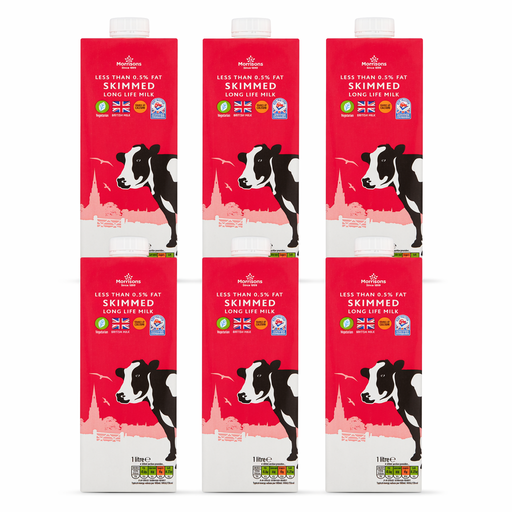
This six-pack offers separate cartons of regular skimmed milk for a household that can use regular dairy; it is not a lactose-free alternative.
 No image available
Morrisons British UHT Skimmed Milk, six 1-litre cartons
Separate 1-litre cartons may suit a household that opens milk one carton at a time, provided regular milk fits the diet of everyone drinking it. This is a six-pack of UHT skimmed milk, not a lactose-free product. Check the carton's storage and after-opening instructions; the product information also says it is unsuitable for children under five.
View on Joybuy
Frequently asked questions
Is skimmed milk automatically suitable for a low-FODMAP diet?
No. Skimmed describes fat content, not lactose content. Monash FODMAP says regular dairy contains lactose, although an individual following a low-FODMAP diet does not necessarily need to restrict it.
When does a four-pint bottle make sense?
It can make sense when regular milk suits the people drinking it and the household can use the opened bottle in time. Sainsbury's lists approximately 11 servings for its 2.272L bottle and says to consume it within three days of opening.
Does filtered skimmed milk solve a lactose concern?
No: a longer stated opened-life does not establish lactose-free status. The Cravendale and Waitrose filtered skimmed milks described by their retailers state seven days after opening; consider that feature for storage when regular milk is otherwise suitable.
Can someone with a milk allergy have lactose-free dairy milk?
No. Lactose-free dairy remains milk-based. Monash FODMAP distinguishes milk allergy from lactose intolerance, and the Arla Lactofree product listed by Waitrose explicitly warns that it is unsuitable for people with a milk allergy.
What should I check on a plant-milk alternative?
Check the exact ingredients and nutrition panel rather than relying on a plant-based label. Monash FODMAP distinguishes soy drinks made from soy protein from those made from whole soya beans for FODMAP purposes, and advises checking for at least 120mg calcium per 100ml in a calcium-fortified alternative.


