Plain skimmed milk is a straightforward choice for a late-night drink or cereal when fat content is the main consideration: the Sainsbury's fresh and UHT examples list under 0.5g fat and 33–37kcal per 100ml. Choose a fresh bottle you can finish within its stated opened life, filtered milk if its longer stated opened life would help you use the bottle, or UHT milk for an unopened cupboard reserve. A higher-protein skimmed option is worth comparing if its nutrition and taste positioning matter to you, but the taste claim is not an independent test.
Who is each option for?
Late-night cereal or drink snackers
If you want to compare fat and energy, start with the amount of milk you will pour. Sainsbury's reviewed fresh and UHT skimmed milks list under 0.5g fat and 33–37kcal per 100ml; cereal or additions need to be considered separately.
Occasional milk users
If you open milk only for an occasional evening drink or bowl of cereal, compare pack size with the time allowed after opening. The reviewed Cravendale filtered milk states seven days once opened; UHT milk can serve as an unopened cupboard reserve but needs refrigeration after opening.
Shoppers comparing taste and protein
If ordinary skimmed milk does not appeal to you, Arla B.O.B is another skimmed option to consider. The Waitrose product information lists 4.5g protein per 100ml; its semi-skimmed-style taste description is Arla's claim, not a result of independent taste testing.
What should you check before buying?
Compare the amount you will use, then choose a pack and storage format that fit how often you open milk at night.
| Priority | What to check | Your needs |
|---|
| Fat and energy |
Compare the same per-100ml basis and your intended serving. Sainsbury's reviewed fresh and UHT skimmed milks list under 0.5g fat and 33–37kcal per 100ml. |
I want to know what my usual glass or cereal serving contains, rather than assuming skimmed milk has no calories. |
| Protein and taste |
Check protein and energy together. Sainsbury's fresh skimmed milk lists 3.6g protein and 37kcal per 100ml; the reviewed Arla B.O.B lists 4.5g and 41kcal per 100ml. Arla's taste comparison is a brand claim. |
If milk is the main part of my snack, I may want to compare protein. Taste still matters, but a description cannot tell me whether I will like it. |
| Pack and storage |
Read the exact unopened and opened storage instructions. The reviewed Sainsbury's fresh milk says three days after opening; Cravendale states seven days. Reviewed UHT cartons require refrigeration once opened. |
Milk is only an occasional evening staple for me, so I want a pack I can finish within its stated opened life. |
| Additions |
Read the milk's per-serving information, then check cereal, cocoa, sugar or other additions separately. The milk label does not describe the whole snack. |
What I mix with the milk may change the serving I am comparing. |
| Milk and lactose |
Check the exact product's ingredients and allergen label. The NHS distinguishes lactose intolerance from food allergy, and the Food Standards Agency identifies milk as an allergen. |
If milk causes symptoms or I have a milk allergy, choosing a skimmed version does not remove the need to check whether the product is suitable. |
What can catch you out?
-
Assuming every skimmed milk keeps for the same time
Opened-life instructions differ: the reviewed Sainsbury's fresh milk says three days, Cravendale states seven days, and the reviewed UHT cartons specify three or five days after opening, depending on the product.
Match the pack to how often you use milk and follow its own storage instructions. UHT milk also needs refrigeration after opening.
A larger bottle may go unused if you cannot finish it within its stated opened life.
-
Treating skimmed milk as calorie-free
Sainsbury's reviewed fresh and UHT skimmed milks list 33–37kcal per 100ml. Cereal, cocoa, sugar and other additions are separate parts of the snack.
Use the label to work out the amount of milk in your serving, then check any additions on their own labels.
-
Confusing lactose intolerance with milk allergy
The NHS describes lactose intolerance as a reaction to lactose in dairy and distinguishes it from food allergy. The Food Standards Agency identifies milk as an allergen; skimmed cow's milk is still milk.
Do not treat ordinary skimmed milk as a substitute for someone with a milk allergy. If you have recurring symptoms and are unsure of the cause, seek clinical advice.
Brands and retailer ranges to compare
Tesco
Tesco's skimmed-milk range includes standard fresh bottles as well as filtered, organic and branded choices.
- The listed standard fresh bottles come in different sizes, so pack size can be matched to how quickly you use milk.
- For occasional use, check the chosen bottle's opened-life instructions before opting for a larger pack.
Sainsbury's
Sainsbury's reviewed products offer both chilled fresh skimmed milk and a UHT carton for cupboard storage before opening.
- The reviewed fresh product lists 37kcal and under 0.5g fat per 100ml; the UHT product lists 33kcal and under 0.5g fat per 100ml.
- Both reviewed products instruct users to refrigerate after opening and use within three days.
Cravendale
Cravendale's reviewed filtered fresh skimmed milk is an option when the stated opened life matters more than choosing a smaller standard bottle.
- The Tesco product information lists 0.3g fat and 37kcal per 100ml.
- The seven-day opened-life and up-to-three-week unopened freshness statements are Cravendale claims shown on the retailer page; follow the bottle's instructions.
Arla B.O.B
Arla B.O.B is a filtered skimmed-milk option for comparing protein content and a brand-described semi-skimmed-style taste.
- The reviewed Waitrose product information lists 4.5g protein, 0.4g fat and 41kcal per 100ml.
- The taste description is Arla's positioning, not an independently established comparison.
Waitrose essential
The reviewed essential long-life skimmed milk is a UHT option for keeping unopened in reserve.
- Its product information lists 37kcal and under 0.5g fat per 100ml.
- Once opened, the carton must be refrigerated below 5°C and consumed within five days.
M&S
The reviewed M&S fresh skimmed milk comes in a 568ml bottle, a size to consider if a larger bottle would be difficult to finish.
- M&S lists 37kcal and 0.3g fat per 100g for this product.
- M&S says to refrigerate it at 0–5°C and that it is best consumed within three days after opening.
Joybuy UHT skimmed milk option
This UHT carton represents the unopened cupboard-reserve route for an occasional late-night drink or bowl of cereal.
 No image available
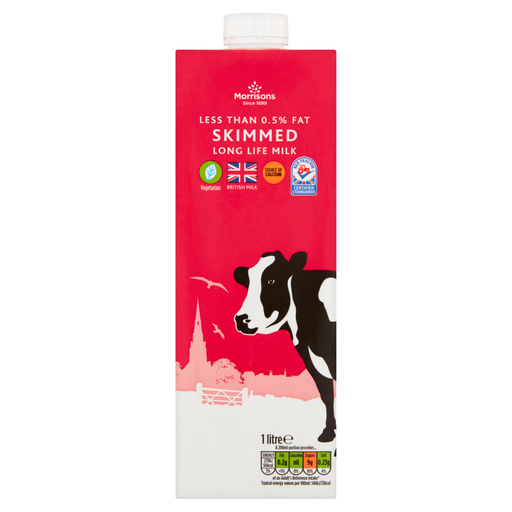
Morrisons British UHT Skimmed Milk 1 Litre
A 1-litre UHT carton to consider when you want unopened milk in reserve for an occasional snack. Follow the carton's instructions to refrigerate after opening and use within three days. It contains milk, so it is not suitable for someone with a milk allergy; the product information also states that it is not suitable for children under five.
View on Joybuy
Common questions
How much fat and energy are in the reviewed skimmed milks?
Sainsbury's reviewed fresh and UHT examples list under 0.5g fat and 33–37kcal per 100ml. For 200ml, those stated energy values correspond to 66–74kcal before cereal, cocoa, sugar or other additions.
Which format makes sense if I only use milk occasionally?
UHT skimmed milk can be kept as an unopened cupboard reserve, while a smaller fresh bottle may suit you if you will finish it promptly. The reviewed Sainsbury's fresh milk says to use it within three days of opening; Cravendale states seven days for its filtered milk. Refrigerate UHT milk after opening and follow the particular carton's deadline.
Does skimmed cow's milk still contain lactose?
Yes. Removing fat does not make cow's milk lactose-free. The NHS explains that lactose intolerance can cause digestive symptoms after consuming dairy containing lactose; seek clinical advice if symptoms recur and you are unsure of the cause.
Is lactose intolerance the same as a milk allergy?
No. The NHS distinguishes food intolerance from food allergy, which can be life-threatening. The Food Standards Agency identifies milk as an allergen, so someone with a milk allergy should not assume that skimmed or lactose-free dairy milk is suitable.


