Parents considering a baby’s night feed
Check the feeding option before looking at milk packs. NHS guidance says skimmed and 1% cow’s milk should not be a main drink before age five; a larger bottle does not change that age limit.


Do not use skimmed cow’s milk as a baby’s night feed or as the main drink for a child under five: NHS guidance says skimmed and 1% cow’s milk should not be given as a main drink until age five. For an adult or child aged five or over who can have cow’s milk, choose a larger pack only if its storage and use-after-opening instructions fit the household’s routine. A multi-carton pack and a single large chilled bottle solve different storage needs.
Check the feeding option before looking at milk packs. NHS guidance says skimmed and 1% cow’s milk should not be a main drink before age five; a larger bottle does not change that age limit.
Compare a single 2L or 2.272L chilled bottle with a pack of smaller cartons according to how much milk you use, where you can store it and the instructions after opening.
Skimmed cow’s milk still contains the milk allergen. The Food Standards Agency identifies milk as a possible risk for people with an allergy or intolerance to milk or its constituents.
Start with the recipient’s age and whether cow’s milk is suitable for them. Then match the pack format and storage instructions to how the milk will be used.
| Priority | What to check | Your needs |
|---|---|---|
| Age and feeding | Identify who will drink the milk. NHS guidance says skimmed and 1% cow’s milk should not be a main drink before age five; for babies under one, use an age-appropriate feeding option instead of skimmed milk. | If I’m preparing a baby’s night feed, bottle size is not the deciding factor: skimmed cow’s milk is not the replacement I need. |
| Pack format | Compare a 2L bottle, a 2.272L four-pint bottle and multiple 1-litre cartons by the amount opened at once. Check the storage space each format requires. | Our household uses skimmed milk regularly, but I want a quantity we can store and finish as directed on the pack. |
| Storage | Read the chosen product’s refrigeration and after-opening instructions. An M&S skimmed-milk label specifies 0°C to +5°C storage and consumption within three days of opening; do not assume every product has identical instructions. | For repeated night-time use, I need to know where the unopened milk goes and how long an opened container can be kept. |
| Milk type | Check whether the product is standard, filtered or UHT skimmed milk, and read its own storage directions. Treat claims about freshness or taste as product-specific rather than a guarantee for every bottle. | I may prefer several unopened cartons to one large chilled bottle, or want to compare the labels on filtered and standard milk. |
| Milk allergen | Check the ingredients and allergen information. According to the Food Standards Agency, milk can pose a risk to people with an allergy or intolerance to milk or its constituents; skimming does not remove the milk allergen. | If someone in the household cannot have cow’s milk, changing its fat level does not address that need. |
A large pack is still skimmed cow’s milk. NHS guidance says it should not be a main drink before age five.
Choose the feeding option appropriate to the child’s age before comparing milk formats.
A single large bottle must be stored according to its label once opened. The reviewed M&S skimmed-milk label calls for refrigeration and consumption within three days of opening.
Compare the amount you will open at one time, and follow the instructions on the bottle you buy.
Milk left beyond the pack’s use-after-opening instructions may have to be discarded.
Skimmed milk remains cow’s milk; reducing its fat content does not remove the milk allergen.
Check the label against the person’s dietary requirements rather than switching between dairy milk fat levels.
A retailer listing may not reflect what is available when you shop. The reviewed Waitrose 2L filtered skimmed milk listing was marked temporarily unavailable online.
Before relying on a particular bottle for regular use, check current availability, its use-by date and its storage and allergen information.
These examples illustrate pack formats and label details; brand inclusion does not indicate which products are available from Joybuy.
Tesco lists British skimmed milk in a 2.272L four-pint bottle and filtered skimmed milk in a 2L bottle.
Cravendale’s 2L filtered fresh skimmed milk is positioned by the brand as “Fresher for Longer”.
Waitrose lists a 2L filtered British free-range skimmed milk.
M&S lists a 2.272L British skimmed-milk bottle. Its skimmed-milk product information also gives specific storage instructions.
Arla B.O.B is skimmed milk that the brand describes as tasting like semi-skimmed milk.
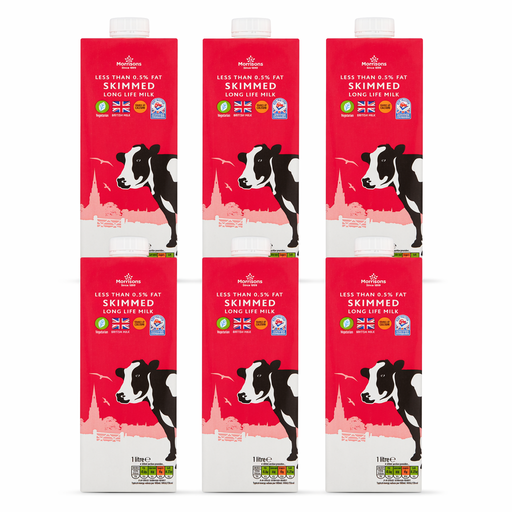
This six-carton UHT skimmed-milk pack is an option for older children or adults who use cow’s milk regularly. It is not a single large fresh bottle or a baby-feeding product.
 No image available
For household use by an adult or child aged five or over who can have cow’s milk, this pack contains six separate 1-litre cartons rather than one large bottle. The product information says unopened cartons do not need refrigeration; refrigerate each carton after opening and consume it within three days. Do not use it as a baby’s night feed or as the main drink for a child under five.
No. For a baby under 12 months, breast milk or infant formula should be the main drink rather than skimmed cow’s milk. NHS guidance also says skimmed and 1% cow’s milk should not be a main drink before age five.
No. NHS guidance says skimmed and 1% cow’s milk should not be given as a main drink until age five. Choose an age-appropriate feeding option rather than treating a larger skimmed-milk pack as a substitute.
Choose according to how much you open and use at a time, as well as the product’s storage instructions. Fresh skimmed milk is listed in 2L and 2.272L bottles, while the Morrisons UHT pack shown here contains six separate 1-litre cartons. Check each product’s after-opening directions.
No. Filtered products may carry freshness-related brand wording, but you still need to read the particular bottle’s use-by date, refrigeration requirements and instructions after opening.
No: skimming does not remove the milk allergen. The Food Standards Agency identifies milk as a possible risk for people with an allergy or intolerance to milk or its constituents, so check the product’s allergen information against the person’s requirements.