Older tea drinkers cutting back on fat
For someone eating normally who wants to keep dairy milk in their afternoon tea, skimmed or 1% milk offers a lower-fat choice. The NHS notes that lower-fat milk retains the nutritional benefits of milk.


Skimmed milk is an option for an older adult who wants to reduce fat in their tea and is eating normally: the NHS notes that it retains the nutritional benefits of milk while containing less fat. If appetite is poor or weight is falling unintentionally, Age UK advises considering full-fat foods instead of applying general low-fat advice. Whichever milk you choose, match the pack to how quickly it will be used and follow its storage instructions.
For someone eating normally who wants to keep dairy milk in their afternoon tea, skimmed or 1% milk offers a lower-fat choice. The NHS notes that lower-fat milk retains the nutritional benefits of milk.
When only a few cups of milky tea are made each week, pack size and the instructions for use after opening matter. A filtered fresh product may have a longer stated storage period, but that period must be checked on the particular pack.
Skimmed milk may not fit this situation. Age UK advises considering full-fat foods when someone has a small appetite or has lost weight unintentionally; individual dietary advice should guide the choice.
Start with whether a lower-fat choice suits the person drinking the tea. Then compare the label and choose a pack that can be used according to its storage instructions.
| Priority | What to check | Your needs |
|---|---|---|
| Fat level | Compare total and saturated fat on the same per-100ml basis. Check whether the milk is skimmed or 1%, rather than relying on the cap colour alone. | I want less fat in my afternoon tea without giving up dairy milk. |
| Protein and calcium | Compare the declared protein and calcium values per 100ml; do not compare a per-serving figure with a per-100ml figure. | I want to see what the milk contributes as well as how much fat it contains. |
| Pack and storage | Check the volume, date mark, refrigeration directions and time allowed after opening. Apply any longer-life claim only to the product that makes it. | For occasional cups of tea, I would rather choose a pack I can use within its labelled storage period. |
| Appetite and weight | Consider whether appetite is poor or weight is falling unintentionally. Age UK advises considering full-fat foods in these circumstances; seek individual dietary advice where needed. | If the drinker is struggling to eat enough, reducing fat is not the automatic priority. |
Age UK advises that general low-fat advice may not suit someone with a small appetite or unintentional weight loss.
Before changing their usual milk, consider their appetite and weight. Where these are a concern, follow individual clinical or dietetic advice.
Opening instructions differ by product: Sainsbury’s lists three days for its British Skimmed Milk, while its Cravendale filtered-milk listing states seven days for that product.
Choose the pack size against the number of milky drinks likely to be made, and read the instructions on the bottle you buy.
Milk left beyond its labelled period may have to be discarded.
GOV.UK distinguishes safety-related use-by dates from quality-related best-before dates. The Food Standards Agency says smell is not a reliable substitute for a use-by date.
Store milk as directed and do not use it after its use-by date. Check the opening instructions as well as the printed date.
Ordinary skimmed cow’s milk is still milk. The NHS describes lactose intolerance as a reaction to lactose in dairy; it is distinct from a milk allergy.
For a diagnosed milk allergy, do not choose ordinary cow’s milk. If lactose intolerance is a concern, check the product and seek advice on a suitable alternative.
These examples illustrate differences in pack format and labelling; check the current label of the product you intend to buy.
A filtered fresh skimmed-milk option for a household that uses chilled milk more slowly.
Own-brand fresh and filtered skimmed-milk listings offer different pack formats.
Its British Skimmed Milk listing gives per-100ml nutrition figures and specific storage directions.
M&S lists skimmed milk sourced, according to the retailer, from its Select Farms.
Its range includes fresh skimmed milk and a filtered fresh skimmed-milk format.
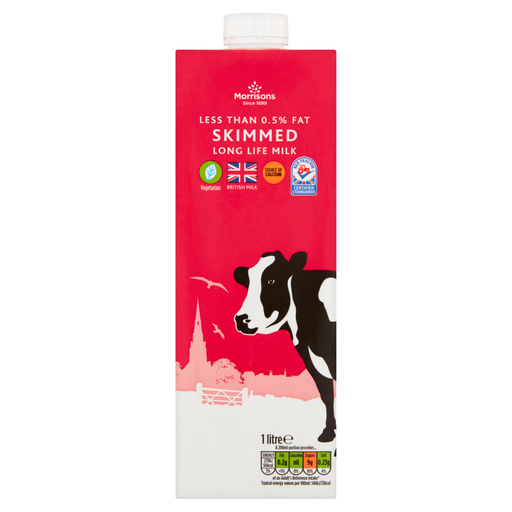
This UHT skimmed-milk option is relevant if cupboard storage would be useful for afternoon tea. Check the pack configuration and storage directions before ordering.
 No image available
A UHT skimmed-milk option for keeping milk available for tea. The title specifies 1 litre, but check whether this SKU contains one carton or a multipack. Confirm the storage directions and current availability before ordering.
No. The NHS describes lower-fat milk as an option for adults cutting back on fat, but Age UK advises considering full-fat foods when someone has a poor appetite or has lost weight unintentionally. Individual dietary advice takes priority when weight or appetite is a concern.
Compare fat and saturated fat on the same basis, such as per 100ml, then check any declared protein and calcium figures on that basis too. Pack volume, the date mark and directions for storage after opening help determine whether the milk fits how often it will be used.
No. The Food Standards Agency says a sniff test is not reliable for food with a use-by date. Follow the date and the pack’s refrigeration and opening instructions.
No. Removing most of the fat does not remove milk as an ingredient. A milk allergy is also different from lactose intolerance, which the NHS describes as difficulty digesting lactose in dairy products.