Families serving children aged 5 or over
Skimmed cows’ milk may be an option with lunch or cereal when it suits the child’s needs. Age matters: the NHS does not recommend skimmed or 1% milk as a main drink for children under 5.


For a child aged 5 or over who can have cows’ milk, choose fresh skimmed milk if the household will finish the bottle within its stated opened-life period. Filtered fresh milk offers a longer stated opened life on some packs, while unopened UHT skimmed milk can serve as a cupboard backup; both need their own storage instructions followed. The NHS does not recommend skimmed or 1% milk as a main drink for children under 5.
Skimmed cows’ milk may be an option with lunch or cereal when it suits the child’s needs. Age matters: the NHS does not recommend skimmed or 1% milk as a main drink for children under 5.
If an opened bottle needs to cover several lunches, compare its size and opened-life instructions. Arla states that its 2 L Cravendale filtered skimmed milk lasts up to 7 days after opening when stored at 0–5°C; other packs give different limits.
A UHT skimmed milk carton can be kept as a cupboard standby where its pack permits cool, dry storage before opening. Sainsbury’s 1 L long-life skimmed milk must be refrigerated and used within 3 days once opened.
Start with the child’s age and any milk allergy, then choose a format and pack size that fit how lunches will be served.
| Priority | What to check | Your needs |
|---|---|---|
| Age and use | Check whether the milk is intended as a main drink or for cooking. The NHS does not recommend skimmed or 1% milk as a main drink under age 5, though it says they can be used in cooking from age 1. | For a younger child, I need to distinguish milk used in cooking from the milk served as their main drink. |
| Opened life | Read the individual pack’s storage temperature and opened-life instruction. Tesco specifies that its 1.136 L fresh skimmed milk is best within 5 days of opening; Sainsbury’s specifies 3 days for its 2.27 L fresh bottle. Arla states up to 7 days for its 2 L Cravendale filtered bottle at 0–5°C. | If we use a little milk across several lunches, I want a bottle we can finish within its stated opened-life period. |
| Unopened storage | Distinguish chilled fresh milk from UHT milk that permits cool, dry storage before opening. Sainsbury’s says its 1 L UHT skimmed milk needs refrigeration and use within 3 days after opening. | A cupboard backup would be useful, but once I open it I can store and finish it as the carton directs. |
| Nutrition label | Compare figures on the same per-100 ml basis and check the exact product. Sainsbury’s lists 37 kcal per 100 ml for its 2.27 L fresh skimmed milk; Waitrose lists 4.5 g protein per 100 ml for Arla B.O.B. | When nutrition values matter to my choice, I want to compare the cartons themselves rather than assume every skimmed milk has identical figures. |
| Milk allergy | Read the ingredient and allergen statement before serving. For a child with diagnosed cow’s-milk allergy, the British Dietetic Association says a replacement must provide suitable nutrition; a different cows’-milk format is not an allergy substitute. | If a child has cow’s-milk allergy, I need an individually suitable alternative rather than a filtered or long-life cows’ milk. |
The NHS does not recommend skimmed or 1% milk as a main drink for children under 5 because it does not contain enough fat.
For an under-5, follow age-appropriate milk guidance instead of using the skimmed-milk choices here as a main drink.
Tesco’s 1.136 L fresh bottle says it is best within 5 days of opening, Sainsbury’s 2.27 L fresh bottle says to use it within 3 days, and Arla states up to 7 days for its 2 L Cravendale filtered bottle at 0–5°C.
Choose a size you expect to finish in time, keep it refrigerated as directed and follow the date and instructions on the particular pack.
Filtering, lower fat content and UHT treatment do not change the need to check whether a product is suitable for a child with cow’s-milk allergy.
Read the allergen statement. For diagnosed allergy, seek advice on a nutritionally suitable replacement; the British Dietetic Association stresses the importance of replacing the nutrition provided by milk.
A bottle that remains unfinished after its stated opened-life period may need to be discarded, even if it was intended to cover several lunches.
Estimate how much the household will use before choosing a 1 L, 2 L or 2.27 L format, and check whether fresh, filtered fresh or unopened UHT storage better fits that pattern.
Storage and nutrition details below apply to the named products, not to every milk sold under each brand.
Its 2 L filtered fresh skimmed milk is a chilled option for households that open a bottle across several lunches.
Its 1.136 L British skimmed milk is a smaller fresh-bottle option.
The named products offer a choice between a 2.27 L fresh bottle and a 1 L UHT carton.
A filtered skimmed cows’ milk whose semi-skimmed-style taste is a brand description, not a measured comparison here.
The Waitrose-listed skimmed milk is described as pasteurised milk from free-range cows.
These Morrisons UHT cartons fit the unopened-backup choice for school-holiday lunches. Choose between a single 1 L carton and a pack of six 1 L cartons according to how many unopened cartons you expect to use.
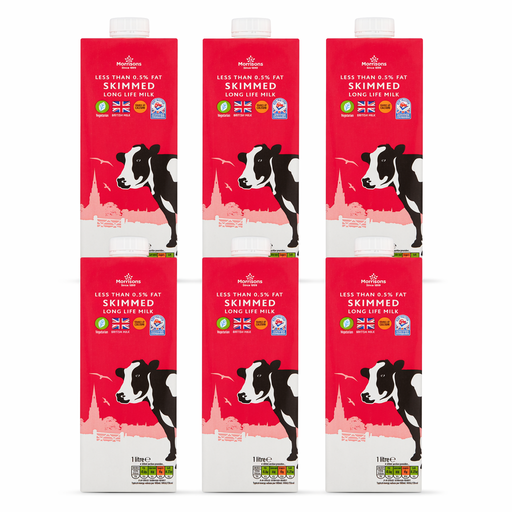 Image unavailable
Six UHT skimmed milk cartons provide separate unopened cartons for lunches on different days. Once a carton is opened, keep it refrigerated and use it within 3 days; follow its best-before date. The product information says it is not suitable for children under 5.
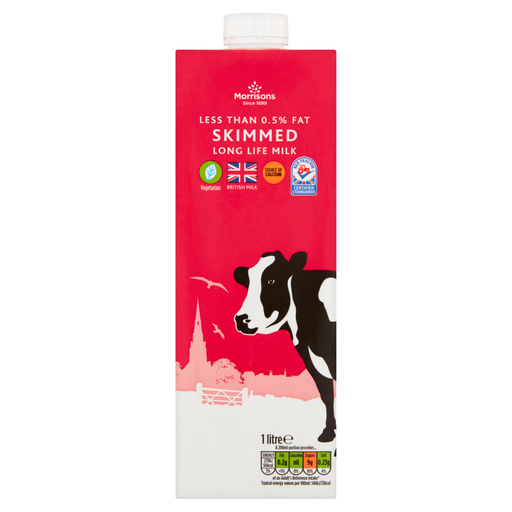 Image unavailable
A single UHT skimmed milk carton suits a household wanting one unopened lunch backup. Once opened, keep it refrigerated and use it within 3 days; follow its best-before date. The product information says it is not suitable for children under 5.
No. The NHS does not recommend skimmed or 1% milk as a main drink for children under 5 because it does not contain enough fat, although it says these milks can be used in cooking from age 1. For an older child, also check any individual dietary needs and the product label.
Choose a bottle size and opened life that fit how quickly you use milk. Arla states that its 2 L Cravendale filtered skimmed milk lasts up to 7 days after opening at 0–5°C; Tesco’s named fresh bottle is best within 5 days, while Sainsbury’s named 2.27 L fresh bottle specifies 3 days. Follow the pack you buy.
An unopened UHT carton can be a backup when its pack permits cool, dry storage before opening. Sainsbury’s says its 1 L UHT skimmed milk must be refrigerated and used within 3 days once opened, so check the carton’s instructions when planning how to serve it.
Do not treat filtered, UHT or skimmed cows’ milk as an allergy substitute. Check the product’s allergen statement and seek advice on an individually suitable alternative; the British Dietetic Association says a replacement for a child with cow’s-milk allergy needs to provide appropriate nutrition.